Related videos:
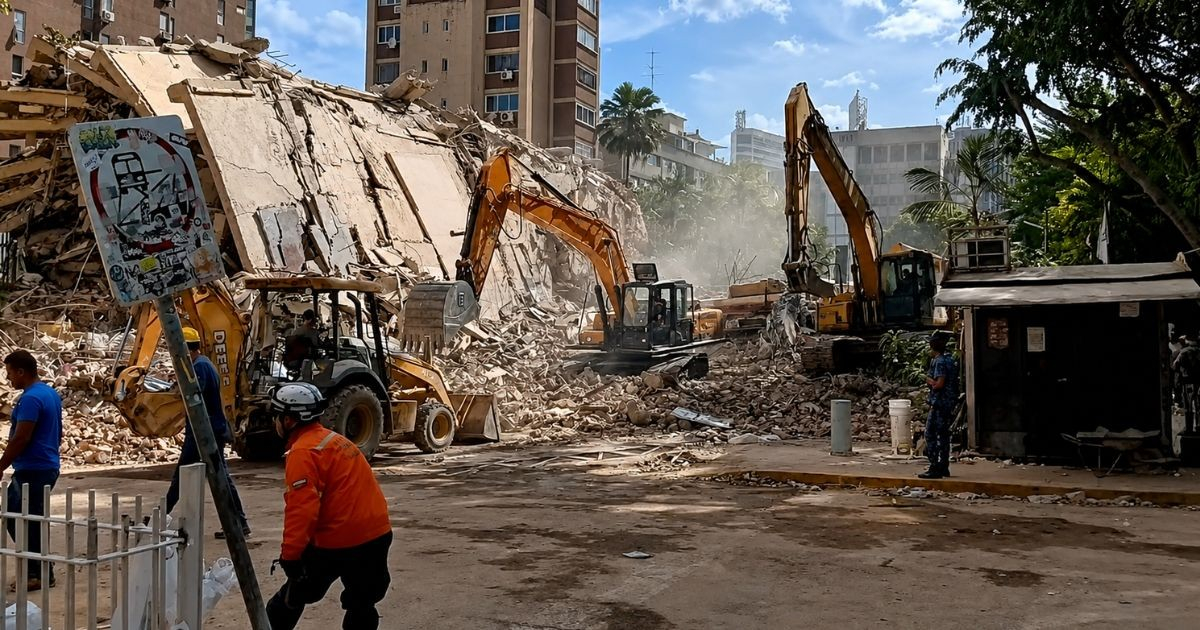
The death toll from the earthquakes that devastated Venezuela on June 24 continues to rise: this Sunday, Jorge Rodríguez, president of the National Assembly, updated the official figure to 4,490 dead.
The report from the Venezuelan government, shared by Rodríguez on social media, also records 16,740 injured and 6,462 people rescued alive. Another 17,907 people remain homeless and 19,583 are housed in 108 temporary camps set up by the authorities.
The progression of deaths has been constant since day one: 164 confirmed on the night of June 24; 188 the following day; 920 at the end of June 26; 1,719 on June 28; 3,535 on July 5; 4,118 on the 10th and 4,333 the night before.
The figure from this Sunday makes the disaster the deadliest earthquake in modern Venezuelan history.
The seismic doublet —with magnitudes 7.2 and 7.5 on the moment magnitude scale— occurred at 6:04 PM local time, with only 39 seconds separating the two events.
The epicenter was located near Yumare, in the state of Yaracuy, and the waves shook a densely populated strip that includes Caracas and the coastal state of La Guaira.
That territory bore the brunt of the destruction: 158 of the 190 buildings with total collapse recorded across the country were located there.
An analysis of images from the European satellite Sentinel-1 processed by NASA determined that more than half of the constructions in areas such as Caraballeda, Macuto, Naiguatá, and Catia la Mar had a damage probability exceeding 75%. Ohio State University estimated the total number of damaged structures in Venezuela to be around 59,000.
The geophysicist Michael Schmitz explained to the newspaper El Nacional that the extent of the destruction is not solely due to the strength of the earthquakes, but rather to the simultaneous displacement of two geological faults, the amplification of waves due to the characteristics of the soil, and the deterioration of the building infrastructure.
"Since major earthquakes do not occur as frequently as in Chile or Japan, seismic considerations have taken a back seat," he remarked.
While the rescue efforts have shifted to the recovery of bodies, the government of Delcy Rodríguez has not released an official number of missing persons.
The UN estimates that up to 50,000 people are unaccounted for, while the citizen platform "Encuéntralos" recorded over 71,000 as of June 29. The official opacity has raised open questions among the Venezuelan population.
This lack of transparency is compounded by reports from relatives of victims who claim to have been blocked by military personnel in their search efforts.
“Please, we demand to be allowed to work. The national Armed Forces have not let us work,” declared a volunteer quoted by Infobae.
The United Nations Development Program estimated the material damages at approximately 6.7 billion dollars, equivalent to 6% of Venezuela's Gross Domestic Product.
The World Food Program launched a $50 million appeal to provide food for half a million people for three months, and more than 4,000 foreign rescuers were deployed in the country.
The region had already experienced the worst disaster in its contemporary history: the Vargas Tragedy in December 1999, when mudslides and rocks resulted in between 10,000 and 30,000 deaths.
With 1,222 recorded replicas since June 24 and thousands of families in temporary camps, Venezuela faces a reconstruction that is expected to be lengthy and complex in a region struck twice in less than 30 years.
Filed under: