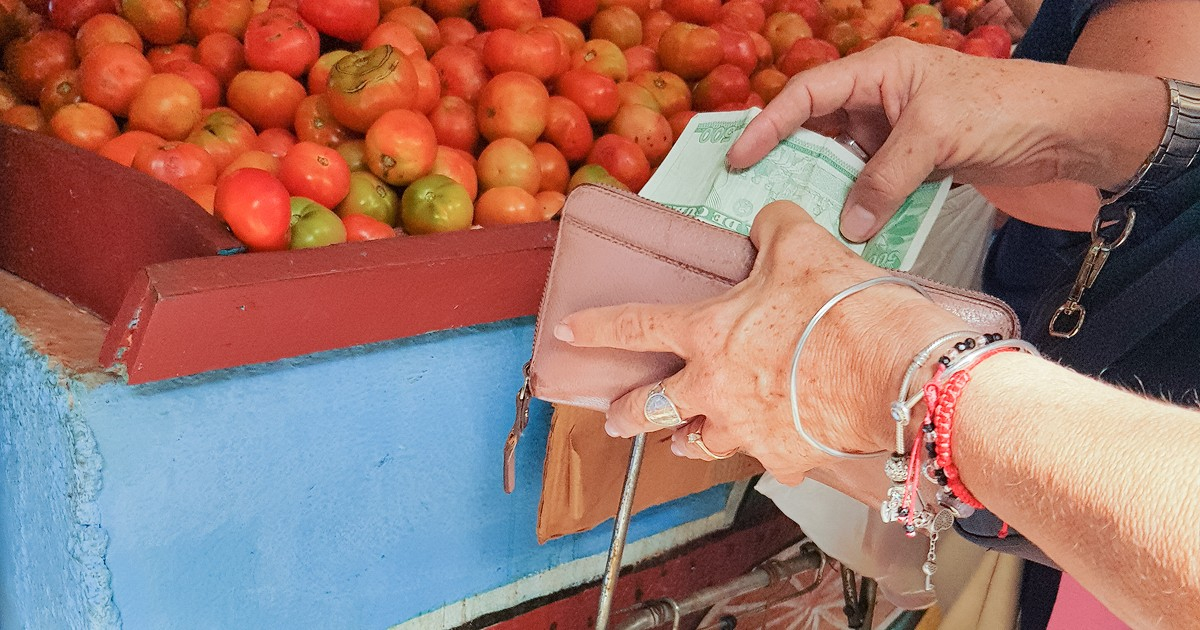
A journalist from the state-run newspaper Juventud Rebelde published an opinion piece on July 4 in which he attributes the liquidity crisis of the Cuban peso to wholesalers and private traders, avoiding any responsibility from the State. The response from Cubans on social media was strong: the regime and its banking system are the true culprits.
The text, titled “The Hijacking of the Cuban Peso” and authored by Yurisander Guevara Zaila, points to those accumulating cash to replenish foreign currency, to sellers who refuse transfers, and to businesses that charge commissions for dispensing bills, as the perpetrators of the monetary collapse that the population is experiencing.
The article acknowledges that banking regulations "are systematically violated," but completely omits the government's responsibility for the cash shortage, the crumbling banking infrastructure, and the rapid devaluation of the peso.
As the sole structural cause, the journalist refers to an economy "suffocated to the brink of asphyxiation by the greatest global power," alluding to the U.S. embargo, without mentioning six decades of economic management by the regime.
The Banco Metropolitano shared the article on its official Facebook page, which sparked a torrent of criticism from citizens who rejected the text's approach.
"Nobody accumulates large amounts of CUP because it is a very weak currency, with a very high devaluation. The Cuban government and its banking and financial system are primarily responsible for all the issues present, not just the cash shortage," wrote a user on the Metropolitan Bank's page.
Another comment described the daily contradiction faced by Cuban families: "Money on a card and an empty fridge. Who explains to a child that there's money on the card but they can't eat bread because they couldn't get into the bakery, and the resellers and freelancers don't accept transfers? So we end up withdrawing cash with the middleman at a 20-25-30% fee."
A third comment pointed directly at the government as an accomplice of the black market: "Our government strongly promotes the illegal sale of everything the Cuban needs. The black market thrives on the Cuban, with the help of the state itself."
Cubans also questioned the propaganda surrounding the new high-denomination bills: "Where are the two thousand and five thousand peso notes? They really were only seen when they were promoted," wrote another user, referring to the bills issued by the Central Bank in March and April of this year, whose distribution has been minimal.
The context contradicts the approach of the official article: the dollar is trading in the informal market at over 650 CUP, while the official rate hovers around 590 CUP; more than 50% of the ATMs in Havana are out of service; the Metropolitan Bank reduced the withdrawal limit from 5,000 to 3,000 pesos per transaction in June; and the government itself admitted it does not have cash to pay pensions to 111,000 retired individuals in Havana.
This is not the first time that Banco Metropolitano has outsourced the blame for the monetary crisis. In May 2024, the institution blamed the independent media El Toque for causing "induced inflation" by publishing the exchange rate of the informal market.
The mandatory banking system imposed in August 2023 is today regarded as a structural failure, with only 3.77% of transactions in Cuba conducted digitally, according to data from July 2026.
"You should be ashamed of this journalistic work. You have done nothing, or very little, to help resolve this," summarized a Cuban on the bank's page, with a statement that encapsulates the frustration of those who see the regime and its spokespeople continuing to look for culprits in every direction except in the mirror.
Related videos:
Filed under: