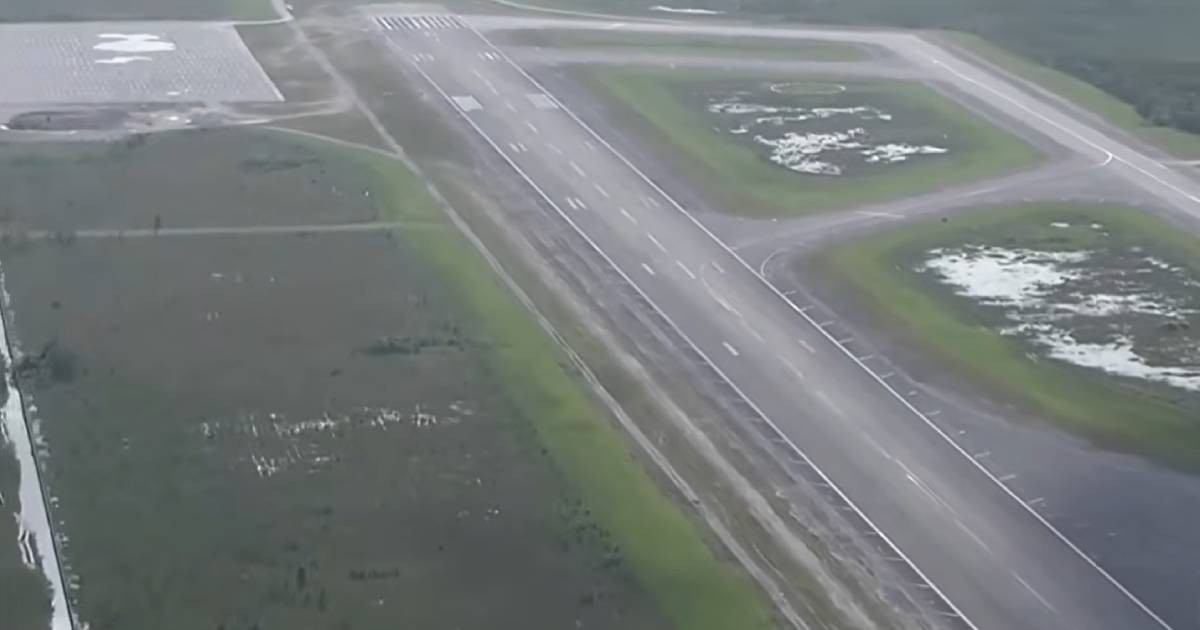
The Alligator Alcatraz immigrant detention center, which for almost a year symbolized the hardline immigration policy in Florida, is now history. Aerial images captured this Tuesday by the WPLG channel show the facilities completely dismantled, with no trace of the infrastructure that housed thousands of migrants.
The photographs taken from a helicopter reveal an empty landscape: the large white tents, generators, lighting towers, and the iconic blue sign identifying the center have all vanished. Workers are also seen removing the perimeter fence installed around the runway of the Dade-Collier Training and Transition Airport in Ochopee, about 72 kilometers west of Miami.
The final closure was announced on June 25 by Florida Governor Ron DeSantis, alongside the White House border czar, Tom Homan.
"It fulfilled its role during its time. The demobilization efforts at these facilities are already underway," the leader stated.
DeSantis stated that during the year it was operational, about 21,000 people were deported through that center, and he defended its impact on the state's security.
"There is no doubt that this mission has made the state of Florida safer," he stated.
A center built in record time
Alligator Alcatraz was built in just eight days thanks to the state's emergency powers and opened its doors on July 3, 2025. It became the first detention center managed by a state and intended exclusively for undocumented immigrants.
Designed to accommodate between 3,000 and 5,000 people, it never came close to operating at its maximum capacity.
In early June, authorities announced a temporary closure, citing that the hurricane season made it unsafe to keep detainees in the Everglades. The migrants were transferred to detention centers in Florida, Texas, Louisiana, Arizona, and California. For about a week, family members and lawyers were unaware of the whereabouts of many of them.
Reports of the conditions of imprisonment
During its operation, the center was the subject of numerous complaints from human rights organizations and from the detainees themselves.
The testimonies described food with worms, broken bathrooms, floors covered in sewage, infestations of mosquitoes and insects, and restrictions on showering, which in some cases were only allowed every three or four days.
In April 2026, guards also used pepper spray to disperse a protest by inmates who were demanding greater access to phones to communicate with their families and lawyers.
Million-dollar costs and criticisms
The project was also surrounded by questions regarding its high cost.
According to official figures, the operation of the center exceeded 1.2 billion dollars and the daily cost per detainee rose to about 3,571 dollars, far above the approximately 165 dollars per day that the Immigration and Customs Enforcement (ICE) pays in private centers.
Florida requested a reimbursement of 608 million dollars from the federal government, although before the close it had only received 58 million.
The Florida Immigrant Coalition harshly criticized the project.
"The only winners were the corporations and contractors, who made millions of dollars in profits while the Republicans pushed for a non-existent immigration emergency," the organization stated.
What will happen to the land?
Following the dismantling of the facilities, Miami-Dade County Mayor Daniella Levine Cava announced that the local government intends to sell over 17,000 acres of land to the National Park Service to be included in the restoration process of the Everglades.
"We are awaiting the formal return of the property. We are also very interested in returning this site to nature, to conservation, so we will explore the best way to achieve that as soon as possible," he stated.
However, the closure of the center does not put an end to the controversy.
Environmental groups have filed a federal lawsuit, claiming that the construction was carried out without the required environmental impact study. According to their complaint, at least 20 acres within the Everglades ecosystem were paved over without the proper assessment.
While that litigation continues in the courts, the Federal Aviation Administration (FAA) keeps the airport runway closed to air operations at least until September 2026.
Related videos:
Filed under: