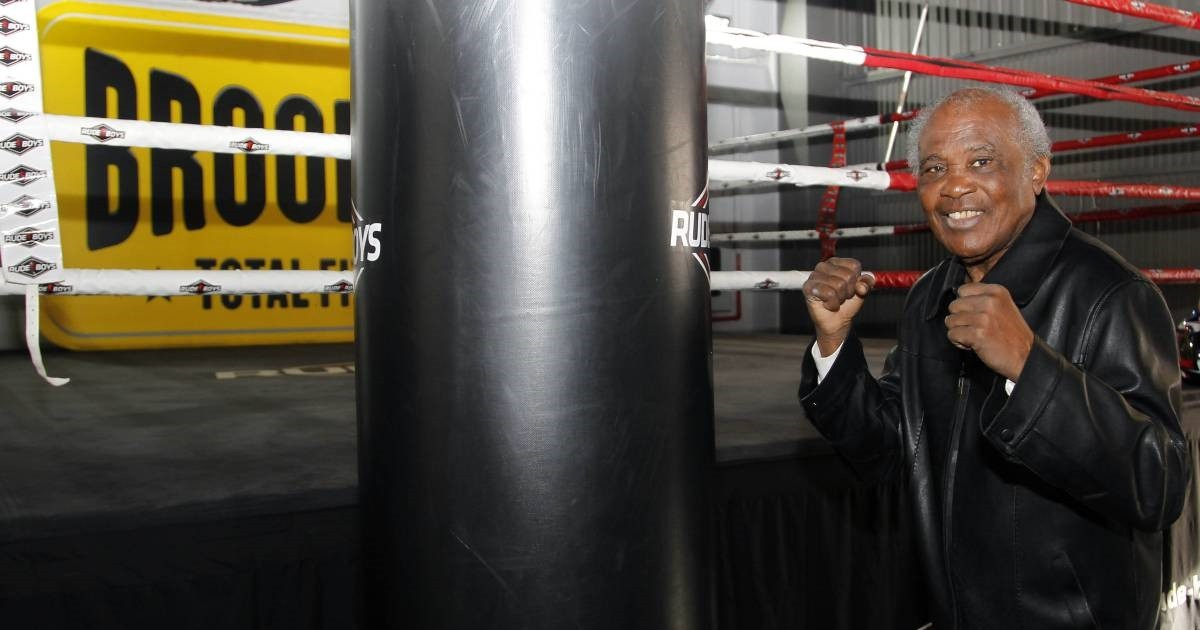
José Legrá, the Cuban-Spanish boxer known as "The Puma of Baracoa," passed away on Tuesday night at the Gómez Ulla Hospital in Madrid, where he had been hospitalized for several days after worsening from a serious illness diagnosed recently, as confirmed by the Royal Spanish Boxing Federation.
The sources do not agree on his exact age: some media outlets and the federation itself indicate that he was 90 years old, while others suggest he was 83, based on the most documented birth date - March 19, 1943, in Baracoa, Cuba. The newspaper Marca states that his identification document recorded May 28, 1937, which would make him 89 years old.
Born in the eastern tip of Cuba as one of seven siblings, Legrá grew up in poverty, working as a shoeshine, dishwasher, and newspaper vendor.
When Fidel Castro's regime banned professional boxing on the Island, he first emigrated to Mexico and then to Miami, where he trained at the legendary gym on 5th Street and met Angelo Dundee and a young Cassius Clay.
"Ali was very boastful, but he delivered on what he said. I was also boastful. I picked up something from him. Opponents climbed into the ring against me and entered with fear. You could see it in their eyes," Legrá recalled in an interview.
In 1963, he landed at Barajas airport with empty pockets, summoned by the Cuban coach Kid Tunero (Evelio Mustelier).
"And Spanish boxing will always be grateful for it. Since the end of 1963, Legrá established himself in Spanish rings at a dizzying pace. He went on to win a world elimination match in the super featherweight category, but it would be with his naturalization and the achievement of the European Title that the opportunity in his best weight, featherweight, would arise," recalled the Real Federación Española de Boxeo.
He made his debut in the Iberian country by knocking out the Moroccan Ben Layachi in six rounds.
On November 30, 1966, he obtained Spanish citizenship through Vicente Gil, Franco's personal physician and president of the Spanish Boxing Federation.
His record was extraordinary: seven featherweight European titles between 1967 and 1972, and two WBC world championships. The first came on July 24, 1968, in Porthcawl, Wales, when he defeated the Welshman Howard Winstone by technical knockout in the fifth round before about 11,000 spectators, in a match broadcast live by TVE.
He was the second Spanish man to hold a world title, after Baltasar Belenguer "Sangchili" in 1935.
The chronicler Manuel Alcántara -who also dubbed him "The Puma of Baracoa"- wrote that night: "The boards of the shoe cleaning box have become a throne. It was champion wood."
"But beyond results, Legrá's legacy could be measured by the magic he exuded in the ring (a pleasure to watch him on his best nights) and by the charm he radiated, which led him to become a television star in the early 90s. A boxer like him is born only every many years," recalled the Spanish Federation.
After losing the title in 1969 to the Australian Johnny Famechon at the Royal Albert Hall in London, he regained it in 1972 in Monterrey by defeating the Mexican Clemente Sánchez.
He lost definitively in 1973 to the Brazilian Eder Jofre in Brasília, and shortly after was knocked out in the first round by the Nicaraguan Alexis Argüello in Managua, which led to his retirement at the age of 30 with a record of 148 fights: 133 wins, 11 losses, and four draws.
Outside the ring, Franco received him several times and gifted him an Oldsmobile and an apartment in Madrid.
Legrá managed to amass a considerable fortune, but his business ventures turned sour. "I earned almost 400 million pesetas. But naivety in life... I thought the world was mine. I had no clue at all!" he confessed.
In 2003, he received the silver medal from the Royal Order of Sporting Merit.
In his last years, he spent time in a nursing home with cognitive decline.
In 2020, Legrá overcame a hospitalization due to COVID-19 in the same Gómez Ulla Hospital where his life ultimately came to an end, with the mischievous smile that unsettled rivals and charmed an entire nation.
He passed away surrounded by family and close friends. His remains were transferred to the North Mortuary in Madrid, and the burial is scheduled for this Thursday at 11:00 AM at the South Cemetery.
Related videos:
Filed under: