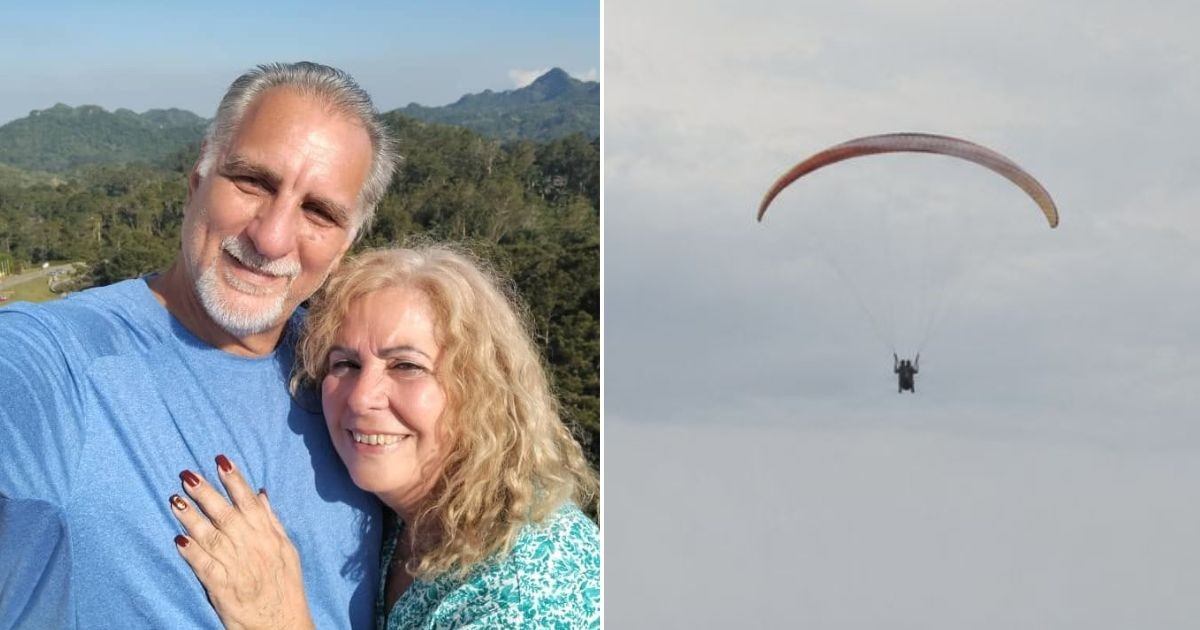
The Aviation Club of Cuba (CAC), presided over by former spy René González Sehwerert, released a statement acknowledging that the lack of a life jacket was crucial in the death of 12-year-old Joel Alejandro Suárez Sánchez during a tandem paragliding flight in Isla de la Juventud on July 4.
"We all know that using a life jacket, the most fundamental safety measure required for that operation, would have made the difference between just an incident and the deadly accident that occurred. It's not fair to place the responsibility of uncovering this on the mother," acknowledged the former spy.
The document explicitly rejects the voices within the aeronautical community that pointed to the child's mother as responsible for what happened.
According to González, the woman agreed to sign the consent after overcoming her initial doubts due to the observation of successful previous flights, the verbal assurances from the operators, and the persistence of the child himself.
"That mother was unsure about signing the consent form, and her uncertainty was overcome by the practical observation of several successful flights, the verbal reassurances she received from the operators, and the child's insistence," González noted.
The statement adds that "the absence of a waiver document, which would explain the risks, undermined their ability to provide informed consent."
The joint investigation by the CAC and the Cuban Institute of Civil Aeronautics (IACC) uncovered serious irregularities in the operation: the flight was part of an unauthorized commercial venture charging 3,000 Cuban pesos per person without permission from the Ministry of Tourism, and the pilot lacked certification for tandem flights and commercial endorsement.
The investigative committee also emphasized that life jackets were not used, which are mandatory according to Cuban Aeronautical Regulations for operations near the coast.
How did the events occur?
The accident occurred when a storm cloud created currents that pushed the paraglider into the sea from about 50 meters high, landing approximately 500 meters from the shore.
While trying to free himself from the harnesses in the water, the pilot lost control over the minor, whose body was located on Monday, July 6.
The new statement contrasts with González's initial position, who declared on July 6 that it was "the first fatality of the CAC in 15 years," a claim that was refuted by the aeronautical community, which documented at least four deaths linked to aerial sports between 2022 and 2023.
On July 14, the CAC declared a temporary moratorium on all tandem paragliding flights in the country, with the exception of individual sports flights.
"Let's all work so that never again does a child, whose fate their parents placed in our hands, transition in the blink of an eye from the enjoyment of a beautiful experience to the horror that ended Alejandro's life," concluded the statement from former spy René González, president of the Club de Aviación de Cuba.
Related videos:
Filed under: