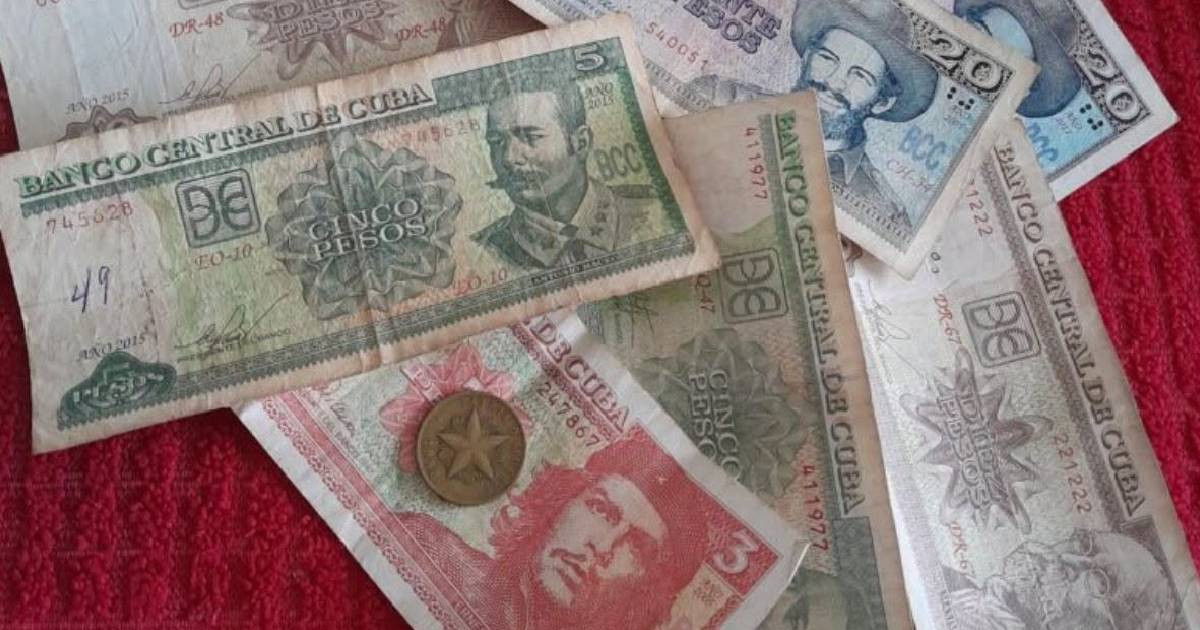
Numerous private businesses in Santiago de Cuba are rejecting one, five, 10, and 20 peso bills, a practice reported by customers and merchants that worsens the difficulties in making everyday purchases.
The report was shared this Friday on the Facebook profile of journalist Yosmany Mayeta Labrada, who gathered testimonies from citizens affected by a practice that, they claim, is starting to spread across various establishments in the city.
A woman from Santiago shared that she went to buy soaps and seasonings, but the saleswoman insisted she pay with a 100-peso bill. "She told me they didn't accept 20-peso bills, as if they weren't money or didn't have value," she recounted.
The merchants themselves assert that the problem does not originate at the points of sale. The owner of a small mipyme located on Trocha Street explained that wholesale suppliers also do not accept those denominations, which means receiving them results in having cash that then becomes difficult to use.
"If we accept those bills from a customer, later no one wants to take them. We end up with money that we can't use," he stated.
The situation also affects the employees. A saleswoman recounted that the owner of the business admonished her after finding 600 pesos in 10 and 20 bills and ordered her to avoid accepting that type of cash.
Among citizens, uncertainty is growing about the real value of the Cuban peso. Ernesto, a private driver, summed up that sentiment by noting that today 20 peso bills are being rejected, and tomorrow they might stop accepting 50 peso bills.
The measure particularly affects those who rely on cash payments. María Elena, a 68-year-old retiree, lamented that her check is paid in low-denomination bills and questioned why those same bills are now being rejected at some stores. "So now my money isn’t worth anything? It’s a lack of respect toward retirees," she expressed.
Although the one, five, 10, and 20 peso bills remain legal tender in Cuba, reports indicate that, in practice, an increasing number of private businesses refuse to accept them.
The situation reveals a new distortion in the monetary system and shifts the consequences of the economic crisis directly onto consumers, who witness how even the money issued by the State is losing acceptance in everyday transactions.
Citizen comments on social media confirm that the phenomenon goes far beyond Santiago. "That happens all over the country," wrote a user.
Another person recalled that years ago this happened in Havana with signs at the entrances of businesses rejecting those denominations. A third person pointed out the structural contradiction: "The bank is issuing 20 peso bills, but they are not accepted on the streets."
One of the most striking testimonies came from a citizen who witnessed an elderly woman, who had withdrawn her entire check in five-peso bills, trying to buy a spaghetti at a small business because she hadn't eaten the day before. The sales clerk refused to accept the money, citing orders from her boss. "Ladies and gentlemen, our elderly are dying, please," wrote the person recounting the episode.
Another citizen pointed to the root of the problem: "If they refuse to accept transfers as required by law, the cash I receive from the bank is in that denomination. If they are violating the law, they shouldn't impose further obstacles."
This scenario occurs on the same day that the Central Bank of Cuba published the Resolution 74/2026, which eliminates the limit of 5,000 pesos for cash payments between economic actors, implicitly acknowledging the failure of the mandatory banking system imposed in 2023. The measure will take effect on July 20.
The popular reaction was one of skepticism. One Cuban summed it up on social media: "Now there are no limits on cash payments, the problem is that there is no cash in the banks."
In early July, the Bandec of Ciego de Ávila described the refusal to accept low-denomination bills as a "flagrant violation of citizens' rights", while reminding that all bills hold full liberating power according to current regulations. The official warning had no practical effect.
Related videos:
Filed under: