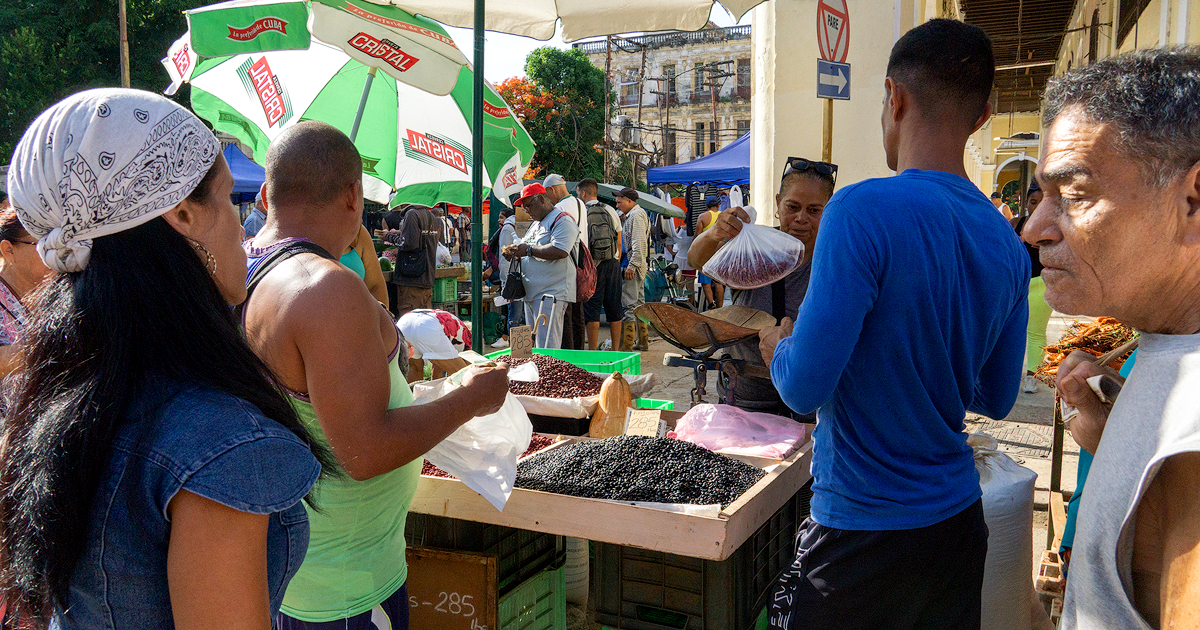
The journalist and founder of 14ymedio Yoani Sánchez published a reflection on Facebook this Friday about inflation in Cuba, summarizing the economic deterioration that Cubans face daily, with prices written on the board of an informal market.
In his Facebook post, Sánchez argues that economic reports are unnecessary to understand what is happening: “It is enough to stop for a few minutes in front of the board at any market to grasp how the pockets of Cubans are shrinking.”
The numbers described are striking: the pound of rice costs 360 pesos, black beans reach 450, the kilogram of wheat flour exceeds 1,000 pesos, a carton of eggs is around 3,000, and a liter of vegetable oil surpasses 2,000 pesos.
In the face of these prices, the average monthly salary in Cuba still falls short of 7,000 pesos, making every purchase an impossible equation.
Sánchez describes it accurately: "One looks at these numbers written on a whiteboard and feels that they are not just simple prices. They are decisions. Do I buy rice or oil? Do I get eggs or save the money for transportation? Do I cook beans today or wait until next month to do it?"
The journalist emphasizes that inflation has ceased to be a technical concept and has become an everyday experience: "It has the face of the mother who counts the bills again before entering the store. Of the retiree who walks around the block with empty hands. Of the worker who gets paid and, before the first week is over, discovers that his salary has already lost another battle."
Official data supports this diagnosis. According to the National Office of Statistics and Information, the year-on-year inflation in Cuba in June was 18.27%, with a monthly variation of 2.82% and a semiannual cumulative of 12.24%, driven by increases of 14.79% in oil and 6.76% in pork.
However, independent economists estimate that the real inflation, including the informal market, hovers around 70% annually. Economist Elías Amor Bravo described Cuban inflation as "out of control" on July 14 due to the regime's inaction, and projected that Cuba could close 2026 among the economies with the highest inflation in Latin America, with figures ranging from 40% to 50%.
The gap between income and prices is enormous. The average state salary is around 6,930 pesos per month, which is equivalent to between five and 12 dollars at the informal exchange rate. The new minimum wage set at 3,210 pesos from July 1 amounts to about 4.65 dollars, barely enough to buy a carton of eggs. Economists estimate that a person needs about 96,000 pesos per month to cover their basic needs, a gap of more than 13 times the average salary.
The deterioration has been accelerated by additional factors: the informal market dollar rose from 435 pesos in December 2025 to 670 pesos in July 2026, and the regime eliminated the price caps on imported basic products in June through Resolution 150/2026, further worsening the situation for consumers.
Sánchez warns that the most serious issue is not just the rising cost of food, but the normalization of impoverishment: "A few years ago, finding a pound of rice priced at 360 pesos would have seemed absurd. Today, many people read that figure, sigh, and hand the bag to the merchant. The ability to be shocked has also depreciated."
The journalist concludes that inflation "not only makes food more expensive. It also dampens expectations, forces the abandonment of nutritious foods, reduces portion sizes on the plate, and turns every trip to the market into an exercise in survival math."
Related videos:
Filed under: