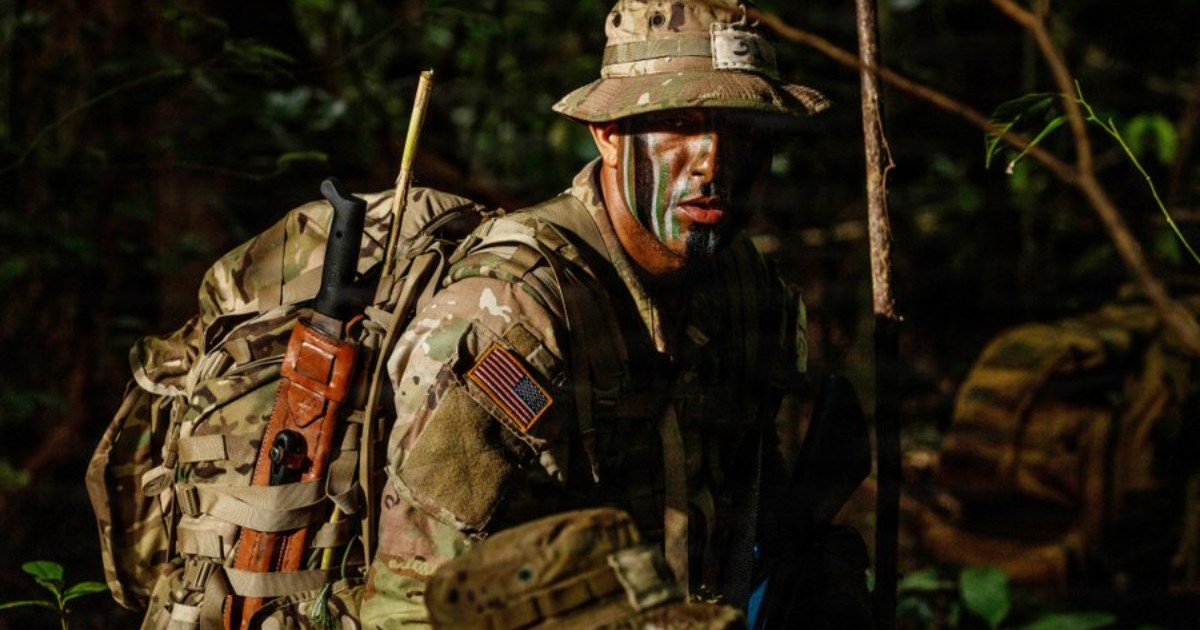
The United States Secretary of Defense, Pete Hegseth, announced on Thursday the return of U.S. Army jungle warfare training to Panama, in a post on X that garnered over 213,000 views in a few hours and comes at a time of intense diplomatic and military pressure on Havana.
"The legendary jungle training of the U.S. Army has returned to Panama," wrote Hegseth, accompanying the message with an article from Infantry magazine, authored by Colonel Keith W. Benedict and Captain Christian M. Hert.
The message does not announce any specific operation against Cuba or any other country. Its purpose is to show that the U.S. armed forces are regaining operational capabilities in tropical environments that had been sidelined after two decades of wars in Iraq and Afghanistan.
"Conducting jungle training in Panama again honors the past by recognizing the lessons learned during World War II and Vietnam, and will help soldiers, both individually and, perhaps soon, as units, to prepare to fight in any environment," the article states.
A program that revives after 25 years of inactivity
The Jungle Operations Training Course (JOTC-P) is conducted at the Cristóbal Colón Naval Air Base, the former Fort Sherman, on the Caribbean coast of Panama. The program was reactivated in 2025 after 25 years of inactivity.
The original school operated from 1951 and trained about 9,000 soldiers a year before closing in 1999 with the Torrijos-Carter Treaties.
Hegseth formalized the return of the course through a memorandum of understanding signed in April 2025 during the Central America Security Conference.
The program lasts 18 days and is divided into three phases:
- Survival in the jungle with Panamanian instructors
- Small unit tactics with American instructors
- Final exercise known as the "Green Mile."
In December 2025, the Army gave another institutional signal of its strategic shift: it closed FORSCOM, its largest territorial command, and activated the US Army Western Hemisphere Command (USAWHC), a new four-star command dedicated exclusively to the Western Hemisphere.
The combination of both measures indicates that Washington is deliberately rebuilding its capabilities to operate in Latin America and the Caribbean.
The context: maximum pressure on Havana
The display of military capabilities occurs amid ongoing tension between Washington and Havana. President Donald Trump himself stated on Thursday during an interview with Fox News: "I'm watching Cuba. A lot of things are going to happen in Cuba over the next perhaps two months."
Trump also noted that it would "not be difficult" for the United States to take military action on the island, although he clarified that he did not see it in the same way as the Venezuelan case.
According to a CBS News report, Pentagon planners assessed military options against Cuba at the end of June, including an air assault led by the 101st Airborne Division.
The interim Pentagon spokesman, Joel Valdez, responded succinctly: "We do not comment on hypothetical military operations." Officials cited by that outlet clarified that armed action is unlikely in the short term, given that offensive capabilities remain concentrated in the Middle East.
The Cuban regime reacted harshly. Foreign Minister Bruno Rodríguez Parrilla accused Washington of waging a “psychological war” through alleged media leaks and warned that an attack on Cuba “would result in a bloodbath.”
Related videos:
Filed under: