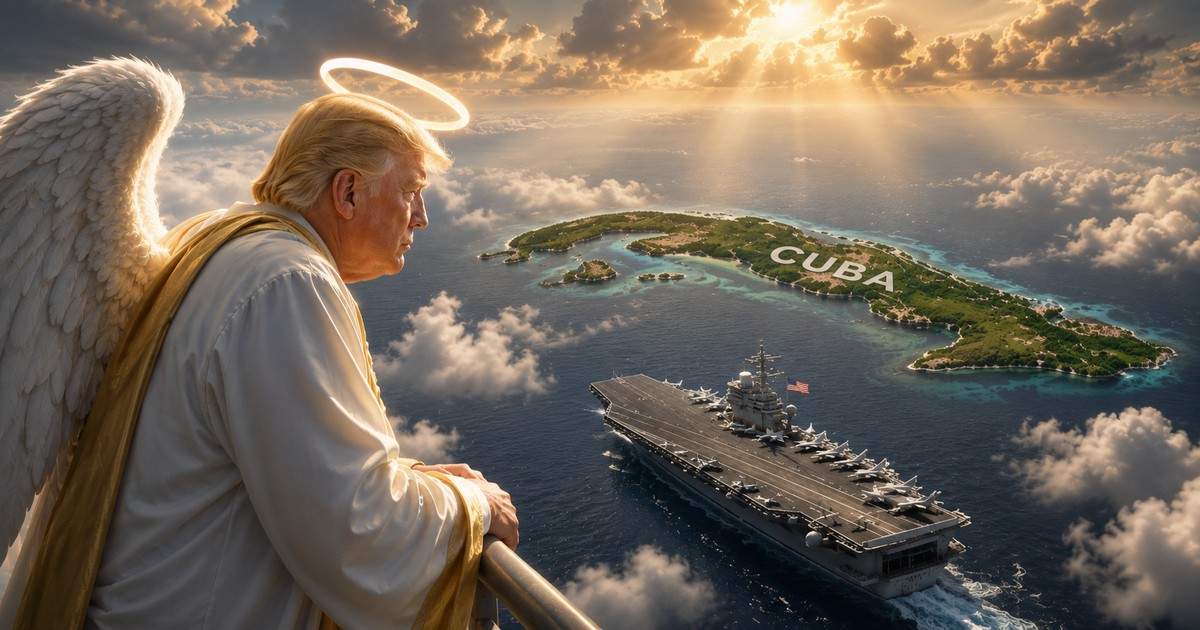
In an interview with Fox News correspondent Trey Yingst, President Donald Trump stated: "I am watching Cuba. Many things are going to happen in Cuba, perhaps in the next two months, but I don't see it being like Venezuela."
When asked if he was referring to a possible military action, he replied: “We could do that with Cuba. It wouldn't be difficult for us to do it. Venezuela is much larger than Cuba. It has gold, it really has gold. It has a lot of gold, a lot of oil. It probably has the most valuable lands in the world in terms of gold and rubies…”
These statements sparked an intense debate on social media. Many argue that, since Cuba lacks significant reserves of oil or gold, Trump has no real interest in fulfilling the dream of the majority of Cubans: the end of tyranny and a true democratic transition.
However, the reality is different. On January 29, when he signed Executive Order 14380 titled "Addressing Threats to the United States by the Government of Cuba," Trump made it clear that he fully understands the serious danger that the Castro-communist regime poses to the national security of the United States and to freedom and democracy on the continent.
Liberating Cuba is not only a moral issue: it is an excellent strategic business opportunity.
For decades, the conflict with the Cuban dictatorship has been analyzed almost exclusively from a political perspective, through the lens of the Cold War or human rights. Rarely has the true cost of having a communist regime just 90 miles from its territory been quantified for the United States.
The persistence of the Cuban dictatorship has been one of the most burdensome strategic liabilities that Washington has borne for the past 70 years.
It all began with the kidnappings of American citizens and the sabotage of properties by Fidel Castro's guerrillas. After coming to power, massive confiscations without compensation ensued: hundreds of businesses, industries, banks, sugar mills, and hotels were nationalized. The U.S. Foreign Claims Settlement Commission certified thousands of claims worth an original amount of approximately $1.9 billion at the time. With interest accrued over more than six decades, the current total is estimated to be in the tens of billions of dollars.
But the economic damage was only the beginning. The alliance with the Soviet Union turned Cuba into Moscow's main geopolitical platform in America. The United States was forced to redesign its military strategy in the Caribbean, strengthen its naval and air presence, increase spending on intelligence, and maintain constant surveillance over the island.
The Cuban Missile Crisis of 1962 brought the world to the brink of nuclear war. The enormous military buildup and subsequent investments in defense shaped U.S. strategic planning for decades.
Meanwhile, the regime exported its revolution. It trained thousands of guerrillas and supported insurgent movements throughout Latin America. Washington allocated billions of dollars to security and counterinsurgency programs to contain that expansion, which had its epicenter in Havana.
The Castro influence was not limited to the continent either. Military interventions in Angola and Ethiopia solidified the Soviet presence in Africa and compelled the United States to respond with greater diplomatic and military efforts.
After the end of the Cold War, rather than disappearing, that influence mutated. The Cuban regime decisively contributed to building and strengthening the far left in the United States and in the hemisphere. As Secretary of State Marco Rubio recently pointed out, the dictatorship has infiltrated U.S. institutions and has been linked to the introduction of drugs into American territory.
Without Castroism, Chavismo would not have been possible. Venezuelan oil economically sustained the Cuban regime while Havana exported intelligence, social control, and political leaders that solidified the Chavista project. From that alliance emerged ALBA, Petrocaribe, the strengthening of the São Paulo Forum, and other mechanisms that hindered U.S. initiatives like ALCA and diminished Washington's influence in the region.
This is further compounded by Havana's current strategic relationship with Russia, China, Iran, and North Korea. Cuba continues to serve as a hostile aircraft carrier off the U.S. coast. Maintaining surveillance, intelligence, and military capabilities against this axis involves ongoing costs that will not disappear as long as the current system remains in place.
For all these reasons, the best "deal" Donald Trump can make is to put an end to the Castro regime as soon as possible and support the Cuban people in a structured process of democratic transition. This is not just a moral imperative to liberate millions of people; it is a decision of immense strategic profitability.
A democratic Cuba would mean:
• Eliminate a hostile platform off its shores.
• Open investment opportunities for American companies.
• Reduce security risks.
• Weaken the presence of Russia, China, and Iran in the Caribbean.
• Promote regional stability and build an economic relationship based on trade, tourism, and investment.
Putting an end to Cuban communism would be more beneficial for the United States than doing business with all the oil from Venezuela and Saudi Arabia, alongside gold from Australia and South Africa. Anyone who doubts this assertion only needs to review history and do the calculations. In the end, they will conclude that José Daniel Ferrer was very moderate.
Noriega and Maduro were less dangerous and were captured. The Castros have done —and continue to do— worse things for over six decades.
Liberating Cuba would guarantee Donald Trump a place in history more valuable than the six Nobel Prizes awarded each year. The only achievement of greater significance—democratizing China—seems impossible for now.
Related videos:
Filed under:
Opinion article: Las declaraciones y opiniones expresadas en este artículo son de exclusiva responsabilidad de su autor y no representan necesariamente el punto de vista de CiberCuba.