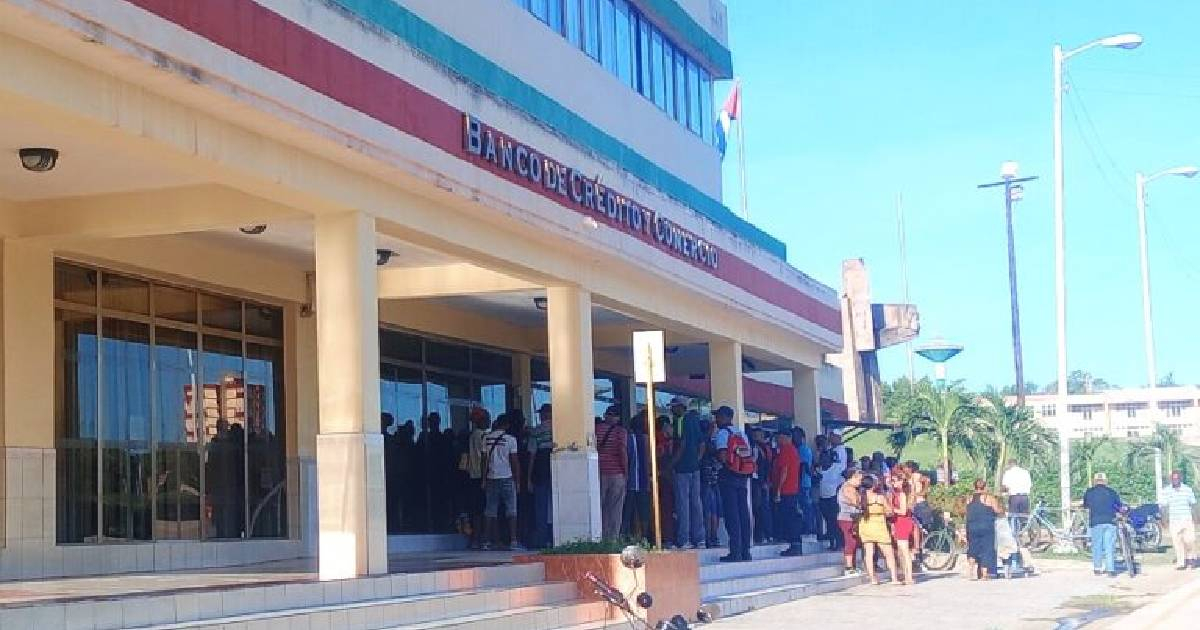
Anyone needing 2,000 pesos in cash in Cuba must be prepared to transfer 2,800 from their bank card: 800 pesos—40% of the amount—goes to an intermediary stationed outside the bank.
That is the price thousands of Cubans pay to access their own salary, according to a testimony posted on Facebook by Mary Elena Hernández Rodríguez, who describes the phenomenon as "a silent embezzlement that highlights the deep distortion of what we thought would be development."
The scenario repeats itself at the end of each month across the island. The salary shows up credited on the card, but converting it into physical cash has become an odyssey: ATMs without cash, networks down, withdrawal limits that don't meet basic needs.
"Waking up early and submitting to endless lines has become an unpaid second job," writes Hernández Rodríguez.
In that void, so-called "liquidity managers" have proliferated, individuals who offer physical cash in exchange for transfers from cards, charging commissions ranging from 30% to 45% of the amount.
They do not operate in secrecy: they set up directly in front of bank branches.
On the other hand, the impact is not solely economic. "Hypertension and anxiety have become constant companions of the wage earner, who sees the monetary result of their efforts caught in a plastic that, far from bringing happiness, generates frustration and discontent," describes Hernández Rodríguez.
"As long as access to one's own money is dependent on the chance of finding an ATM or an intermediary, the banking system will not be an ally, but rather an enemy of family finances," he concludes.
The phenomenon was also reported by poet and physician Ericka Castellanos Abad, who documented that next to BANDEC on Avenida Victoriano Garzón, in Santiago de Cuba —just a few blocks from the Provincial Committee of the Communist Party—, anyone transferring 1,000 pesos receives only 600 in cash.
"Transferring 1,000 Cuban pesos to receive 600 Cuban pesos in cash is the worst kind of abuse," he wrote.
The commissions have steadily increased. In September, the Revolutionary National Police arrested two men in Santiago de Cuba who were charging a 15% fee alongside that same ATM, seizing more than 250,000 pesos from them.
However, by May, new arrests at the Santiago train station documented commissions ranging from 35% to 50%. The arrests have not eradicated the business.
The root of the problem is structural. The mandatory banking imposed by the regime in August 2023 required that transactions over 5,000 pesos be conducted through digital channels, but without ensuring the availability of cash in the system.
Three years later, only 3.77% of transactions in Cuba are digital, and less than 10% of private businesses regularly accept transfers.
The physical scarcity of banknotes exacerbates the vicious cycle. In May, over half of the ATMs at Banco Metropolitano in Havana were out of service.
Similarly, in June, that bank reduced the withdrawal limit from 5,000 to 3,000 pesos per transaction, while in Sancti Spíritus, the Banco Popular de Ahorro set a cap of only 500 pesos.
Citizens reported waits of up to three days to access a functioning ATM and withdraw only 40% of their salary.
However, the Central Bank of Cuba announced on Friday a package of emergency measures that includes the issuance of 2,000 and 5,000 peso bills, the suspension of the 5,000 peso limit for cash payments between economic actors —through Resolution 74/2026, effective from July 20— and the reduction of commissions for merchants for online payments.
Related videos:
Filed under: