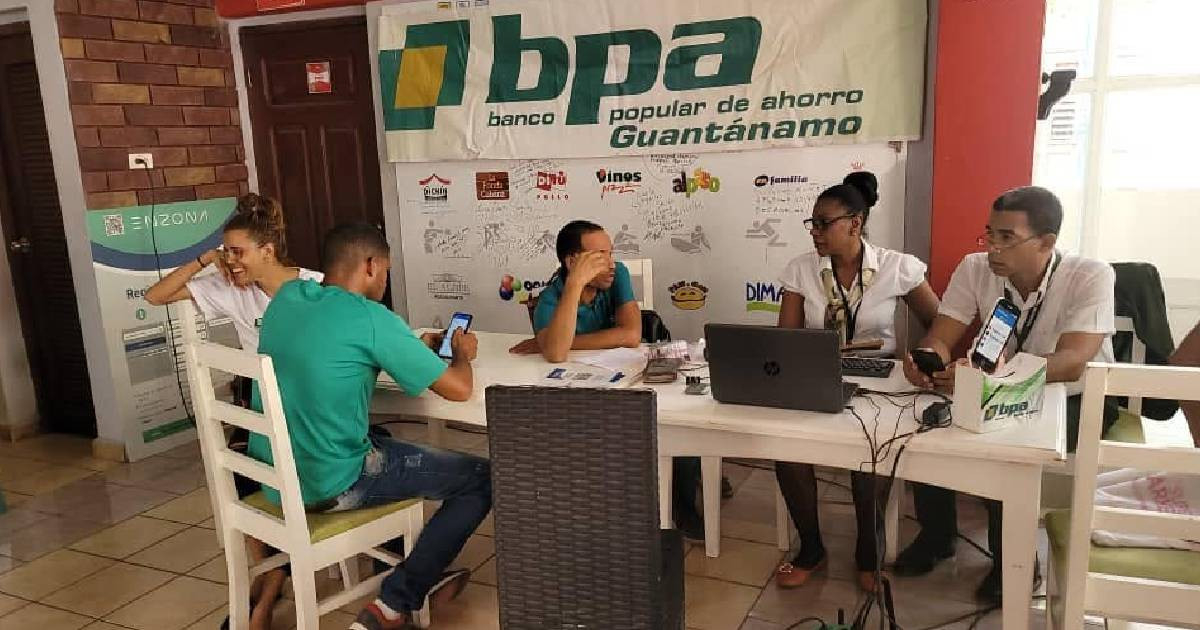
The provincial authorities of Guantánamo publicly acknowledged on Friday that the banks in the province lack sufficient cash to meet their operational needs and warned that they would impose penalties on state and private merchants who refuse to accept payments via electronic transfer.
This was established during the meeting on operational and socioeconomic vitality held on Friday, chaired by the highest authorities of the Communist Party and the provincial Government, and conducted via audioconference with all the municipalities in the province, reported the official newspaper Venceremos.
The data revealed in the meeting is compelling: Bandec, which needs to generate nearly 15 million pesos daily, is only able to capture just over 35% of that goal.
The BPA bank, for its part, collects 92% of the more than two million pesos it requires daily, a figure that still does not meet the actual demand for cash in the province.
The scarcity directly impacts the most vulnerable sectors, such as workers in education and public health, who do not receive their salaries on time, while retirees face serious difficulties in collecting their pensions.
The meeting called for intensified actions by inspection bodies to enforce the existing legal obligations. "All state or private establishments are required to operate with electronic payment methods, accepting transfers and enabled digital payments," the source emphasized.
The threat of sanctions is not new. The regime has already accumulated a total of 15,240 fines and 269 closures of establishments nationwide for not accepting electronic payments, without these measures reversing the trend.
The failure of the mandatory banking policy, launched in August 2023, is acknowledged even by the official press, considering that only 3.77% of transactions in Cuba are digital, three years after the regime enforced that requirement.
The situation in Guantánamo is not new either. On July 4th, provincial authorities called an emergency meeting due to the same crisis, when Bandec was only reaching 77% of its target and more than 6,000 workers in Culture, Sports, Education, and Higher Secondary Education had not received their July salary due to lack of liquidity in the banks.
Venceremos acknowledged then that the crisis "has ceased to be a banking difficulty and has become a social problem."
In that context, the Central Bank published Resolution 74/2026 on Friday, which removes the cap of 5,000 pesos for cash transactions between economic actors, effective July 20.
Cubans reacted with skepticism to the measure: "Now there are no limits to cash payments, the problem is that there is no cash in the banks."
Related videos:
Filed under: