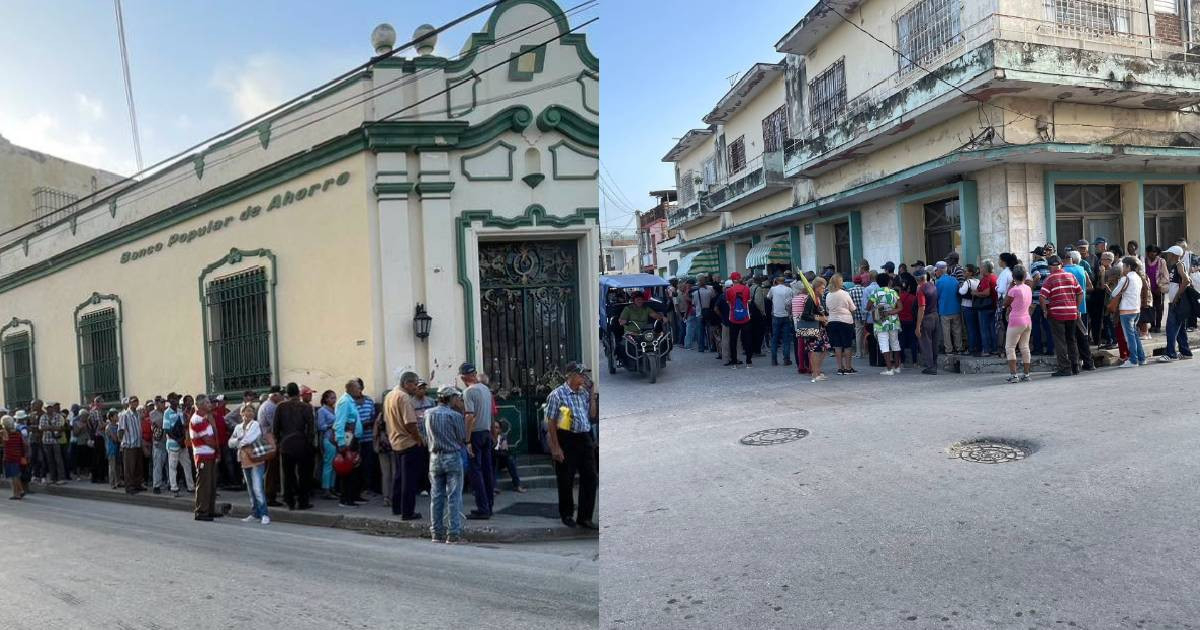
The Popular Savings Bank of Holguín closed its doors at 3:00 p.m. this Friday, leaving dozens of elderly people unable to collect their pensions, despite the branch having electricity, available cash, and internet connection, reported citizen Pedro Lorenzo Hechavarría Pupo via his wall on Facebook.
"If Wednesday was bad for collecting retirement benefits in the city of Holguín... today, Friday, it was worse. What has changed? NOTHING. What improvements have been made for retirees?… NOTHING," wrote Hechavarría, who documented the situation with images of long lines surrounding the colonial building of the branch located on the streets Aguilera and Maceo, in the heart of the Cuban City of Parks.
The complainant stated that the employees communicated: "We have to close now, please," and ended their service regardless of how many people were left waiting in the sun.
Hechavarría also questioned the logic of the system: if the bank can postpone service until the next day when there is no electricity, cash, or connection, why can't it extend its hours when all conditions are met?
He also proposed that in branches with six counters, employees take their lunch breaks in shifts to avoid disrupting service.
"And if we say that we need to give autonomy to the municipalities... should not a single municipality be able to protect its retirees? Is there no talent available that can address the situation of the retirees?" asked the whistleblower.
The scene this Friday follows a pattern that the retirees in Holguín endure month after month: in May, the same citizen documented identical lines at the same branch.
The public's outrage in the comments of the post was unanimous.
"This situation regarding the payment of retirees is inhumane; those elderly people wait for hours to receive the meager pension under the scorching sun. Many of these seniors go to that dreadful line without having breakfast," wrote someone.
Another voice pointed directly to the responsibility of the authorities: "This happens simply because the leaders in charge do not care about the reality of the people; they literally live in a parallel world where they are not affected by power outages, nor do they have to stand in those endless lines. If the banks were private, as they are in the real world, these things would not happen."
A commentator invited the governor, the mayor, and the first secretary of the Party to "step in and protect their vulnerable population that is so often discussed yet not acted upon, total inaction by the Government and the Party."
Another pointed out that the problem is not limited to the bank: "The central post office in Holguín is the same, and now that they removed the mail from the 12 floors, it’s even worse."
A commentator bitterly summarized the announced measure: "Now there are no limits on cash payments, the problem is that there is no cash in the banks."
The ordeal in Holguín is not an isolated case. This same Friday, a retired journalist from the state newspaper Granma recounted spending eight hours in line at a bank in Havana to collect her pension, while a photojournalist from the same outlet described "screams, cries of helplessness, cane strikes, and loud accusations" at another capital branch.
The structural background is devastating: More than 50% of the country's ATMs are inoperative or empty, only 3.77% of transactions are digital despite three years of forced banking, and the maximum pension of 4,000 pesos a month is worth less than seven dollars at the informal exchange rate, while the basic food basket exceeds 30,000 pesos.
This Friday, the Central Bank of Cuba announced the national extension of the pension payment scheme through local businesses, an implicit acknowledgment that the State cannot sustain its own social security system.
In Holguín, a similar pilot program launched in May reached only 5,000 of the more than 52,000 retirees in the municipality, which is less than 10%.
Related videos:
Filed under: