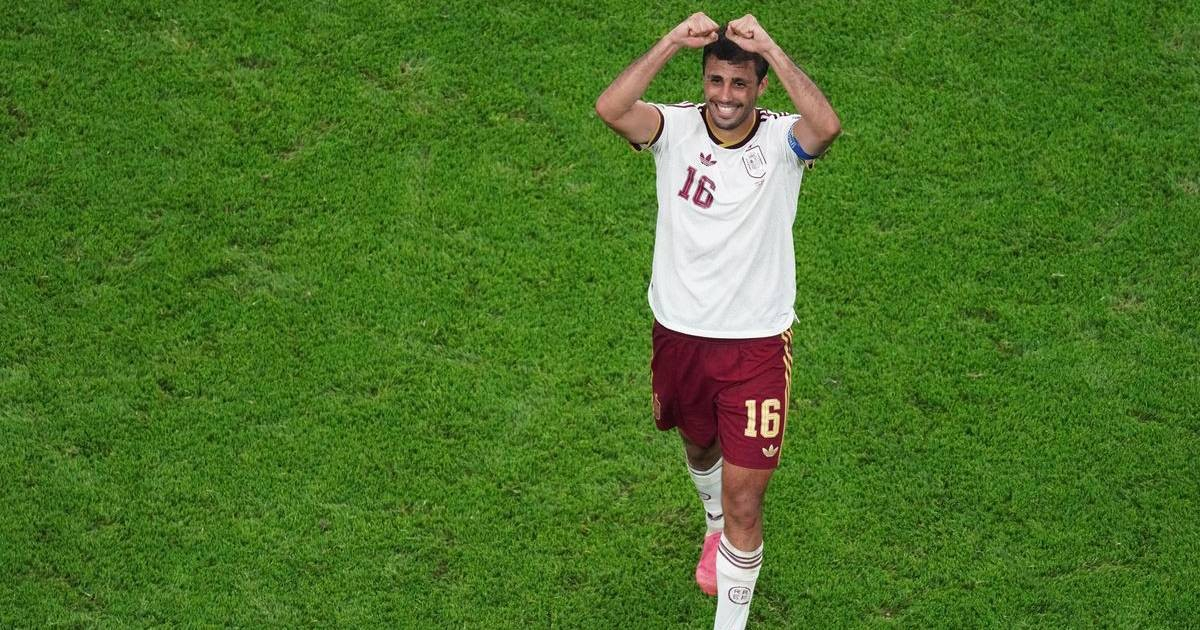
Rodri will once again be the linchpin of La Roja's midfield when Spain competes this Sunday in the 2026 World Cup final against Argentina at the MetLife Stadium in East Rutherford, New Jersey. The midfielder from Manchester City will arrive at that match with 70 international caps and 12 as captain of the "Red Fury."
Beyond the personal milestone, the player from Madrid has the opportunity to become the fifth captain in Spain’s history to lift a trophy with the national team. This has only been achieved before by Ferran Olivella (Euro 1964), Iker Casillas (Euros 2008 and 2012, World Cup 2010), Jordi Alba (Nations League 2023), and Álvaro Morata (Euro 2024).
The figures Rodri has accumulated throughout the tournament are unprecedented. His 655 completed passes represent the highest record registered by a player in a single edition of the World Cup since comparable data has existed, that is, since 1966.
In the opposing field, his dominance also approaches historic levels. With 371 completed passes in enemy territory, he is only surpassed in all-time records by Dunga, who had 393 in the 1994 World Cup in the United States, and Xavi Hernández, with 391 in South Africa 2010.
His ability to break defensive lines has been equally decisive. Since 2010, only Xabi Alonso —with 126 in that same tournament— and Toni Kroos —with 109 in Brazil 2014— have surpassed the 106 passes that broke lines that the midfielder has recorded in this World Cup.
Rodri's influence extends beyond distribution. He leads the tournament in receptions under pressure, with 232, and is the player who has covered the most distance in the entire competition: 83,802 meters in total.
Spain's journey to the final has been strong. La Roja eliminated France 2-0 in the semifinals on July 14 in Arlington, Texas, and heads into the decisive match undefeated in the final stages of the tournament.
Argentina, the opponent this Sunday, arrives as the two-time defending world champion following their title in Qatar 2022 and defeated England 2-1 on July 15 in Atlanta, with goals from Enzo Fernández and Lautaro Martínez.
The historical context adds significance to the match: it's the first time Spain and Argentina are facing each other in a World Cup final. For La Roja, victory would mean their second World Cup title, 16 years after their win in South Africa 2010 against the Netherlands, with Iniesta's goal in the 116th minute.
Spain will once again rely on the footballer who best embodies its style: "the one tasked with setting the pace, connecting all the lines, and sustaining the operation of a team that dreams of capturing its second star."
Related videos:
Filed under: