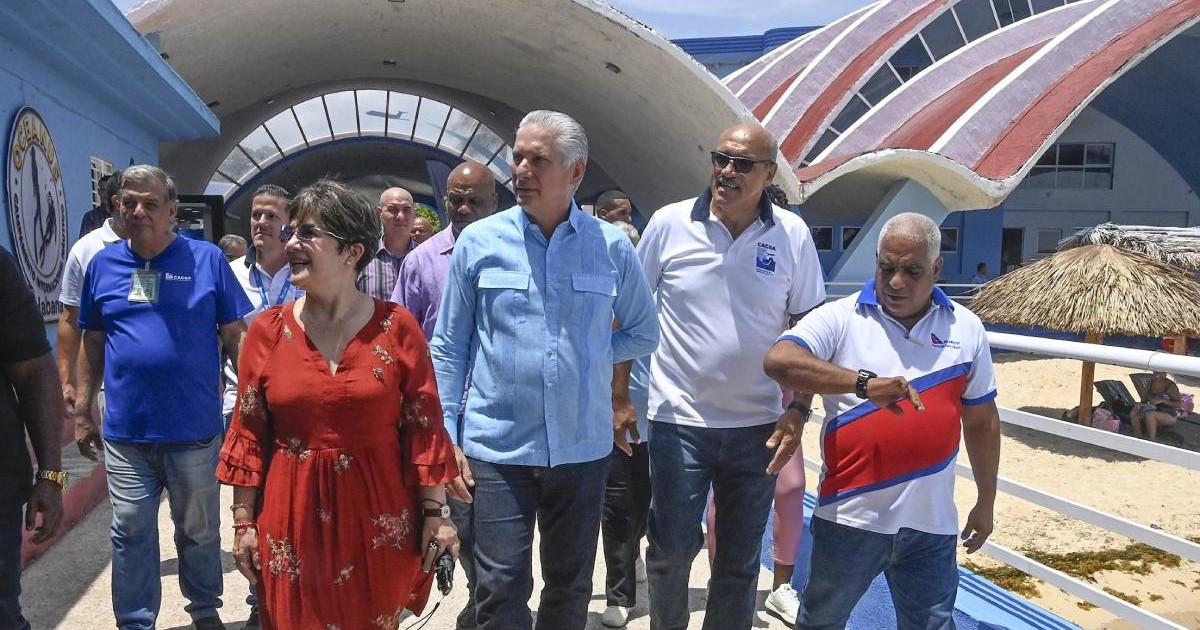
Miguel Díaz-Canel and his wife Lis Cuesta Peraza visited the Social Workers' Circle "Félix Elmusa" this Saturday, located in the Náutico neighborhood of the Playa municipality in Havana.
The Presidencia de Cuba presented the visit as a "work tour" and took the opportunity to showcase the reopening of the facility as a supposed collective victory amid the crisis.
The facility, popularly known as El Náutico, reopened in early July after four months of rehabilitation led by the Cuban Aviation Corporation (CACSA).
The president and his wife toured the diving areas, an art gallery, gym, game room, pizzeria, café, swimming pool, bakery-confectionery, baseball field, and children's room.
The most revealing detail of the rehabilitation is not its facilities. The center had to install solar panels, inverters, and batteries to operate autonomously, independent of a collapsing national power grid.
While Díaz-Canel was strolling through El Náutico, the rest of the workers' social circles in the country remain in ruins.
- El Havana Yacht Club, transformed into CSO "Julio Antonio Mella", está completamente clausurado y en estado de abandono total, según documentación de junio de 2026.
- El Cuban Spanish Casino of Havana y el Marcelo Salado Social Club in Jaimanitas corren la misma suerte.
- La instalación «La Concha» was destroyed by a fire in December 2024 tras décadas de desidia.
The selectivity pattern of the regime is hard to ignore
In the summer of 2025, Díaz-Canel inaugurated the restored FAR Club, the former Miramar Yacht Club, a facility with exclusive access for military personnel.
In 2026, it was El Náutico's turn for rehabilitation, a social club for workers in aviation, transportation, and communications. The public can access the beach area of this facility, but does not have access to other areas and services that are exclusive to members.
The bulk of Cuba's popular recreational heritage, meanwhile, is deteriorating without anyone intervening.
Lis Cuesta's presence at the event adds another layer of contrast. The president's wife, who holds no official position in the government, often appears at specific moments, engaging in socio-cultural activities and some policies aimed at mass participation.
The phrase with which Díaz-Canel ended his visit to El Náutico sounds mocking to millions of Cubans without electricity, without water, and without recreational spaces: "This is an experience that can be multiplied."
The manager of the center, Maytée Crespo Alonso, was more candid: "The challenge is to sustain it."
Related videos:
Filed under: