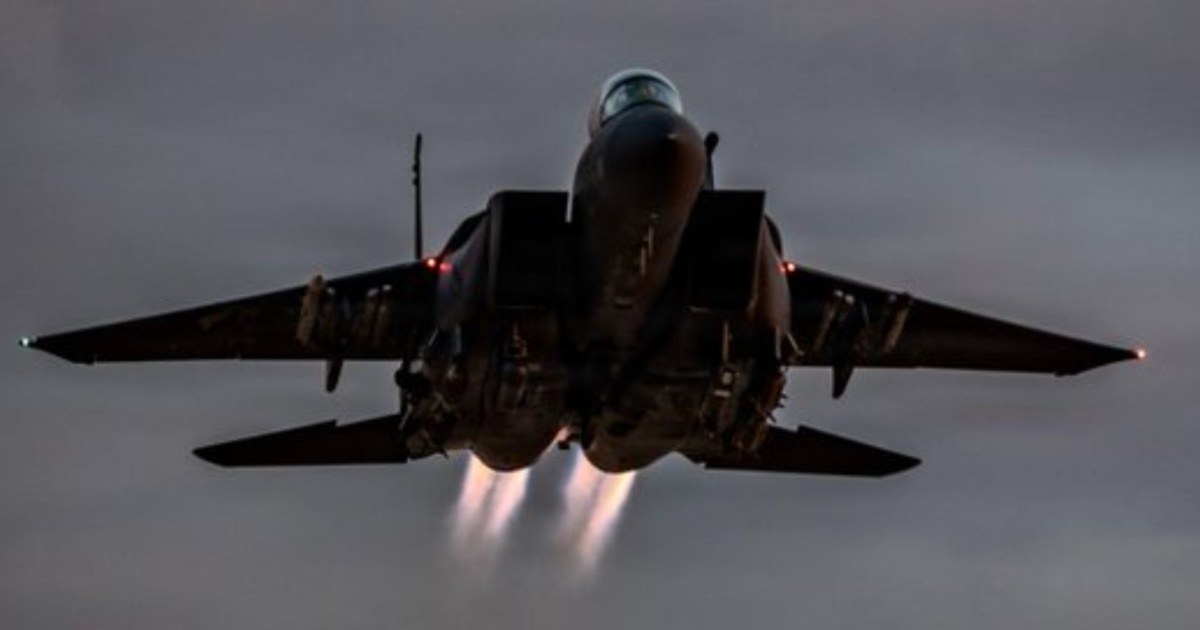
The Trump administration deployed F-16 fighters from Spangdahlem Air Base in Germany and F-35 stealth aircraft from RAF Lakenheath in the United Kingdom to the Middle East on Sunday, which could be preparation for a new offensive against Iran, according to a report by EFE citing the newspaper The New York Times.
The information was confirmed by U.S. officials who spoke on the condition of anonymity. In addition to the fighter jets, additional refueling aircraft are also en route, indicating long-range and sustained operations.
A key detail reveals that the deployment is not an improvised reaction: the order to send these air reinforcements was issued before the Iranian attack on Friday in Jordan, indicating that the White House was already contemplating an escalation regardless of that incident.
On Friday, July 17, the Islamic Revolutionary Guard Corps of Iran launched ballistic missiles and drones against the Muwaffaq Salti Air Base in north-central Jordan, resulting in the deaths of two American soldiers and leaving a third missing. The U.S. Central Command (CENTCOM) confirmed the casualties on Saturday. Four additional military personnel were evacuated to Jordanian hospitals and have since been discharged.
In retaliation, in the early hours of this Sunday, the U.S. launched its eighth wave of bombings against Revolutionary Guard facilities in Iran, targeting coastal surveillance, air defense, maritime capabilities, and missile and drone depots. The total number of U.S. soldiers killed in the conflict has now risen to 16.
The new deployment represents the largest air reinforcement from the U.S. in the region since the Gulf Wars, with up to 300 combat aircraft mobilized in total.
The conflict dates back to February 28, 2026, when Trump announced the "Epic Fury Operation", a joint offensive with Israel that targeted over 500 Iranian sites in its initial hours, including nuclear facilities, and resulted in the death of Supreme Leader Ali Khamenei.
After months of fighting, the Islamabad Memorandum was signed between June 17 and 19, 2026, establishing a 60-day ceasefire mediated by Pakistan, Qatar, Saudi Arabia, and Turkey. The truce was short-lived: Iran attacked three merchant ships in the Strait of Hormuz on July 6 and 7, prompting Trump to declare the ceasefire ended from the NATO summit in Ankara with a direct warning: "We are going to hit them very hard."
Since then, the U.S. has struck more than 300 military targets in Iran during consecutive nighttime waves, while Iran has responded with attacks against U.S. bases in Bahrain, Kuwait, and Jordan.
On July 15, in an interview with Fox News, Trump issued an ultimatum to Iranian leaders: "They better make a deal. There will be no one left for them," although he also pointed out that Iran "is negotiating now" and that there is a "good chance" of reaching an agreement.
Related videos:
Filed under: