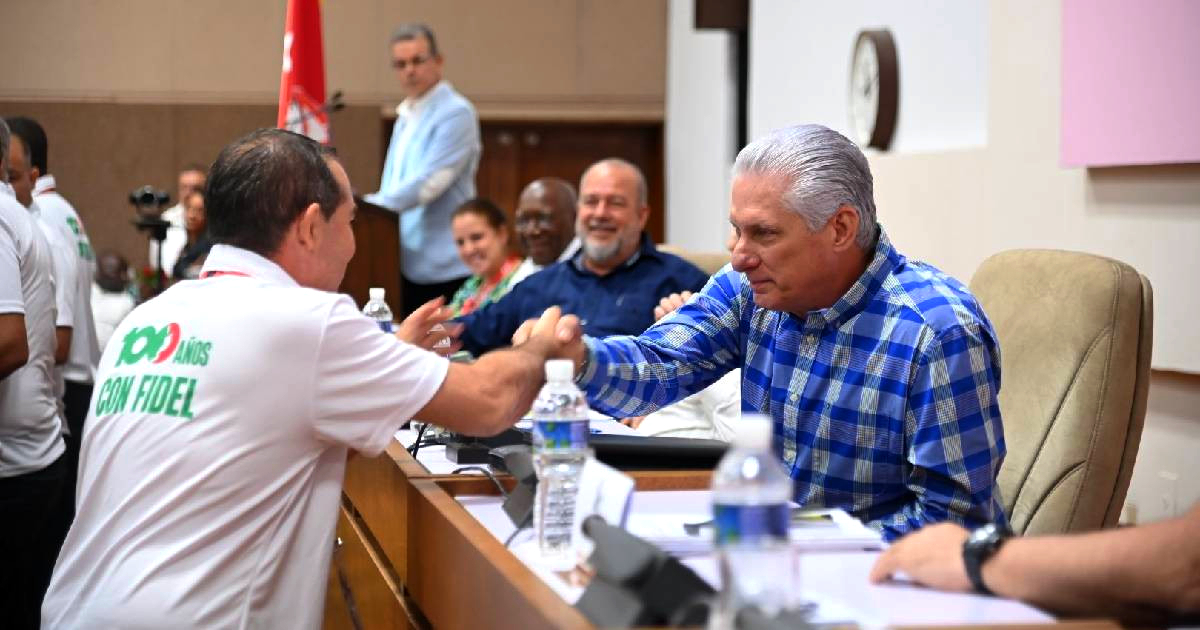
When Miguel Díaz-Canel defended the recent salary increase, he stated that the measure demonstrated that the regime's economic transformation program "protects those who are in the most difficult situations".
However, the fine print of the reveals that the increase is not limited to low-income workers or retirees.
The new salary scale approved by the Ministry of Labor and Social Security benefits all 32 occupational groups in the budgeted sector, including the so-called " cadres ", the category of leaders responsible for managing state institutions and implementing the policies of the Communist Party of Cuba (PCC) and the government.
The explicitly states that ' cadres' are placed between groups XVII and XXII of the salary scale. With the implementation of this measure, their base salaries for a 44-hour workweek will be as follows:
- Group XVII: 7,045 pesos.
- Group XVIII: 7,350 pesos.
- Group XIX: 7,735 pesos.
- Group XX: 8,115 pesos.
- Grupo XXI: 8,500 pesos.
- Group XXII: 8,880 pesos.
Before the increase, those same groups received between 4,610 and 5,810 pesos per month.
The increase is part of the package of 176 economic transformations approved by the National Assembly and benefits over a million workers in the budget sector.
Although the government has focused on the increase in the minimum wage—from 2,100 to 3,210 pesos—the Gazette confirms that the adjustment reaches the entire salary pyramid.
That is to say, it is not only those in the lower tiers of the hierarchy who benefit from increased earnings. The salaries of management positions within the state apparatus, responsible for implementing the regime's directives and policies, also receive raises.
Who are the "cuadros"?
In Cuban political language, a 'cuadro' is not merely a director or an administrator.
The legislation itself and the internal documents of the PCC define ' cadres' as leaders chosen for their political reliability and responsible for managing state institutions, organizations, and enterprises, in addition to ensuring the implementation of the directives of the Communist Party and the government.
In practice, school directors, hospitals, state-owned enterprises, administrative bodies, and other public institutions are part of this leadership structure, which is also subject to ongoing mechanisms of political evaluation.
Beyond the official definition, the figure of the 'leader' today carries deep weariness among a significant portion of the population. For many Cubans, it represents a rigid bureaucracy, highly ideologized and more concerned with fulfilling political directives than with addressing the everyday issues of the citizens.
On social media and in public conversations, there is an abundance of criticism towards leaders who are seen as inflexible, out of touch with reality, complacent amidst scarcity, excessively subservient to the Party hierarchy, unresponsive to popular demands, and, in some cases, prone to the abuse of power that accompanies certain positions.
This perception has been fueled for years by the economic deterioration, the emigration of many professionals and qualified young people, and the feeling that advancement to management positions often depends more on political loyalty than on merit or management skills.
Miguel Díaz-Canel has dedicated a significant portion of his speeches in recent years precisely to the ' cadres '.
In 2019, he demanded they not be "timid and slow" and called for leaders with "revolutionary concern" and political sensitivity.
In 2024, following a corruption scandal that shook the economic leadership of the regime, he urged the ' cadres' to act with "ethics" and asked them to avoid bureaucratic and insensitive responses to the population.
By January 2026, during the extraordinary sessions of the Communist Party, he again placed a significant portion of the responsibility for the country's crisis on them by stating that the members should feel responsible for "everything that goes wrong".
The regime's concern for its officials also responds to another phenomenon that the authorities have publicly acknowledged: the gradual deterioration of communist party membership.
In recent years, leaders of the PCC have acknowledged the decline in the recruitment of new members, the existence of hundreds of centers without party nuclei, and the growing rejection among many young people to join both the Union of Young Communists and the Party.
In that context, the structure of 'squares' continues to be one of the main pillars on which the daily functioning of the Cuban state rests.
A contrast with the official discourse
The inclusion of the 'frameworks' within the salary increase introduces a contrast to the discourse used by Díaz-Canel to present the measure.
While the ruler stated that the increase demonstrates the government's commitment to protecting those facing the greatest economic difficulties, the resolution approved by the Ministry of Labor extends the benefit to the entire salary structure of the budgeted sector, including management positions.
The increase remains almost the same percentage for all groups on the scale, close to 53%, so 'managers' do not receive preferential treatment compared to other workers. However, starting from higher salaries, they also receive greater absolute increases.
The news has generated numerous reactions among the readers of CiberCuba, many of whom question whether the increase will be applied uniformly across the entire state structure in a context where the minimum wage continues to be equivalent to less than five dollars per month in the informal market, and where the cost of basic products such as oil, eggs, or chicken greatly exceeds the purchasing power of a significant portion of the population.
For many Cubans, the debate is no longer solely focused on the percentage of the increase, but rather on the priorities of public spending in a country where the economic crisis, inflation, and the decline of basic services continue to impact daily life.
Related videos:
Filed under: