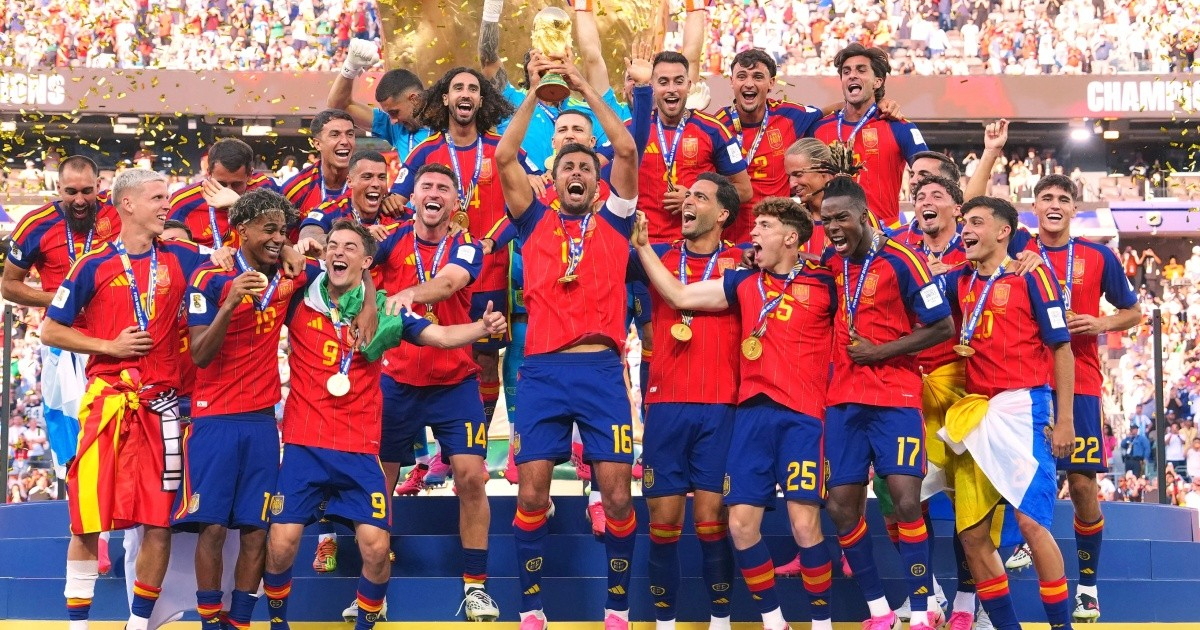
Spain was crowned world champion on Sunday, July 19, after defeating Argentina 1-0 in extra time in the final at the MetLife Stadium in New Jersey. With this title comes the largest financial reward in World Cup history: 51 million dollars from FIFA for the Spanish federation.
The governing body of world football established a record prize pool of 871 million dollars to be distributed among the 48 participating teams, nearly double the 440 million distributed in Qatar 2022, when Argentina received 42 million for lifting the trophy.
What Spain collects as champions
FIFA transfers the prizes to the national federations, not directly to the players.
However, the Royal Spanish Football Federation agreed in March 2026 with the team captains to distribute 45% of the prize equally among the 26 summoned players, which amounts to approximately 754,701 euros gross per player, around 415,000 euros net, a record bonus that doubles what was received in Qatar.
The evolution of the champion's prize reflects the sustained growth of the tournament: 30 million dollars in South Africa 2010, 35.1 million in Brazil 2014, 38.1 million in Russia 2018, and 42.2 million in Qatar 2022.
Why did FIFA increase the prize pool so much?
The final figure of 871 million was not anticipated from the start of the tournament.
In April 2026, FIFA added more than 100 million dollars following pressure from several European federations, which warned that they would lose money if their teams did not advance far, given the high logistical costs of a competition spread across three countries.
The president of the French Federation, Philippe Diallo, was one of the most active in demanding improvements, pointing out to the newspaper L'Équipe that "for several months, I had drawn the attention of FIFA president Gianni Infantino to the fact that teams were not being adequately rewarded, compared to what Chelsea received, the champion of the Club World Cup."
Chelsea received 115 million dollars for winning that competition in 2025, also on American soil, more than double what Spain receives as the world champion.
The Associated Press illustrated the paradox by pointing out that "the 51 million dollars for the champion is less than the transfer fee that the English club Brighton paid on Tuesday for a 19-year-old defender who spent most of the World Cup on the bench: the Croatian Luka Vušković."
How much does each team earn based on their performance?
All participating federations received at least 12.5 million dollars: 10 million for qualifying and competing in the group stage, plus 2.5 million for preparation expenses.
The complete breakdown is as follows:
- Champion (Spain): 51 million dollars
- Runner-up (Argentina): 34 million
- Third place (England): 30 million
- Fourth place (France): 28 million
- Quarter-finalists (5th to 8th): 20 million each
- Round of 16 (9th to 16th): 16 million each
- Round of 32 (17th to 32nd): 12 million each
- Group stage (33rd to 48th): 10 million each
Rings, trophy, and logistics
Along with the cash prize, Spain will receive for the first time in the history of world football championship rings in the style of the major American leagues: 18-carat gold with 89 diamonds and 36 sapphires, in a limited edition of 2,026 numbered pieces.
Thirty personalized rings will be given to players and coaching staff; the remaining 1,996 will be sold to the public for $12,000 each.
The original trophy does not remain in the possession of the champion: the Spanish national team will keep a gold-plated replica delivered after the awards ceremony.
With this second world title for Spain, 16 years after the first in South Africa 2010, the Red Fury concludes the tournament with eight matches, seven wins, one draw, 14 goals scored, and only one against, boasting the most solid defense of any champion in the history of the competition.
Related videos:
Filed under: