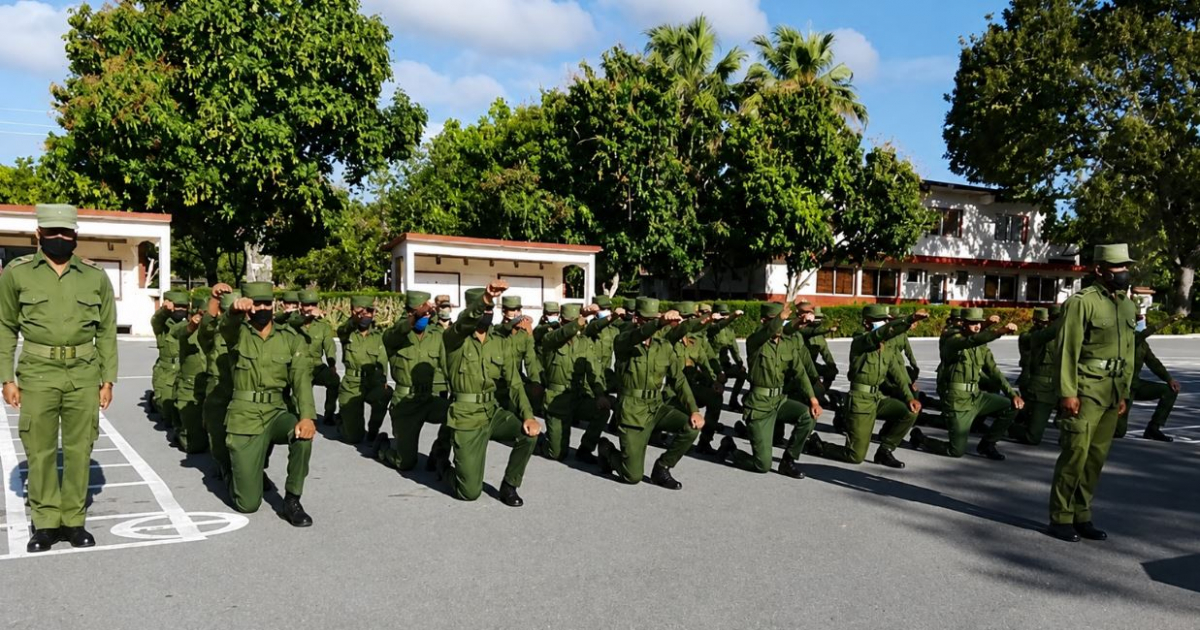
A new report from the Cuban Observatory for Citizen Auditing (OCAC), prepared with the support of Cuba Siglo 21, documents 97 deaths and disappearances of Cuban recruits during the Mandatory Military Service (MMS) between August 2001 and the spring of 2026, with an average age of 18.7 years, and suicide emerging as the leading cause of death.
The research, titled "The Strengthening of Mandatory Military Service in Cuba," was conducted by researcher José Manuel González Rubines and is based on records compiled by the Archivo Cuba project, with assistance from Alfredo González, the father of one of the victims. The document itself warns that the actual figure is much higher: "The documented number is a floor, not a ceiling," it notes, reminding that there are no official Cuban statistics on mortality in military service.
Suicide leads the causes of death, with 33 cases (34% of the total), followed by severe or criminal negligence with 25 (25.8%) and accidents with 22 (22.7%). Seven of the deceased were under 18 years old—children according to the Convention on the Rights of the Child, which Cuba ratified in 1991—representing 11.1% of the cases with known ages. In four of the cases classified as suicide, families suspect that the official version conceals a homicide.
The testimonies of former recruits gathered in the report describe isolation, extreme hardship, and humiliating discipline. "The Military Service is a mechanism designed to break us. I believe that suicide crossed the minds of many of us at some point," one of them stated.
Two tragedies have drawn public attention to the SMO in recent years. On August 5, 2022, four recruits aged between 18 and 20 were burned alive at the Supertanker Base in Matanzas without the means or training to tackle the largest industrial disaster in the country's recent history. On January 7, 2025, nine recruits and four officers died in the explosion of an ammunition warehouse in Melones, Holguín.
The most recent documented case is that of Dailier Rodríguez Tamayo, a 19-year-old from Ciego de Ávila, who died in March 2026 at the Military Unit 10-24 in El Cotorro, in Havana, over 400 kilometers away from his home, despite having a Naval Hospital report against carrying weapons.
In July 2021, 18-year-old Annier González took his own life 13 days after being assigned the rifle he was given to guard alone in a tower of the Combinado del Sur prison in Matanzas. His father manages the Facebook group "No more victims in Military Service in Cuba," which has over 18,000 members, and the heartbreaking message he dedicated to his son —"Forgive me for not taking you out of that place"— has become a symbol of the pain experienced by affected families.
The report highlights that those seeking justice face reprisals. The father of Orlando Lago Vega, who was murdered in a military unit in Havana in June 2020, was sentenced in 2023 to one year and six months in prison for insisting that the death of his son be investigated. The Military Penal Code of July 2023 establishes penalties of up to five years for evasion, and the Military Prosecutor's Office considers suicide as an attempt at desertion, which can lead to sentences exceeding ten years for those who survive.
Adrián Rodríguez García, 19 years old, died while serving his Mandatory Military Service in Cuba. The young man, originally from Santa Clara, was supposed to complete this phase in the Armed Forces by early December 2023, but the officials at the Manuelita unit kept delaying and on December 31 of that year, he was still on guard duty. That day, his mother went to visit him and brought him food because it was New Year's Eve. He told her he had four or five days left, at most, to finish his service. She returned home, and four hours later, she received a call informing her that her son had died. They granted him permission to leave the unit on December 31, and a drunk driver hit him, leaving him to suffer until death. There was no investigation into the commanders who authorized his departure.
In comparative perspective, Cuba recorded 22 documented cases in 2025 during peacetime, the same number that Israel— a country engaged in active war with an army of several hundred thousand troops—reported that year as the highest in 15 years. The report emphasizes that the difference lies in the institutional response: in Israel, each case is publicly investigated; in Cuba, silence is the norm.
"As long as the system that produces that loss remains intact, there is no reason to believe that the death toll will stop rising," concludes the OCAC report.
Related videos:
Filed under: