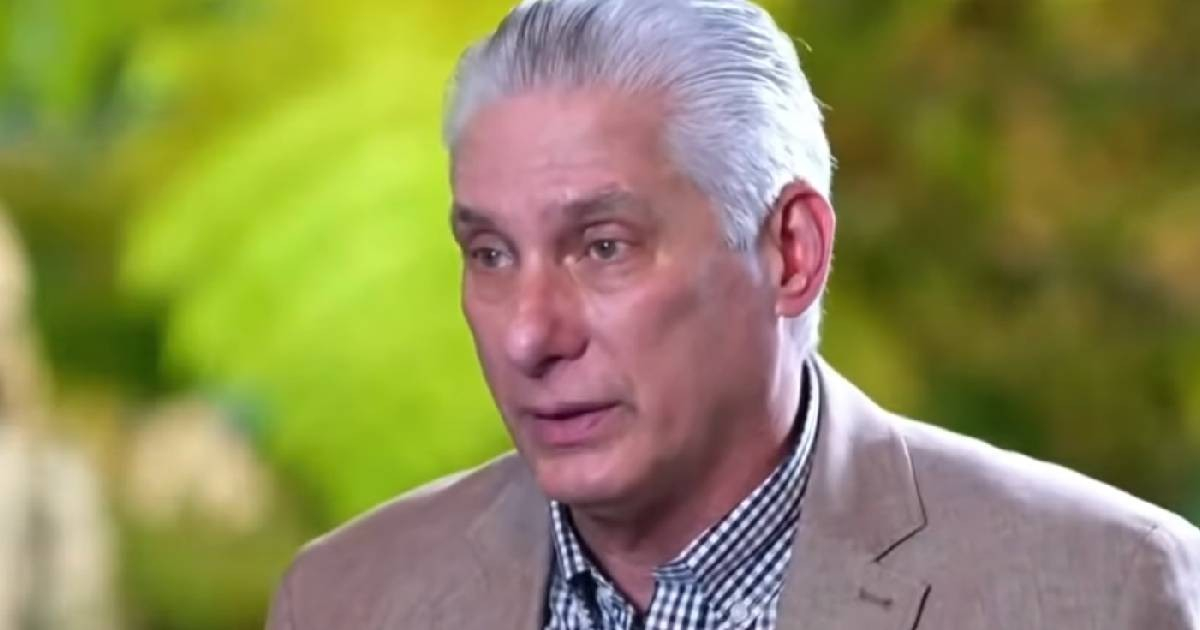
Miguel Díaz-Canel stated this Monday, in an exclusive interview with the Russian state media RT, that companies and individuals from Latin America, Europe, and Asia are interested in investing in Cuba despite Washington's pressure to deter investors from the island.
The president responded in this way to a question from correspondent Oliver Zamora about the real possibilities of success for the economic transformations that the regime plans to implement in the coming weeks.
"There are many people willing to invest in Cuba, studying carefully all the possibilities that arise from the transformations in both Latin America and the Caribbean, as well as in Europe and Asia. There are many individuals, many companies, many entities that are interested in working with Cuba and are willing to not be subordinated to the impositions of a nation that believes it is the empire that can govern the world,” he asserted.
Díaz-Canel acknowledged, however, that those contacts are not discussed publicly. "Unfortunately, we do not talk publicly about those matters because there is a truly aggressive persecution against anyone who has and wants to conduct business with Cuba," he admitted.
The leader also mentioned Cubans living abroad who, according to him, are seeking "all the legal mechanisms" to work with the island "in an honest, clean, and transparent manner." These statements come shortly after the regime approved in June a package of 176 economic transformations that includes the opening up to private banking, foreign investment in small and medium-sized enterprises, and a legal framework for the diaspora to invest in the island.
In the same interview, Díaz-Canel promised that by the end of July the regime will be ready to implement 121 of the more than 170 transformations that have been approved, prioritizing retirees and individuals in vulnerable situations.
The backdrop to these statements is an unprecedented energy crisis. Díaz-Canel himself acknowledged to RT that "it has been six months since a fuel ship arrived; only a Russian ship has come." Cuba needs between 90,000 and 110,000 barrels daily but produces barely 40,000, and the Venezuelan supply collapsed following Nicolás Maduro's capture at the beginning of the year.
This crisis is compounded by the mass exit of foreign companies triggered by the secondary sanctions imposed by the Trump administration against GAESA —the military conglomerate that controls between 40% and 70% of the Cuban economy— and related entities. Companies such as Sherritt, Meliá, Iberostar, and the shipping companies Hapag-Lloyd and CMA CGM left Cuba before the deadline set by Washington on June 5.
Díaz-Canel described U.S. policy as having a "perverse intention" and characterized it as a "policy of maximum suffocation, of maximum pressure," equivalent to "collective punishment" and an "expression of genocide." At the same time, he compared the Cuban situation with the reforms in China and Vietnam to highlight the differences: "China and Vietnam, when they began their reforms years ago, were not under a blockade. Therefore, neither a carbon copy nor a replica. Heroic creation is what we must pursue."
Díaz-Canel's statements to a media outlet sympathetic to the Kremlin stand in stark contrast to the reality faced by the Cuban population: prolonged blackouts, widespread shortages of food and fuel, and an unrelenting exodus. The regime has been promising reforms for decades that never come to fruition, and public skepticism regarding this new set of measures is widespread.
"Although there is a whole intention-action, I would say perverse, on the part of the United States Government to limit that, trying to restrict it. There is a lot of will in the world, there is a lot of will in us as well. Everything will depend on how we manage these processes," concluded the leader.
Related videos:
Filed under: