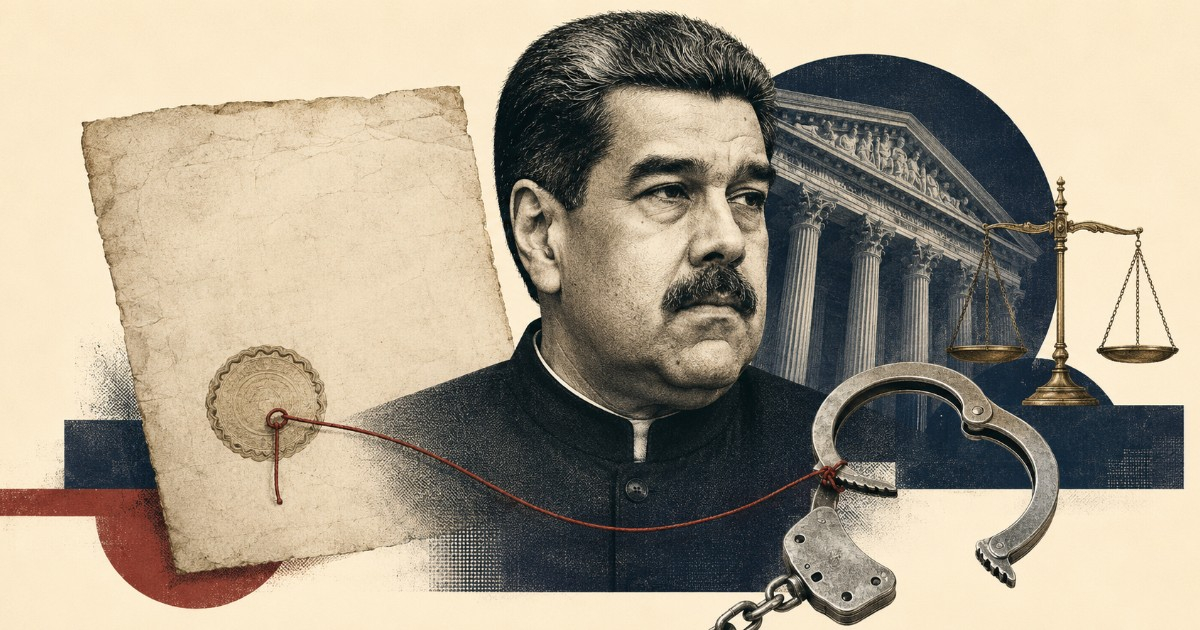
A treaty of extradition signed over a century ago between the United States and Venezuela could become an obstacle for the criminal proceedings against Nicolás Maduro, according to an opinion piece published by The New York Times.
Its author argues that if this legal interpretation succeeds, the United States could be compelled to release him.
The case will return this Wednesday, July 22, before Judge Alvin Hellerstein of the Federal Court for the Southern District of New York, during a follow-up hearing on the proceedings, marking Maduro's third court appearance since his transfer to the United States.
The legal knot is in the bilateral extradition treaty of 1922, approved by the U.S. Senate and ratified by the president, which has full force of law.
Its central clause states that "all differences between the contracting parties, relating to the interpretation or execution of this treaty, shall be settled by arbitration."
The Venezuelan government has publicly insisted that Maduro's capture was illegal under international law.
According to the author of the column, that controversy could represent a "disagreement between the contracting parties" capable of triggering the arbitration clause.
Moreover, the interpretation presented in the column suggests that Judge Hellerstein should suspend the proceedings and refer the dispute to a panel of independent arbitrators.
If that panel concludes that the capture violated the treaty, the United States could be obliged to release Maduro.
The jurist David Sloss, editor of The Role of Domestic Courts in Treaty Enforcement, stated that it would not be particularly surprising if the dispute were temporarily withdrawn from the courts and referred to arbitration.
He explained that this procedure would be consistent with the usual approach of the courts regarding contracts that contain arbitration clauses.
For his part, international law expert Steven Ratner explained that, unless stated otherwise, the arbitrators would likely follow the principles of the Vienna Convention on the Law of Treaties and examine the agreement in light of "the relevant norms of international law from 1922."
The Supreme Court has upheld the underlying principle on three distinct occasions.
In 1886, in the case of United States v. Rauscher, the Supreme Court ruled that the defendant could not be tried for charges other than those for which he had been extradited from the United Kingdom.
In 1927, the then president of the Supreme Court—former President William Howard Taft—asserted that the "right of the court" to retain foreign defendants "for their trial" depended on the applicable treaty.
And in 1992, in the case United States v. Álvarez-Machaín, the Court allowed the trial of a Mexican citizen who had been abducted by the DEA, but reaffirmed that a defendant "cannot be tried in violation of the terms of an extradition treaty."
The key difference between that 1992 precedent and the Maduro case is that the treaty with Venezuela, unlike the treaty with Mexico, contains a clause for mandatory arbitration to resolve any disputes regarding its interpretation.
The analysis concludes that "the trial cannot legally continue without this step" and warns that "any attempt by the United States to evade arbitration" would make the operation "flagrantly illegitimate according to U.S. law itself."
Related videos:
Filed under: