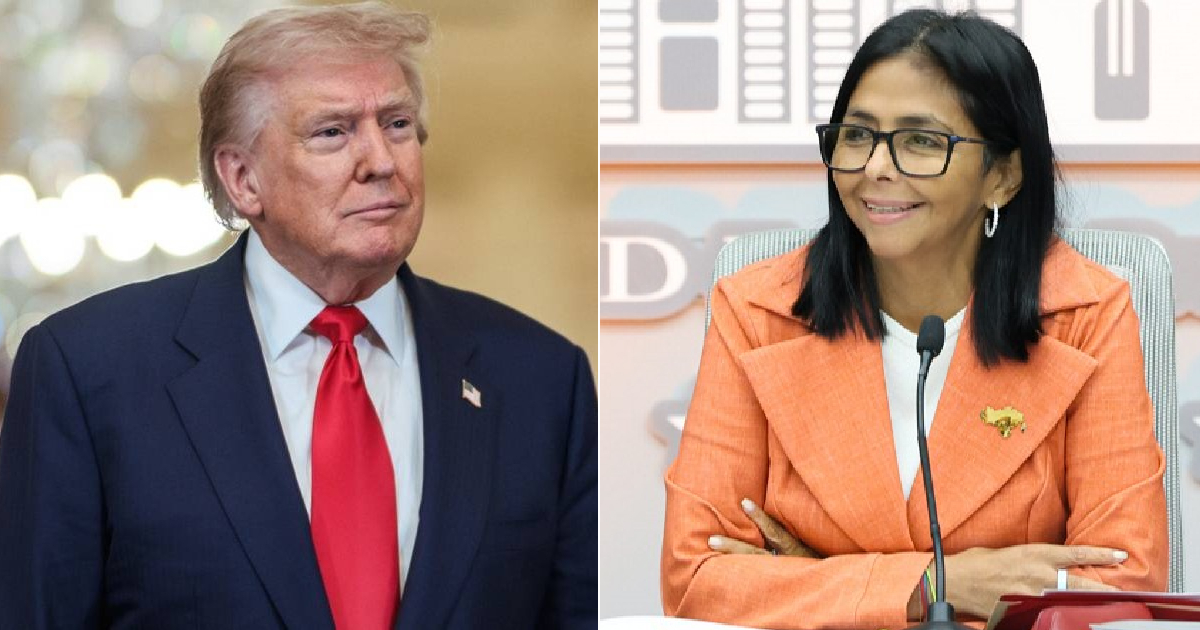
The administration of Donald Trump formally requested the United States Department of Justice to ensure judicial immunity for Delcy Rodríguez, the acting president of Venezuela, in the civil lawsuit involving her in a federal court in Miami, as reported by the EFE agency on Tuesday.
The request was made on June 11 by Reed D. Rubinstein, legal advisor for the Department of State, in a letter addressed to Deputy Attorney General Brett Shumate.
In the document, Rubinstein argues that Rodríguez, officially recognized by Washington as the head of state of Venezuela since March 5, enjoys sovereign immunity from U.S. courts while she remains in office.
"The president Rodríguez, as the acting head of state of a foreign country, enjoys immunity while in office from the jurisdiction of the United States District Court in this case," the letter states.
The document also underscores "the special importance" that the dismissal of the case holds for Washington, given "the significant foreign policy implications that such an action would entail."
The case in question is Kenemore v. Maduro, filed on January 4, 2026, in the Southern District of Florida by three American citizens—Jerrel Kenemore, Jason Saad, and Edgar Marval—who were kidnapped and tortured in Venezuela and released in December 2023 in a prisoner exchange.
The lawsuit, based on the Antiterrorism Law and RICO, names Nicolás Maduro, the Cartel de los Soles, Alex Saab, and other high-ranking officials of Chavismo as defendants for kidnapping, torture, and terrorist acts.
On July 15, Judge Darrin P. Gayles issued a default judgment of 314 million dollars against Maduro and other Chavista officials, although Rodríguez was excluded from that ruling.
On Monday, the Department of Justice formally submitted a "suggestion of immunity" to the court to protect Rodríguez in this process, according to Efecto Cocuyo.
This legal maneuver is part of a sustained rapprochement policy between Washington and Caracas following Maduro's capture by U.S. forces on January 3, 2026.
Since then, the Trump administration has taken concrete steps to bolster Rodríguez's government: it officially recognized his government on March 5, raised the American flag at the embassy in Caracas on March 14 for the first time in seven years, and on April 1 removed Rodríguez from the OFAC sanctions list.
In May, it was also reported that the administration discreetly ordered a halt to DEA criminal investigations against Rodríguez, which covered nearly a dozen cases involving drug trafficking, money laundering, and gold smuggling, although the Department of Justice publicly denied that instruction by stating: "There was never an investigation into her to stop."
Behind this strategy lie specific energy interests: Washington and Caracas agreed to deliver between 30 and 50 million barrels of Venezuelan oil to U.S. refineries as part of the bilateral normalization.
Meanwhile, the opposition leader María Corina Machado continues her intention to return to Venezuela to promote a democratic transition and criticizes both Rodríguez's management and his legitimacy in leading the country.
Related videos:
Filed under: