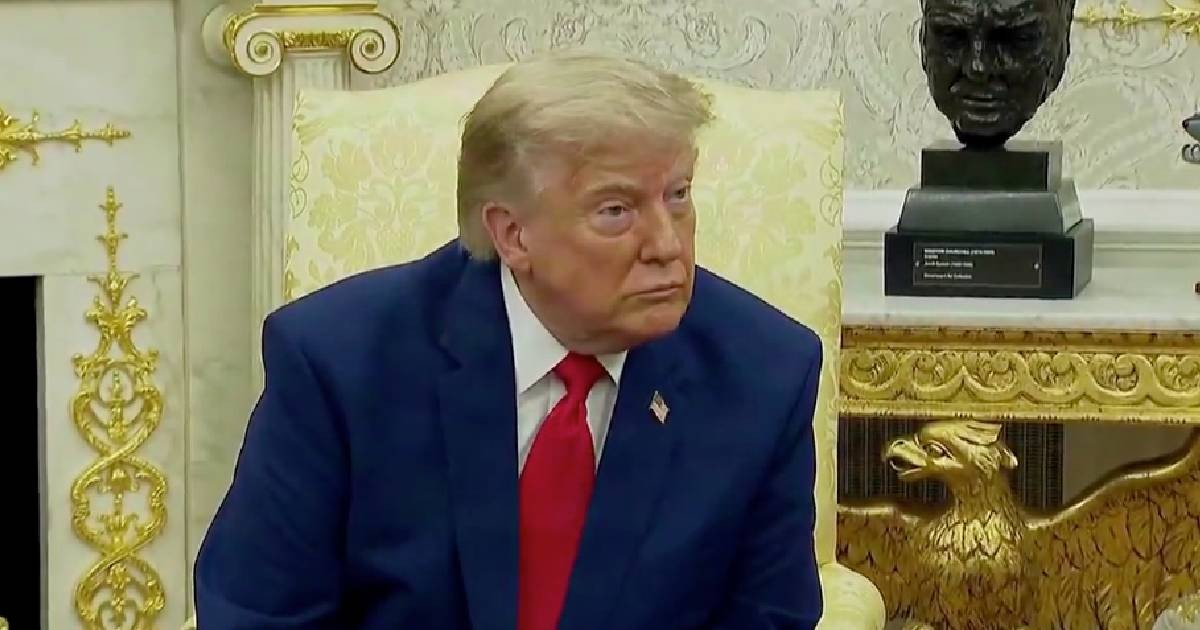
President Donald Trump warned on Tuesday that the United States will act if the Houthi rebels in Yemen carry out their threat to impose a maritime blockade in the Red Sea, according to reports from the EFE agency.
The statements were made during a meeting at the White House with Lebanese President Joseph Aoun, when a journalist asked the leader about his level of concern regarding a possible closure of that strategic route.
"Until now it hasn't happened. It could happen, but we will take care of the matter," Trump responded to the press.
The president recalled that his administration had previously used force against the group, resulting in a long period of calm. "There were about 45 days of very decisive actions we carried out against the Houthis, and we had no problems with them," he stated.
The warning comes a day after the Houthi military spokesman, Yahya Sarea, announced on Monday an immediate maritime embargo against vessels linked to Saudi Arabia in the Red Sea, with a threat to close the Bab al-Mandeb Strait, which is only 32 kilometers wide between Yemen and the Horn of Africa.
The commercial repercussions are already being felt: at least six ships turned back within the first 24 hours after the Houthi warnings, and two Saudi oil tankers headed for China and India changed their course toward the Suez Canal.
A complete closure of Bab al-Mandeb could reduce global oil supply by 7%, given the volume of Saudi exports that pass through that route.
Saudi Arabia, a key ally of Washington, condemned the Houthi announcement on Monday and promised to take "all necessary measures" to protect its vessels.
This escalation represents the most serious confrontation between Saudi Arabia and the Houthis since both sides began a rapprochement process backed by the UN in 2022, which dramatically reduced cross-border attacks without reaching a definitive peace agreement.
The breaking of that truce was triggered by the bombing of the airport in Sana'a on July 13, which the Houthis attributed to Saudi Arabia, although the internationally recognized Yemeni government admitted to executing the attack to prevent the landing of an Iranian aircraft carrying a Houthi delegation.
A blockade in the Red Sea would open a new front of regional tension at a critical moment: the U.S. and Iran signed a peace agreement in June that included the reopening of the Strait of Hormuz, but the Houthis, while allies of Tehran, are not part of that pact and maintain their operational autonomy.
Trump ordered bombings against the Houthis in March 2025, in the first military action of his second term, during a campaign lasting approximately 45 days that significantly reduced the group's activity.
At the same time, during the meeting with Aoun, Trump expressed his willingness to engage in dialogue with the Shiite group Hizbullah if the Lebanese president requested it. "If the president says he wants me to talk to Hizbullah, I will do it," stated the leader, who emphasized that "he talks to everyone."
Regarding the situation in Lebanon, Trump stated that the Israeli Army is proceeding with its withdrawal from southern Lebanon as part of the trilateral agreement signed on June 26 in Washington, although on that same Tuesday, Israeli forces opened fire near a unit of the Lebanese Army in Zawtar al-Gharbiya, one of the areas from which Israel had committed to withdraw.
"I just found out about that right before this meeting, so we will analyze it," Trump said regarding the incident.
Related videos:
Filed under: