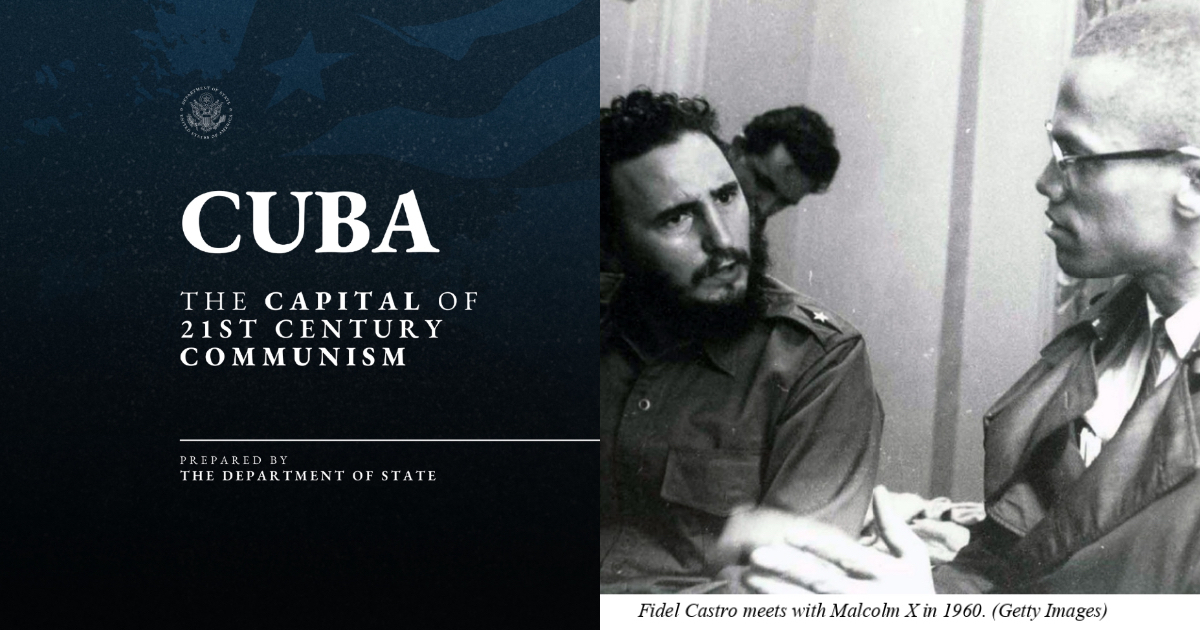
For decades, much of the debate about Cuba in the United States focused on the embargo, migration, human rights, or diplomatic relations. The report “Cuba: the capital of 21st-century communism”, released by the Department of State this Monday, offers a much deeper perspective. It does not merely denounce that there is a dictatorship in Cuba that violates human rights. It presents the Cuban regime as what it has always been: a strategic actor that, for more than six decades, has developed a systematic policy of espionage, infiltration, propaganda, and the expansion of its influence against the United States and Western democracies.
This precision in the narrative has significant implications. When the main diplomatic body of the United States stops describing the Cuban regime solely as a human rights issue and begins to define it as a strategic threat to national security, the foundations of U.S. policy are also shifting. There is a diagnosis of a danger that must be eliminated.
The report claims that Havana has not only repressed its own people, but has also sought to influence governments, institutions, universities, political organizations, and social movements in other nations. Furthermore, it links this strategy to the exportation of the authoritarian model to countries like Venezuela and Nicaragua, as well as cooperation with powers such as Russia, China, and Iran.
In practical terms, this could translate into increased sanctions against officials and state entities, an increase in investigations into intelligence networks and influence operations, closer surveillance of organizations linked to the Cuban state apparatus, and more intense cooperation with international allies to limit the regime's capacity for projection.
It is also predictable and logical that political support for independent civil society, human rights defenders, and media not controlled by the Cuban state will increase.
The report also holds historical significance. For years, there were deep divisions within Washington regarding how to interpret the Cuban regime. While some sectors viewed it primarily as a bilateral issue or a remnant of the Cold War, this document places it within the context of the 21st-century strategic competition between democracies and authoritarian regimes.
From this perspective, Cuba is no longer presented as an isolated actor but rather as a piece of a network of alliances with governments opposed to the West. This interpretation broadens the scope of the Cuban issue and facilitates the integration of policy toward the island into a larger national security strategy.
The document combines historical background, documented cases, and strategic assessments from the Department of State. In foreign policy, the significance of an official report lies not only in the evidence it gathers but also in the conceptual framework it provides to guide future decisions.
Administrations may change, but strategic documents often influence the formulation of public policies for years. In this regard, this report could serve as a reference point for Congress, intelligence agencies, and those responsible for U.S. foreign policy.
Beyond the specific measures that may be adopted, the political message is clear: the United States Government states that it no longer views the Cuban regime merely as a dictatorship that represses its citizens, but as a structure capable of projecting influence, conducting intelligence operations, and collaborating with other authoritarian regimes to the detriment of U.S. interests.
When a power redefines the nature of a threat, it typically also redefines its response to that threat. This may, in fact, be the most significant aspect of this report. While it does not alone announce a new policy, it does lay the intellectual and strategic groundwork upon which future decisions by Washington regarding the Cuban regime could be built, including the action that many have anticipated and that could finally put an end to that old and destructive cancer known as Castrocommunism.
The current U.S. policy towards Cuba is the most intelligent, effective, and humane we have seen. As the characteristics of the illness are defined with clinical precision and the best possible treatment is applied, aid to the oppressed people is increased and provided through independent channels: today, the first shipment of humanitarian aid amounting to 100 million dollars announced by the State Department was made.
The criminal Castro-communist tyranny must be condemned and overthrown, but the pro-democracy opposition that is persecuted and repressed, along with the people suffering oppression and extreme misery, need solidarity and effective assistance.
Related videos:
Filed under:
Opinion article: Las declaraciones y opiniones expresadas en este artículo son de exclusiva responsabilidad de su autor y no representan necesariamente el punto de vista de CiberCuba.