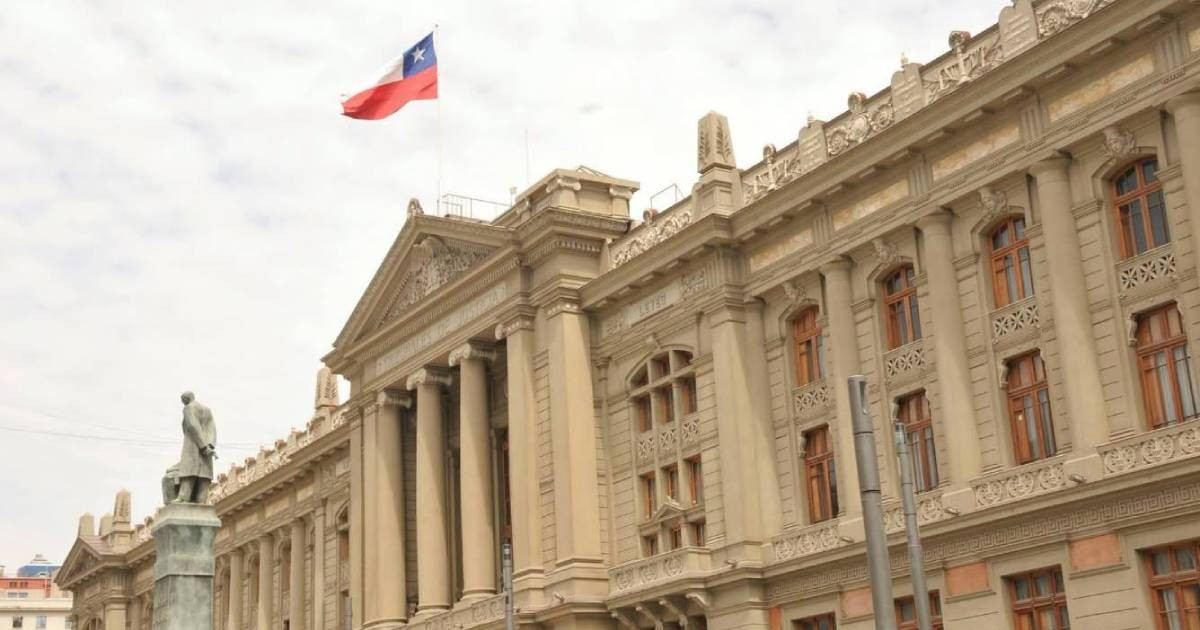
The Supreme Court of Chile revoked a ruling in favor of the Court of Appeals of Iquique and upheld the decision of the immigration authorities to deny the extraordinary temporary residency requested by a Cuban citizen, determining that his case did not meet the exceptional conditions outlined by the legislation.
With the ruling, the highest court nullified the order requiring the Undersecretary of the Interior to issue a new statement and upheld that the authority acted within the powers granted by the Migration and Foreigners Law, reported Diario Constitucional.
The Cuban had requested to be granted the exceptional procedure provided for in Article 155, numeral 9, of Law No. 21.325, which allows for the granting of temporary residence permits in qualified cases or for humanitarian reasons.
However, the Undersecretariat of the Interior rejected the request, concluding that the submitted evidence did not substantiate any of those circumstances. Subsequently, both that agency and the National Migration Service appealed to the Supreme Court to challenge the decision of the Court of Appeals in Iquique, which had deemed the administrative denial insufficiently justified and ordered a re-examination of the case.
In the ruling corresponding to Role No. 21,720-2026, the Supreme Court concluded that the administrative decision was indeed properly justified, as it identified the applicable regulations and explained why the applicant's circumstances did not constitute an exceptional or humanitarian case.
The court maintained that "the authority granted to the Undersecretariat of the Interior is exceptional, non-delegable, and highly discretionary," and that its exercise solely corresponds to that authority, within the framework established by the country's legislation and immigration policy.
It was also clarified that the protection remedy "does not serve as an instance intended to review the timing, merit, or appropriateness of an administrative decision, but solely its legality," meaning that the courts cannot replace the technical judgment of the administration when the decision is properly substantiated.
The decision marks a difference from a precedent set in July 2023, when the Second Chamber of the Supreme Court accepted a motion presented by two Cuban citizens in Valparaíso and ordered that they be given a 60-day period to rectify the required documentation. On that occasion, the court deemed that the actions of the Undersecretary of the Interior had been arbitrary due to a lack of justification, a circumstance that, according to the current ruling, is not present in this case.
Beyond the specific situation of the applicant, the ruling reinforces the criterion that courts can review the legality of immigration decisions, but they cannot override the judgment of the authority when it exercises discretionary power in accordance with the law and adequately justifies its decision.
The resolution also holds significance for the Cuban community residing in Chile. According to data from the National Migration Service and the National Institute of Statistics, the country is home to over 21,300 Cuban citizens, with a notable presence in the Tarapacá region, where this case originated. Between 2014 and 2024, Chilean authorities granted 19,265 temporary residencies to Cuban nationals, within a context of gradual tightening of migration policies.
With this ruling, the Supreme Court strengthens the decision-making power of the administration in granting extraordinary residencies and limits judicial intervention to cases where there is clear evidence of manifest arbitrariness or a significant violation of the law.
Related videos:
Filed under: