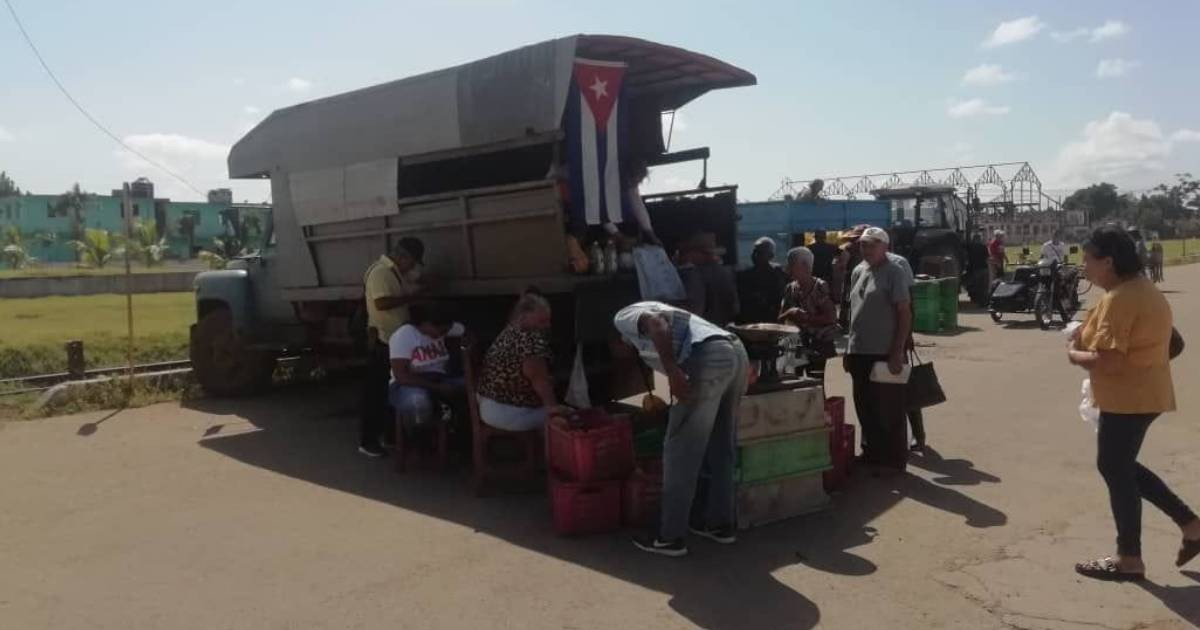
A sale of agricultural products held this Wednesday in front of the Unión de Reyes terminal in the province of Matanzas caused discontent among buyers after sellers categorically rejected payments via electronic transfers.
The complaint was made on Facebook by journalist Hanoi Moreno Enríquez, who stated that when he tried to make a payment through a digital platform, he received a clear response. “A resounding ‘no,’” he wrote.
According to the complainant, this refusal "not only impacts consumer comfort but also contradicts the official policy of computerization and modernization of services in Cuba."
Moreno Enríquez stated that the State itself has promoted the digitalization of transactions as part of its economic strategy and argued that rejecting electronic payments sends "a contradictory message that undermines citizen trust in the modernization process."
In his post, the citizen recalled that Resolution 111/2023 from the Central Bank of Cuba (BCC), amended in 2026, regulates digital payments and promotes their use within the national strategy for banking.
He also stated that this regulation includes real-time accreditation of electronic transactions and introduces incentives for businesses and consumers who use Online Payment.
A policy that fails to assert itself
What happened in Unión de Reyes is not an isolated case. Despite the Cuban government promoting banking and the use of electronic payments for years, the majority of commercial transactions in the country continue to be conducted in cash.
Data released in July 2026 indicates that only 3.77% of transactions in Cuba are conducted through digital means. In provinces like Sancti Spíritus, less than 10% of private businesses regularly accept transfers, while in Matanzas, many establishments only allow this payment method for certain amounts or impose surcharges deemed illegal, ranging from 10% to 30%.
The situation contrasts with the current regulatory framework. The established a limit of 5,000 pesos for certain cash transactions among economic actors; the required agricultural cooperatives to offer electronic payment methods, and the Resolution 16/2026 of the Ministry of Agriculture mandated that agricultural marketing operations be conducted through banking instruments.
Reality surpasses the norms
In practice, many vendors claim they need cash to purchase goods from suppliers who also do not accept transfers, creating a parallel economic circuit that complicates the enforcement of official regulations.
The magnitude of the problem was acknowledged even by the state media Cubadebate, which on July 14 admitted that "the street has already built its own parallel financial system".
In light of the limited impact of the coercive measures, the Central Bank recently modified its strategy. Since July 20, the Resolution 74/2026 has been in effect, which indefinitely suspended the 5,000 pesos limit on cash transactions and introduced incentives to encourage electronic payments.
Among the new measures are a reduction of the commission for businesses from 1.5% to 0.8%, the elimination of fees for cash deposits, and a 4% bonus for consumers who make purchases over 5,250 pesos through digital channels.
The contradictions persist
Despite these changes, the implementation of the policy remains uneven.
On July 21, authorities in Guantánamo warned that penalties could be imposed on sellers who refuse electronic transfers, while in Unión de Reyes, buyers continued this Wednesday unable to use their mobile phones to pay for agricultural products.
Moreno Enríquez believed that this inconsistency ultimately undermines the credibility of the government's own strategy.
"The State, which promotes digitalization, must be the first to set an example by accepting digital payments. Otherwise, it undermines the credibility of its own policy and limits citizens' rights," he concluded.
Related videos:
Filed under: