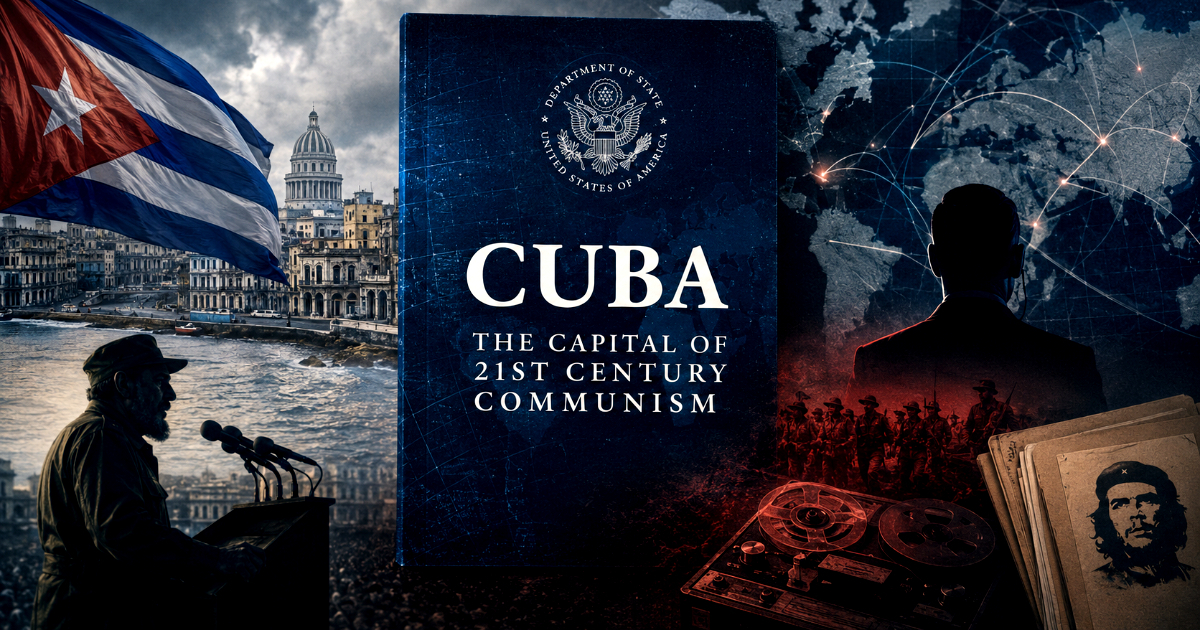
When the State Department released the report «Cuba: the capital of 21st-century communism», many of the facts it presents were already known.
The Cuban military presence in Africa, support for Latin American revolutionary movements, the close relationship with the Soviet Union, the alliance with chavismo, and cooperation with Russia and Iran are part of an extensive bibliography and a political debate that has been ongoing for decades.
However, reducing the document to a compilation of historical episodes would overlook its most intriguing aspect.
The report does not aim merely to recall the past. It reorganizes it. It takes events separated by more than sixty years, arranges them according to a specific logic, and transforms them into a coherent explanation of Cuba's position in the current world.
That way of constructing the narrative is, probably, the main novelty of the document.
A structured narrative to demonstrate a thesis
Unlike many government reports, which are typically structured by thematic areas or geographic regions, "Cuba: The Capital of 21st Century Communism" presents a progressive argument. Each chapter sets the stage for the next. Each historical episode adds a piece to a larger construction.
The revolution of 1959 serves as the starting point. The alliance with the Soviet Union provides resources and international reach. Military campaigns in Africa and support for Latin American guerrillas illustrate the regime's export-oriented agenda.
The collapse of the Soviet bloc forces a redefinition of the strategy. Venezuela provides a new regional platform. Ultimately, relations with Russia, China, and Iran are presented as the contemporary evolution of that same project.
Seen this way, the chronology ceases to be a mere sequence of events. It transforms into a narrative.
The report does not encourage the reader to interpret each stage separately. It leads them towards a broader conclusion: that there is a line of continuity between the harmful revolutionary internationalism of the 1960s and 21st century Cuban foreign policy.
The "revolution" ceases to be the center
That shift in perspective also changes the role that the so-called "Cuban revolution" plays within the narrative.
In many historical interpretations, the revolution is the central fact, and foreign policy emerges as a consequence of it.
The report partially reverses that relationship. The revolution remains the origin of the process, but its true interest lies in having created a structure capable of projecting itself internationally for decades.
For this reason, it dedicates relatively little space to internal debates about the economic model or social transformations on the island. Its attention is focused on what it considers permanent: the construction of political influence beyond national borders.
Military campaigns, international cooperation, diplomatic alliances, and support for revolutionary movements do not appear as situational responses to different historical moments. The document integrates them within the same pattern of behavior.
The idea that ultimately prevails is that the Cuban regime never conceived its survival solely in national terms.
From his earliest years, he would have understood that his stability also depended on creating allies, extending ideological affinities, and developing a much greater international presence than what the country’s economic dimensions would allow.
Intelligence as a guiding thread
The chapter dedicated to intelligence services occupies a central place within that architecture.
Under the title "An Empire of Espionage," the report states that the Intelligence Directorate (DI) managed to develop a disproportionately large operational capability compared to the size of Cuba and positions it among the key tools for the regime's international projection.
But the interest of the chapter lies not only in describing espionage operations. Its purpose is much broader.
Intelligence emerges as the element that links all the other dimensions analyzed in the document. Diplomacy, international cooperation, academic relations, political training, international solidarity, and ideological influence cease to be separate compartments to become part of a single network.
The report even emphasizes that a significant part of that effectiveness relied on the ideological commitment of its agents, defined as true believers, convinced they were serving a political project rather than a conventional bureaucratic structure.
Regardless of whether this characterization may spark debate, it serves a very clear narrative function: to explain why a country with limited resources has managed to maintain an influence greater than one would expect based on its economic weight for decades.
Networks replace alliances
Another distinctive feature of the document is that it barely speaks of alliances in the classical sense of the term. Instead, the idea of a network appears constantly.
The Cuban Institute of Friendship with the Peoples (ICAP) is described as "the central link of the entire Cuban network of intelligence and influence". It is not merely presented as an institution dedicated to international solidarity, but as a key player capable of connecting organizations, political leaders, academics, activists, and social movements from various countries.
This same approach is reflected in other sections of the report.
Universities, exchange programs, solidarity brigades, international meetings, and related organizations are analyzed less for their specific activities than for the role they occupy within a relationship structure built over decades.
The effect is significant.
Cuba's international influence no longer solely depends on agreements between governments. The report outlines a much broader network, comprised of both state and non-state actors, whose strength lies precisely in their ability to withstand political changes and maintain long-term connections.
From Castroism to the 21st Century
The transition proposed in the report between the end of the Cold War and the present day represents another of its fundamental axes.
Instead of presenting the disappearance of the Soviet Union as a definitive break, the document interprets it as a phase of adaptation.
The alliance with Venezuela holds a crucial place in this historical reconstruction. According to the report, the arrival of Hugo Chávez to power allowed Havana to regain its capacity for regional influence and develop a new form of political, economic, and intelligence cooperation.
From there, the narrative progressively incorporates Russia, China, and Iran.
They do not appear as independent relationships, but rather as components of the same geopolitical configuration in which Cuba would act as a connecting point between different actors opposed to the United States.
The chapter dedicated to Iran is particularly illustrative of this logic as it describes decades of political, intelligence, and technological cooperation between the two governments.
It is precisely that continuity that explains the title of the report.
To speak of 'The capital of 21st-century communism' does not merely mean stating that Cuba remains a communist state.
It means asserting that the regime has managed to adapt the tools of influence developed during the Cold War to the new international context and transform them into a strategic asset for a new stage of competition among great powers.
A document designed to guide the perspective
The strength of the report does not depend on each of its arguments being irrefutable. As is the case with any document of a strategic nature, some of its interpretations may be debated by historians, intelligence specialists, or experts in international relations.
Its significance lies elsewhere.
The Department of State does not present a collection of scattered events. It articulates them within the same interpretative framework.
Revolution, intelligence, diplomacy, international solidarity, the training of personnel, and geopolitical alliances cease to appear as independent phenomena to merge into a single narrative about the international role of the Cuban regime.
That exercise in synthesis helps to understand why the report acquires a meaning that transcends the academic or historical realm. More than offering a new history of Cuba, it proposes a new way to read it.
And, in international politics, the way a government organizes the events of the past is often as revealing as the decisions it makes in the present.
Related videos:
Filed under: