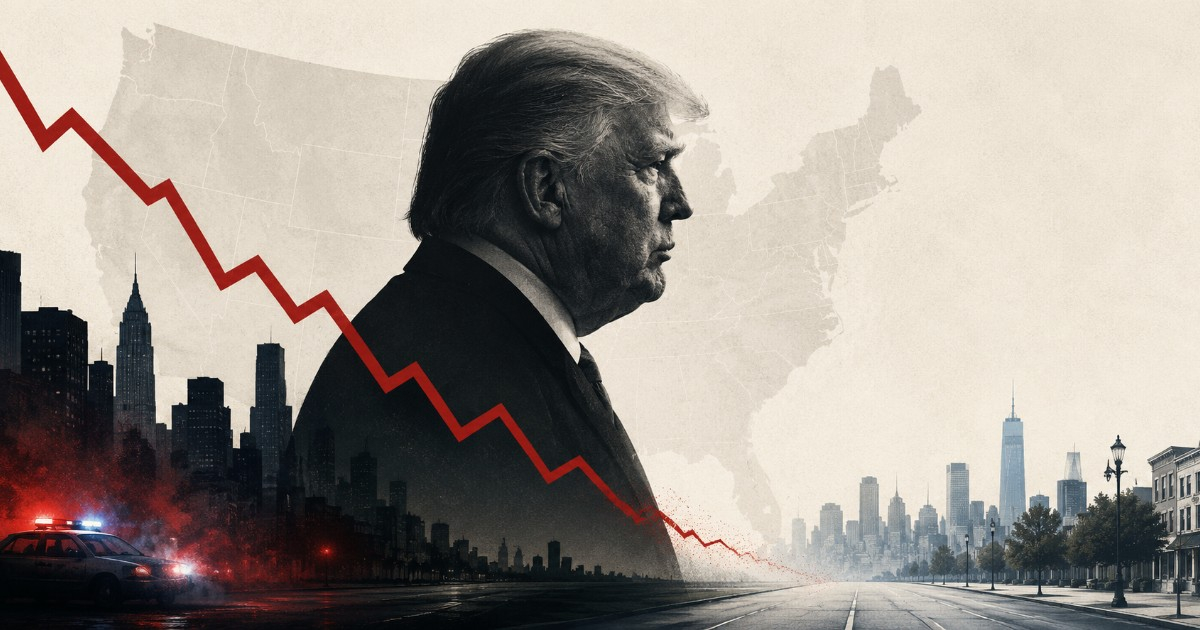
The United States could end 2026 with its lowest homicide rate in over a century, according to a new report from the Council on Criminal Justice published this Thursday, which documented an 18% decrease during the first half of the year compared to the same period in 2025, months during which President Donald Trump has enforced a stringent immigration policy.
The analysis, conducted by the Council on Criminal Justice —an independent and nonpartisan center— gathered data from 30 U.S. cities and estimated that the reduction amounts to approximately 215 fewer homicides.
If the trend continues until December, the country could reach homicide levels not seen in over a hundred years, although final data will not be available until the end of the year.
The report tracked 13 categories of crimes and recorded declines in nine of them, including car thefts, residential burglaries, and aggravated assaults.
A particularly relevant fact is the 23% drop in the lethality of violent crimes, measured by the proportion of serious offenses that result in fatalities, indicating that not only are there fewer crimes, but those that do occur are less deadly.
Burglaries in residences fell by 13% compared to the previous year and by 50% compared to the levels before the pandemic in 2019.
Not everything was positive: thefts in stores increased by 5%, and there were smaller rises in domestic violence, sexual assaults, and drug-related crimes.
The president and CEO of the Council, Adam Gelb, emphasized that the improvement spans cities with very different political leadership, economic conditions, and security strategies.
"Crime rates are declining across the board, in cities with different political leaderships, varying housing and economic conditions, diverse police strategies, prosecution approaches, and violence reduction initiatives, as well as differing levels of federal law enforcement activity," he noted.
"This is one of the most significant advancements in public safety in decades. It means that lives are being saved, families are being spared from trauma, and communities are regaining stability," Gelb concluded.
Trump Effect?
In a midterm election year, Democrats and Republicans are trying to capitalize on the improvement.
According to John Roman, the conservatives connected to President Donald Trump might highlight the tightening of immigration measures and the deployment of the National Guard in cities like Los Angeles and Memphis, while the liberals could point out the public safety legislation promoted during Joe Biden's administration.
However, John Roman, director of the Center for Public Safety and Justice at the University of Chicago, points to factors that transcend any administration: the reduction of drug use —which decreases violence linked to illegal markets— and federal funding post-pandemic allocated to social programs.
These funds, Roman explained, financed jobs such as teachers and social workers who assist "young people at the highest risk of violence and victimization."
The landscape was not uniform. Nearly one third of the analyzed cities recorded increases in homicides.
Norfolk, Virginia, experienced a 64% increase, followed by San Francisco with a 55% rise.
In contrast, Lincoln, Nebraska, recorded a 100% reduction during the first six months of 2026 compared to the same period in 2025.
This positive trend is set against a sustained decline since the pandemic peak: homicides had already decreased by 21% in 2025 compared to 2024, which represented 922 fewer lethal crimes across 35 cities, and an accumulated drop of 44% since the peak in 2021.
Related videos:
Filed under: