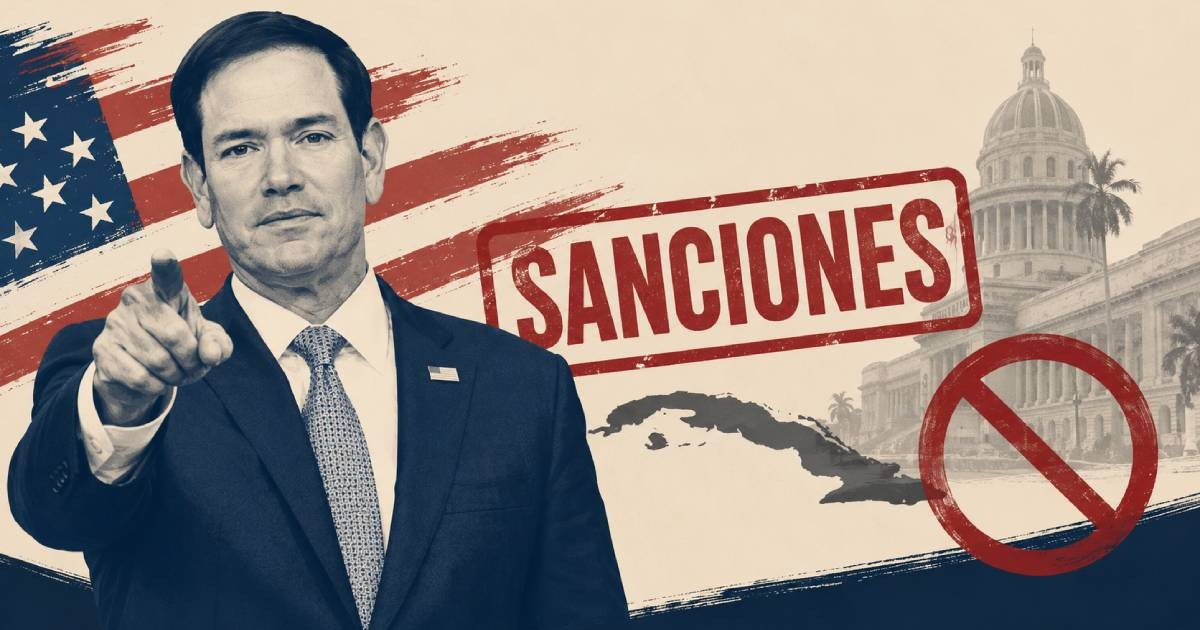
The U.S. Secretary of State, Marco Rubio, fulfilled on Thursday a promise he has been reiterating since May: to maintain and intensify pressure on the Cuban regime until political and economic changes are forced. His most recent decision was to announce a new round of sanctions against nine entities and two high-ranking officials, aimed at targeting three strategic pillars of power on the island: GAESA, the energy sector, and the medical mission program abroad.
The new designations were adopted under Executive Order 14404, signed by President Donald Trump on May 1, 2026, which authorizes sanctions against individuals and entities linked to repression in Cuba and activities considered a threat to the national security of the United States.
"The Cuban communist regime continues to exploit its people and act as the main sponsor of radical leftism and political violence in our hemisphere," Rubio stated when announcing the measures.
New blow to GAESA
An important part of the sanctions is once again aimed at GAESA, the military conglomerate that controls a significant portion of the Cuban economy, which Washington accuses of trying to evade U.S. restrictions by reorganizing its companies.
The State Department cited as an example the transfer of administration of the Port of Mariel to Coral Marítima S.A., an operation carried out in June that, according to Washington, aimed to protect the conglomerate's assets from sanctions.
For this reason, Terminal de Contenedores de Mariel S.A., Coral Marítima S.A., CEIBA Investments Limited, and ORBIT S.A., a remittance processing company that the U.S. government considers "almost certainly" controlled by GAESA, were designated.
The measures also affect the Centro de Investigaciones del Petróleo S.A. (CEINPET), the research arm of the already sanctioned CUPET, as well as ENERSA S.A. and EINARBO S.A., companies engaged in the importation of gas and lubricants.
Washington believes that these entities are part of the infrastructure that supports the regime's energy system.
Medical missions are once again under pressure
The new round of sanctions also impacts the medical services export program, which the United States classifies as a form of forced labor and human trafficking.
The Cuban Medical Services Marketing Company S.A. (CSMC) and the Central Unit for Medical Cooperation (UCCM) were designated, along with the Minister of Public Health, José Ángel Portal Miranda, and the director of the UCCM, Gretza Sánchez Padrón.
According to the State Department, the Cuban regime retains between 50% and 95% of the salaries that recipient countries pay for the services of Cuban doctors.
The sanctions announced this Thursday represent a new chapter in a strategy that Rubio outlined at the beginning of the implementation of Executive Order 14404.
On May 7, after imposing sanctions for the first time on GAESA and Moa Nickel S.A., the Secretary of State warned that the Trump administration "will continue to take actions until the regime adopts all necessary political and economic reforms".
Eleven days later, on May 18, he expanded the sanctions to 11 high-ranking officials of the regime, the Intelligence Directorate (DGI), and other state agencies, and issued a new warning: “Additional sanctioning actions are expected in the coming days and weeks”.
Rubio fulfilled that promise again on June 11, when he sanctioned CUPET, labeling the state oil company as one of the main instruments used by the regime to maintain its repressive apparatus.
On that occasion, he stated that "we will continue to attack the capability of the communist regime to use its energy trade to promote its corrupt agenda and violently suppress the Cuban people."
The new designations come just days after the Department of State itself published the report “Cuba: The Capital of 21st Century Communism”, a document of about 100 pages that details seven decades of Cuban subversion, which Rubio explicitly mentioned as the context for the new measures.
With the measures announced this Thursday, the Trump administration maintains the roadmap that Rubio has supported in recent months: to progressively increase economic pressure on the main sources of revenue for the Cuban regime and on the organizations that, according to Washington, sustain its political, military, and repressive apparatus.
Related videos:
Filed under: