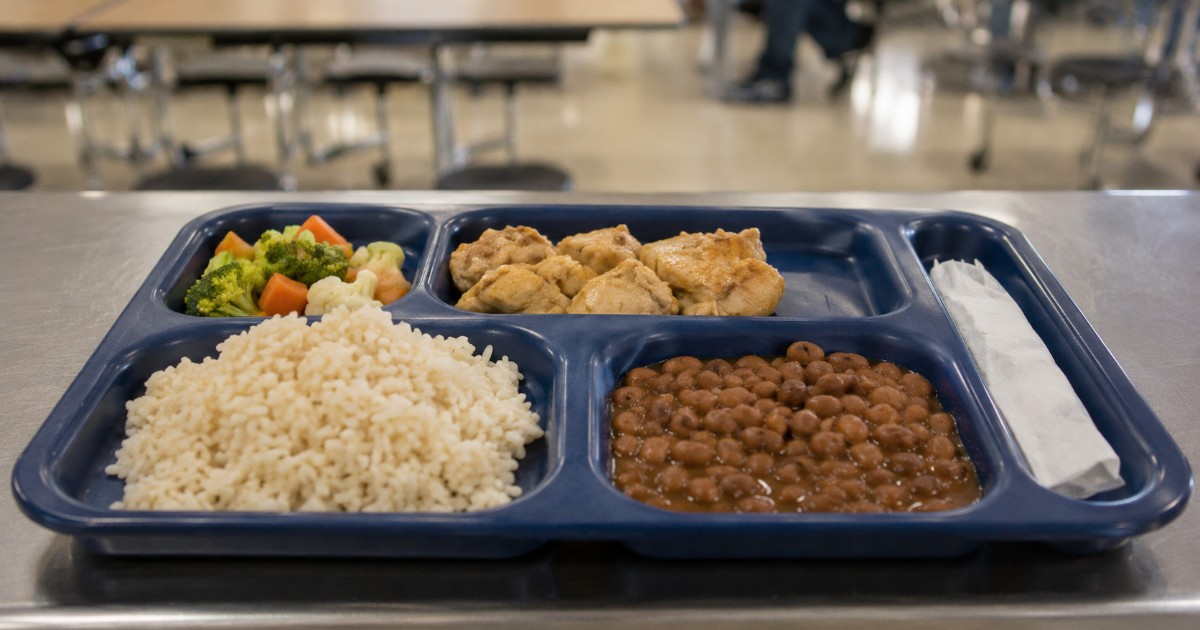
The Miami-Dade school board approved on Wednesday to end universal free lunch for students who do not meet the requirements for full or partial assistance, thus concluding four years of federal coverage for the entire district.
The change will take effect during the 2026-2027 school year, the full lunch price will be 4.20 dollars, while breakfast will cost 2.50 dollars for those who need to pay for it.
However, breakfast will remain free for all students from kindergarten through eighth grade.
Under the new model, 121 schools in the system will continue to offer free meals to all their students, as they individually meet the federal threshold.
Students who are directly certified through assistance programs will not need to submit an application; other potentially eligible families will be able to apply for the benefit starting on August 10.
Approximately 30% of students qualify for reduced-price meals: 40 cents for lunch and 30 cents for breakfast. The eligibility applications will open on August 10.
The trigger for the measure is the decline in the percentage of students who are "directly certified" in the district, meaning those whose families participate in federal assistance programs such as SNAP or Medicaid.
In 2022, that percentage was 64%, above the federal threshold of 62.5% that requires the government to fund meals for all students. An analysis conducted this year revealed that this figure has fallen to 45.1%.
According to Luis Díaz, the director of operations for the district, the decline in direct certification is due to families leaving because of the high cost of living, the decrease in the number of immigrant students, and changes in federal welfare regulations.
Díaz stated that the district will use the parent portal and will train the staff of each school to assist families in the process.
"We are trying to use every possible angle to minimize the cost impact for the coming year, because there hasn't been any over the last four years. But the reality is that there is a financial burden, and we must be responsible about it," he stated.
Among the changes noted by Díaz, the "One Big Beautiful Bill Act" stands out, enacted on July 4, 2025, with the support of President Donald Trump and the Republican majority in Congress, which cut federal funding for SNAP and will reduce Medicaid funding next year.
A report by the Florida Policy Institute documented a 10% decline in the case load of SNAP in Miami-Dade between July and December 2025.
The impact is especially significant for Latinx and immigrant families in the county.
The enrollment of new immigrant students in Miami-Dade has plummeted from 7,193 in the previous cycle to just 1,847 in 2025-2026, which has directly contributed to the decrease in the percentage of students certified for federal assistance.
Related videos:
Filed under: