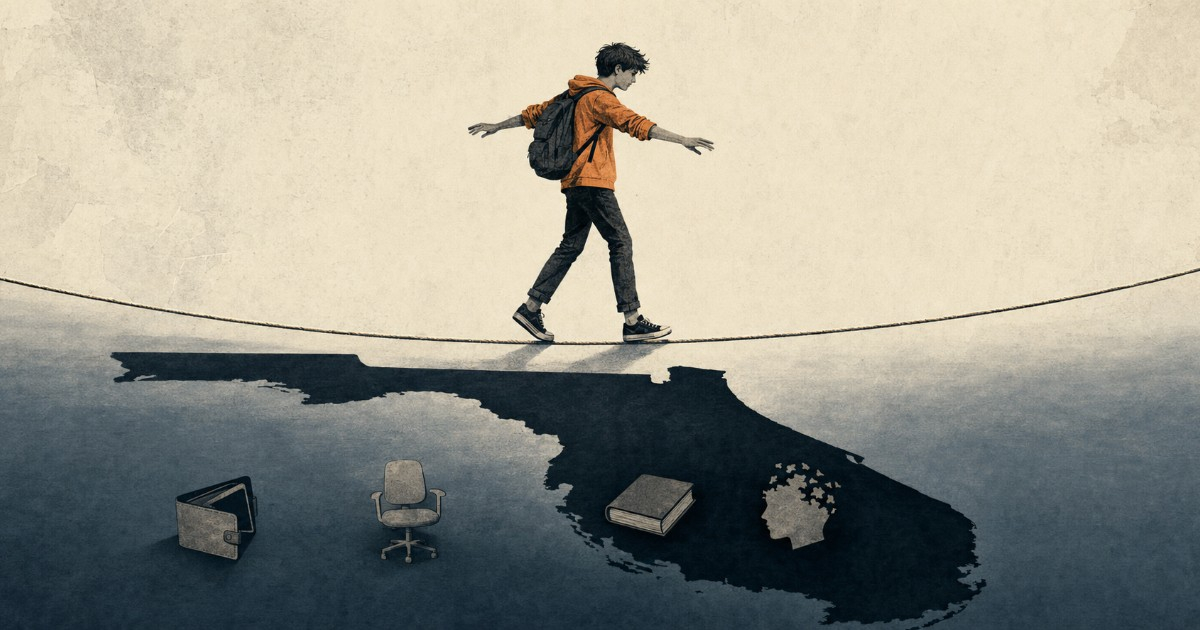
Growing up in Florida can be more challenging than its image of sunshine, beaches, and opportunities suggests. A new study positions the state in a troubling median ranking nationally concerning at-risk youth, while other indicators reveal stagnant employment and a concerning academic decline.
Florida ranks 28th among the 50 states and the District of Columbia, with a score of 41.75 out of 100, where higher values indicate a greater level of risk for young people.
The study by WalletHub compared the 51 jurisdictions using 15 indicators grouped into two categories: Education and Employment, which account for 60% of the total weight, and Health, which makes up the remaining 40%. The data used had been collected up until June 24, 2026.
The indicators include youth poverty, teenage pregnancy, school dropout, labor participation, lack of housing, incarceration, obesity, drug and alcohol use, depression, and limitations caused by physical or emotional problems.
In Education and Employment, Florida ranks 19th, where the first position represents the worst conditions. The result reflects greater difficulties in areas related to the integration of young people into the labor market, the continuation of studies, and economic stability.
The situation changes in Health, a category in which Florida ranks 44th. Since the top positions correspond to the worst results, that position is roughly equivalent to the eighth most favorable performance among the jurisdictions examined.
At the national level, 13% of individuals aged 18 to 24 are neither studying nor working, according to data from the National Center for Education Statistics cited by WalletHub.
Chip Lupo, an analyst at WalletHub, warned that a high proportion of young people not in the workforce or the education system could jeopardize the future of the states.
According to Lupo, authorities must invest more in improving the conditions of young residents. If they fail to do so, he warned, "the future economic and social progress of the state is at risk."
At the most critical end of the youth at risk ranking are Louisiana, with 64.04 points; Arkansas, with 60.38; and Oklahoma, with 60.18.
Louisiana tops the ranking because 16.6% of its young people aged 18 to 24 are neither studying nor working and do not possess a qualification beyond a high school diploma.
The state also has the second highest youth poverty rate and the third highest teenage pregnancy rate in the country.
At the opposite end are New Jersey, in 51st place with 24 points; Massachusetts, in 50th place with 29.19; and Connecticut, in 49th place with 29.27. According to the indicators used by WalletHub, these are the jurisdictions with the lowest level of risk for youth.
Florida does not appear among the states with the most critical situation, but it is also not close to the best.
Its intermediate position, combined with the stagnation of adolescents who neither study nor work and the last place in reading recovery, presents a scenario with significant challenges for the future of its youth.
The platform also uses a more specific definition of "disconnected youth": individuals aged 18 to 24 who are neither studying nor working and do not hold a qualification higher than a high school diploma.
In Florida, another study shows that the problem remains stagnant among adolescents. The KIDS COUNT 2026 profile, produced by the Annie E. Casey Foundation, highlights that 7% of young people aged 16 to 19 were neither studying nor working in 2024, the same proportion recorded in 2019.
Although the ages and definitions of both reports are different, the results point to a persistent challenge: thousands of young people in Florida remain simultaneously disconnected from both the classroom and the labor market.
The academic results worsen the situation. The Education Scorecard, created by researchers from Harvard, Stanford, and Dartmouth, placed Florida in last place among the 35 states evaluated in academic growth in reading from 2022 to 2025.
The average student in Florida was approximately 0.58 grades below the level of 2022 and 0.69 grades below the level recorded before the pandemic in 2019.
The performance in mathematics was less negative. Florida ranked 24th out of the 38 states evaluated and achieved a modest recovery compared to 2022, although it remained nearly half a grade below the levels of 2019.
The situation contrasts with other studies that present a seemingly more favorable image of Florida. The state ranked 14th in the state happiness index by WalletHub for 2026, but none of its evaluated cities made it into the top 40 in the country.
Cape Coral was the best-positioned city in Florida, ranking 41st, followed by Pembroke Pines at 42nd. Jacksonville recorded the worst result in the state, placing 125th among the 182 cities evaluated.
Related videos:
Filed under: