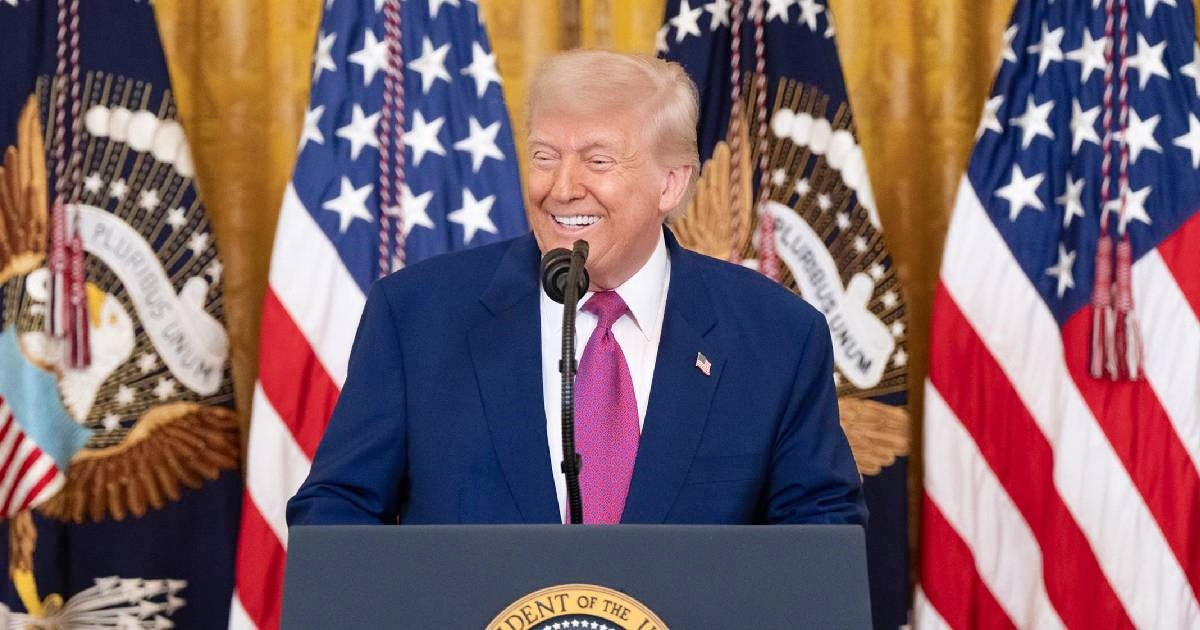
The president Donald Trump signed an executive order this Thursday to impose tariffs ranging from 10% to 12.5% on 60 countries and economies, including members of the European Union, the United Kingdom, India, Japan, South Korea, and Mexico, effective from midnight on Friday.
The measure, reported by El País and CNN Español, comes just as the universal 10% tariff that Trump implemented in February 2026 was about to expire in response to the Supreme Court ruling that declared his reciprocal tariffs from the so-called "Liberation Day" illegal.
This time, the White House turned to Section 301 of the Trade Act of 1974, which allows for the imposition of tariffs on countries with "unfair, unjustifiable, or discriminatory" trade practices and, unlike the previous regulations, has no expiration limit and does not require Congressional approval to remain in effect.
The official justification is that those 60 trading partners did not take sufficient measures to curb imports produced through forced labor.
The countries that took some action in that direction —including Canada, Mexico, EU members, the United Kingdom, India, and Indonesia— are subject to the lowest rate of 10%, while the rest will face 12.5%.
According to the Office of the U.S. Trade Representative, goods from the affected countries account for 99.4% of total imports into the United States, making this measure the most far-reaching of Trump's entire tariff offensive.
A senior White House official stated that "the president will not allow his trade policy and overall objectives to be undermined simply because a tool may be restricted by a court or something else."
Another government official added, "We've heard loud and clear: people want to know what the tariff rate they will be paying will be."
Exemptions were granted for oil and gas, products not available in the country, goods covered by the Mexico-United States-Canada Agreement (USMCA), pharmaceuticals, aerospace components, and certain raw materials.
For most American consumers, the immediate impact on prices would be limited, as the new tariffs replace those that importers were already paying; however, analysts warn that this could change in the coming months.
The new round is part of a sustained trade escalation: last Monday, Trump imposed a 50% tariff on Canadian products effective from August 19, and on July 16, he established a 25% tax on Brazil, accusing President Lula da Silva of negotiating in "bad faith."
The process that led to the new tariffs began on June 2, 2026, when the Office of the United States Trade Representative published its findings from 60 investigations and opened a public comment period that closed on July 6, with hearings the following day.
The Secretary of Commerce, Jamieson Greer, also opened a second case against 16 countries accused of overproduction —including China, Mexico, and the EU— which anticipates a possible new round of tariffs in the coming months.
The administration is also tasked with the renegotiation of the USMCA, signed in 2020, and faces midterm elections in four months, with polls reflecting a growing public dissatisfaction with Trump's economic policies.
"The true message that everyone must understand is that the president will always use the tools at his disposal to achieve his trade policy objectives," concluded a senior White House official.
Related videos:
Filed under: