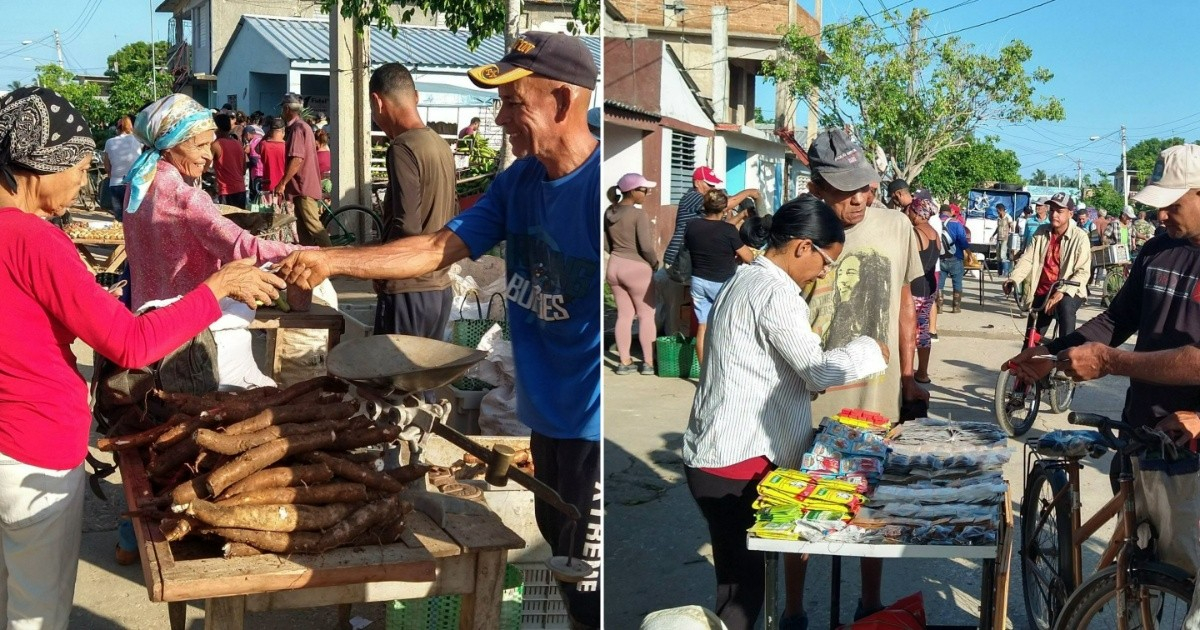
The Cuban regime organized agricultural, commercial, and cultural fairs this Saturday in Bayamo and Manzanillo, in the province of Granma, as part of the official events commemorating the 73rd anniversary of the assaults on the Moncada and Carlos Manuel de Céspedes barracks.
While the state press Radio Bayamo celebrated the event as "a tangible example of how the integration between economy, culture, and society can strengthen local identity," the Cubans who attended or followed the coverage on social media shared a very different story.
In Bayamo, the event took place on Felino Figueredo Avenue, featuring participation from state agro-industrial companies and private enterprises. The most sought-after products included root vegetables, greens, grains, fruits, consumer rice, roasted pork, and household items. In Manzanillo, the venue was Primero de Mayo Avenue, where images published by Radio Granma Manzanillo displayed, among other items, air fresheners at 625 Cuban pesos (CUP) each.
The question that many asked was direct and straightforward. "Did the prices of the offers correspond to the per capita salary of the Cuban?" wrote the user Andy Luis Torres Rivera in the official post of Radio Bayamo.
The response, although not coming from the state broadcaster, is provided by the very economic reality of the Island: the minimum wage in Cuba was set at 3,210 CUP per month as of July 1, 2026, equivalent to less than five dollars at the informal exchange rate. The official average salary is around 7,074 CUP, while the estimated cost of covering a family's basic needs ranges between 50,000 and 96,000 CUP per month, according to estimates from June 2026.
Other comments on social media were even more forceful. "Please stop spreading so many lies; the Cuban people are dying of hunger and misery while you publish falsehoods—enough already," denounced Reinier Rodriguez Vega.
Carlos Hechavarria pointed out another specific problem: "Very nice in the photo. Nothing at all. High prices, expensive, imposed when paying by transfer."
Nieves Báez Reyna directly refuted the extent that the official press attributed to the event: "I apologize, but it wasn't like that; there was no such comprehensive fair in Río Cauto."
The pattern is not new. In Las Tunas, a farmers' market held on July 5 was reported by state media as "a challenge to resistance," but citizens labeled it "the fair of misery" and "a theater." In Trinidad, on July 14, a Cuban woman faced a crowd to buy meat at 800 CUP per pound. In June, a basic purchase at a neighborhood market cost 21,060 CUP, more than three times the average monthly salary.
The Cuban regime uses the July 26 fairs as a political showcase, projecting an image of normality and abundance that contrasts with the food crisis faced by the population. In Granma, the government organized food fairs in 2025 following protests in Bayamo, which highlights the instrumental use of these events to manage social discontent.
While the state media described this Saturday a "dynamic evolution of the local economic sector," ordinary Cubans continued to face a reality where food prices keep rising and the minimum wage hardly covers a few days of basic shopping.
Related videos:
Filed under: