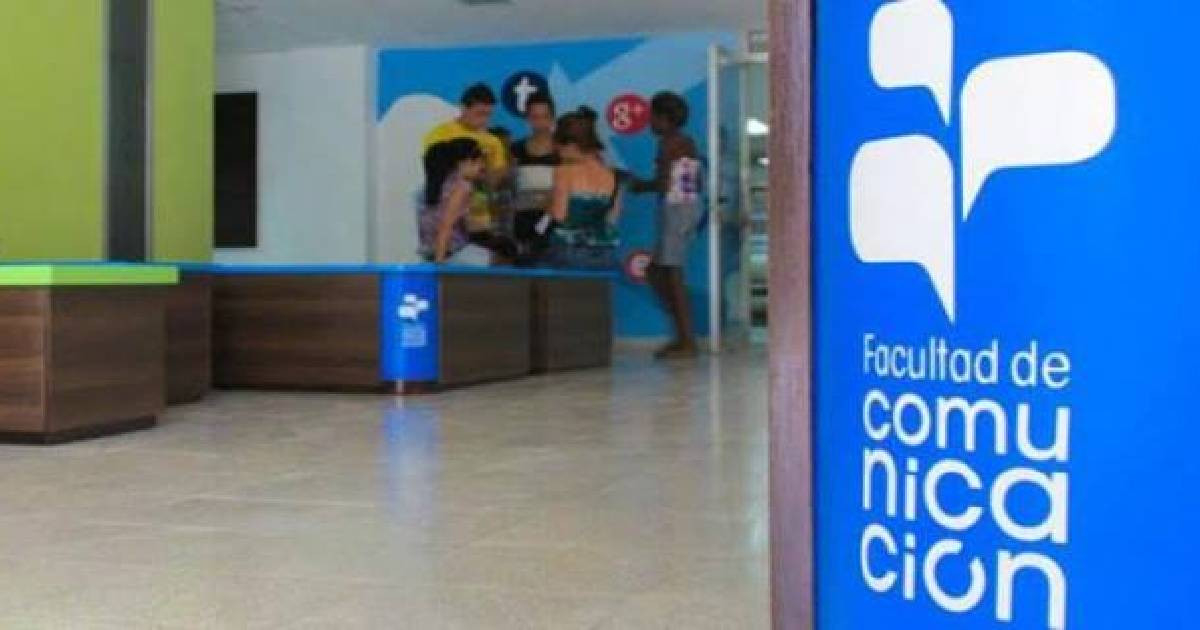
The VI Plenary of the National Committee of the Cuban Union of Journalists (UPEC), which was held on Tuesday via videoconference, openly acknowledged that fewer and fewer young Cubans want to study Journalism, while the regime insists on "winning over" the few graduates to defend "the truth of the Revolution."
The session was chaired by Luis Morlote Rivas, deputy head of the Ideological Department of the Central Committee of the Communist Party, and Ricardo Ronquillo Bello, president of the UPEC. Both discussed the low enrollment in the Faculty of Communication and the limited attendance at the aptitude tests for entering the program, reported the Cuban News Agency.
Far from questioning the model, Morlote urged to "engage them in the commitment to defend the truth," referring to the young people who arrive at state editorial offices after graduation.
In 2025, only two eleventh-grade students presented themselves for the aptitude exam at the Manuel Ascunce Domenech campus of the University of Ciego de Ávila. Furthermore, only 49% of enrolled students manage to graduate; most drop out for economic reasons.
Apathy has a salary-related explanation that is hard to ignore. At the end of May, the once highly selective Canal Habana, the provincial television station of the Cuban capital, published a call on Facebook to incorporate new talents into its journalistic team, at a time when state media in Cuba are facing an unprecedented structural crisis in attracting and retaining professionals.
In April, the official media outlet Cubadebate published a job offer for web journalist-editors with a base salary of 5,060 Cuban pesos per month, equivalent to less than 10 dollars at the informal exchange rate, a figure that generated widespread ridicule. In contrast, workers in hotel construction can earn between 32,000 and 40,000 pesos.
This is compounded by the fact that starting from the 2024-2025 academic year, women choosing Journalism must complete one year of Mandatory Military Service, a requirement unprecedented in other Cuban university programs.
The assembly itself acknowledged that the energy crisis worsens the regime's communication problem. Ronquillo warned that "in the absence of electric power, people do not have access to news broadcasts, either on the radio or television; they are disconnecting, and gaps cannot be left."
Disenchantment also has a voice among those who are still studying the degree. The student Gabriel Hernández summarized it in June: "When I graduate, the very laws of my country will prevent me from practicing free journalism, without adhering to the party line."
The structural context is equally revealing. Cuba ranks 171 out of 180 countries in the 2025 World Press Freedom Index by Reporters Without Borders, in the red zone of a "very serious" situation.
The 2024 Social Communication Law legally recognizes only state-linked media, the PCC, and mass organizations, which leaves independent journalism in a state of illegality.
The plenary session on Tuesday took place just a week after the UPEC marked 63 years of mockery on social media with the phrase "there is no journalism here," a popular summary of what the official organization can no longer conceal during its internal meetings.
Related videos:
Filed under: