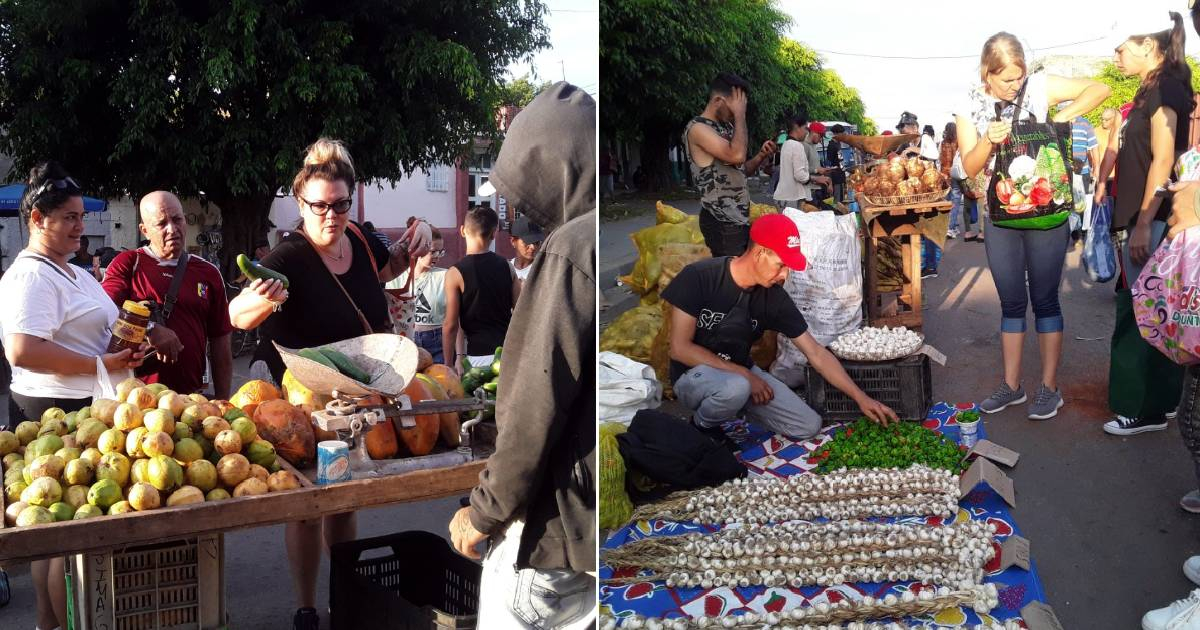
The government set up an agricultural and industrial fair this Saturday in the city of Cienfuegos to celebrate the 73rd anniversary of July 26, featuring reduced prices on basic products that the population cannot afford for the rest of the year.
The event brought together around 18 companies from the agricultural sector, as well as entities from Commerce, Gastronomy, and non-state economic actors, planned over weeks by local authorities, reported the official newspaper 5 de Septiembre.
Reinaldo Gómez Hermida, coordinator of programs and tasks for the provincial government, unabashedly summarized the purpose of the operation. "The intention is to satisfy the population, to make them feel happy on a day like today as we await the arrival of the historic date of July 26."
According to the official, products such as rice, sweet potato, pumpkin, pork, and charcoal have seen "a slight decrease" in prices.
An attendee identified as Nelson Leblanc confirmed having found some items cheaper than usual.
What the state media overlooks is the chasm between that display of abundance and the reality that Cienfuegos experiences for the rest of the year.
The province is among the five with critical levels of food insecurity identified by the Food Monitor Program (FMP) along with Havana, Matanzas, Guantánamo, and Santiago de Cuba.
The sweet potato that the fair is offering today at a reduced price once cost 300 Cuban pesos per unit in that same province last May.
In April, a resident recorded a video showing how 2,500 pesos were not enough to buy meat at the local fair on Calzada, where the price per pound reached 1,000 pesos.
The pattern repeats with every political anniversary. In June, a fair for Father's Day in Las Tunas sparked a wave of criticism due to its unaffordable prices.
The background is an unprecedented food crisis. According to the FMP, nearly 34% of Cuban households experienced hunger in 2025, and in April, around 97% of the population lacked adequate access to food.
On the other hand, 78% of those surveyed believe the current situation is worse than the Special Period of the 1990s.
The average state salary is around 7,074 pesos per month, roughly 13 dollars at the unofficial exchange rate, while independent economists estimate that survival requires between 50,000 and 96,000 pesos per month. The gap between these two figures says it all.
The national central event of July 26 will be held this year in Pinar del Río, a province struggling with power outages of up to 30 hours and more than two years without regular water supply in some municipalities.
Related videos:
Filed under: