
Related videos:
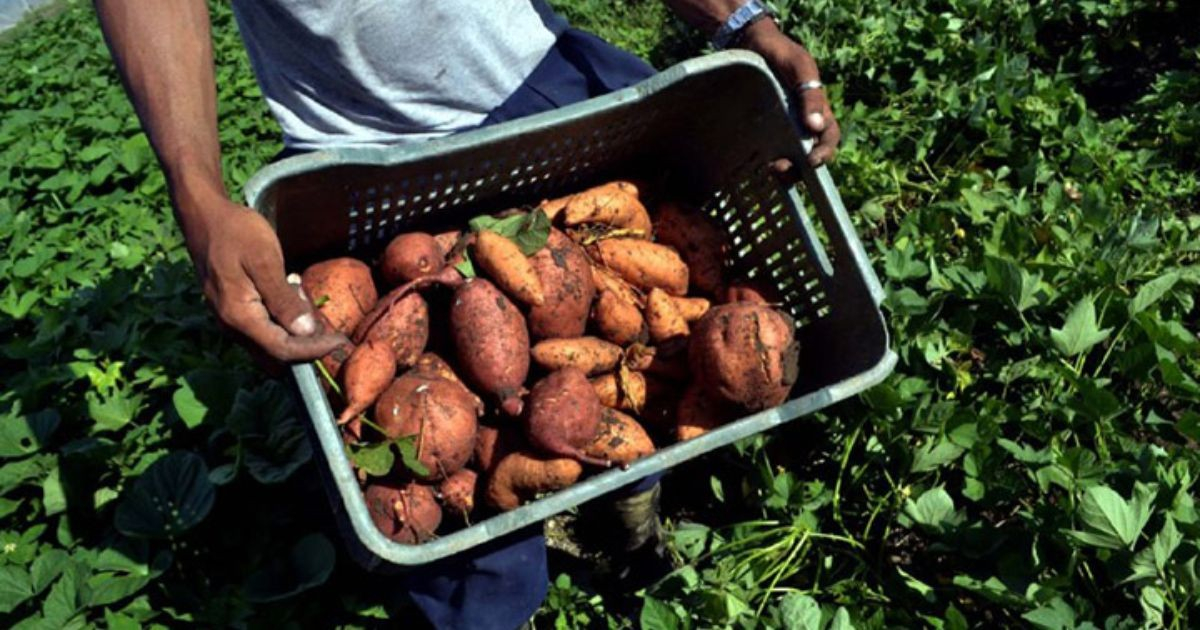
While nearly a third of Cuban households faced hunger in 2025 and Cubans are taking to the streets demanding "Electricity and food!", the official press today celebrates a scientific achievement that the regime presents as a sign of progress: new clones of sweet potato of the El Dorado variety developed at the agroecological farm Punta La Cueva, in the province of Cienfuegos.
The announcement, published this Saturday by the Cuban News Agency, arrives with suspicious timing: tomorrow, May 17th, marks the Day of the Cuban Farmer, and Cienfuegos is precisely the host city for the national event celebrating the 65th anniversary of the National Association of Small Farmers.
Emilio Bermúdez Cuellar, the owner of the farm, explained that they are experimenting with the B-20, B-30, and B-60 replicas, the latter being the one that performs "best under the climatic and soil conditions."
According to Bermúdez Cuellar, prototype four and six of the variety achieve "a yield exceeding 25 tons per hectare" and develop bulbs weighing over 200 grams in just 120 days, with "optimal quality for human consumption."
The owner also emphasized that the variety is resistant to Tetuán (Cylas formicarius), the pest that causes the most losses in sweet potato cultivation in Cuba, and that the crops "can withstand periods of up to 10 days without the vital liquid" without losing vitality.
As if the issues facing Cuban agriculture were solely about seeds and pests, Bermúdez Cuellar added that the vine "does not rely on chemical fertilizers or technological packages; it only requires a bit of organic matter sourced from the agricultural area": a quality that conveniently aligns perfectly with the regime's inability to import agricultural inputs, whose contraction has reached up to 80% in recent years according to economic studies.
In the project, the University of Cienfuegos and the Institute of Tropical Root Crop Research, led by researcher Master of Science Alfredo Morales, are participating, and the seeds will also be distributed to the Young Workers Army and the Military Region, because in Cuba even sweet potatoes have a military vocation.
Bermúdez Cuellar assured that the seeds "will not be sold, but donated to producers to help them establish their own seed bank and lower the high prices of that crop currently on the market."
That last sentence deserves attention: the very promoter of the project acknowledges that sweet potato —historically one of the cheapest and most accessible foods in the Cuban diet— has today "high prices." In Havana, sweet potato reached prices between 80 and 120 CUP per pound in March 2026, while in Cienfuegos —the same province mentioned in the scientific announcement— a single sweet potato could cost 300 CUP.
The contrast with reality is overwhelming. According to the survey "In Cuba, There is Hunger 2025" from the Food Monitor Program, 33.9% of Cuban households experienced hunger in 2025, an increase of 9.3 percentage points compared to the previous year, and in April 2026, 96.91% of the population had inadequate access to food.
Twenty-five percent of Cubans go to bed without dinner, 29% of families have eliminated one daily meal, and 80.4% reported that power outages—lasting up to 20 and 22 hours a day, as acknowledged by the Minister of Energy himself—have affected food preparation.
In that scenario, protests erupted this week in various locations in Havana with the slogan "Electricity and food!", while a Cuban mother cried out, a message that spread across social media: "The children are going without food".
On May 3, Miguel Díaz-Canel unintentionally summed up the magnitude of the collapse with a phrase that sounded more like a warning than a promise: "We will eat what we are capable of producing." If the regime's response to that statement is a handful of sweet potato clones on a farm in Cienfuegos, the outlook for the Cuban table does not inspire optimism.
Filed under: