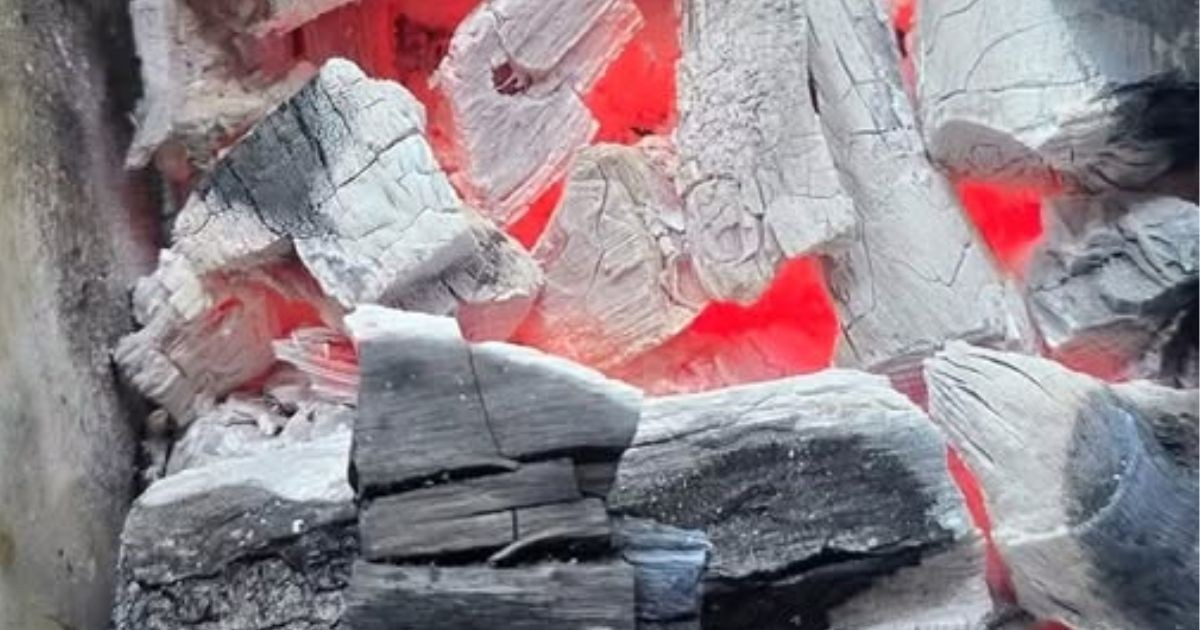
The photographer and entrepreneur from Pinar del Río, Mikely Arencibia Pantoja, published a reflection on Facebook on Tuesday that starkly summarized Cuba's energy reality: charcoal, once reserved for the countryside or outdoor parties, has become the backbone of cooking for millions of Cuban households, and a bag can cost almost half of a professional's monthly salary.
Under the title "The Charcoal of Our Daily Lives," Arencibia wrote: "There was a time when charcoal was something for farmers, for outdoor celebrations, or for those who wanted to add a special flavor to their food. Today, in Cuba, charcoal sustains millions of households."
The text describes a fuel that does not discriminate between social strata or types of housing: "It does not differentiate between buildings and houses, between doctors, teachers, or retirees. When electricity and liquefied gas are unavailable, it always appears, ready to do the job that others can no longer do."
That dependency comes at a cost that directly impacts families' finances. "Paradoxically, it's not cheap either. A bag can cost almost half of a professional's monthly salary. Still, thousands of families make the sacrifice because eating cannot be postponed," Arencibia noted.
The numbers support that statement. The average salary in Cuba hovers around 6,930 pesos monthly (CUP), while a newly graduated doctor earns only 5,060 CUP. In this context, the price of a sack of charcoal ranged between 3,200 and 5,000 CUP in several provinces in June 2026, and in Sancti Spíritus, it exceeded 4,000 CUP. A netizen confirmed in the comments: “Food cooked with charcoal tastes bitter to me now... 2,000 CUP for a sack and I know it’s more expensive in other places... I don’t know how far we’re going to go.”
The shift back to coal and firewood is a direct consequence of the energy crisis affecting the island. The state company CUPET indefinitely suspended the distribution of liquefied gas in Santiago de Cuba and the eastern provinces starting January 10, 2026, and in April of that year, 834,000 out of 1.7 million liquefied gas customers were unable to obtain the product from state distributions.
This is compounded by the electricity crisis: in March 2026, the system's availability was only 1,145 megawatts against a demand of 3,000, with power outages exceeding 20 hours daily in the provinces inland. On July 16, the regime set the official price of liquefied gas at 35 CUP per kilogram — an increase of 55% — while the informal market priced it between 24 and 50 dollars for a 10 kg cylinder.
The paradox is striking: while the population suffers from shortages, Cuba exported charcoal worth 61.8 million dollars in 2023, positioning itself as the ninth largest exporter of the product worldwide. In the first quarter of 2026, a company from Camagüey exported over 150 tons to Europe, generating earnings exceeding 55,000 dollars and with an annual goal of 4,000 tons.
Economic problems are compounded by health issues. An internet user pointed out in the comments: "Coal has never been for daily and mandatory use. It can take an asthmatic to the hospital and without medication, it’s fatal. Today, aside from being the only option for the poor, it is becoming increasingly expensive and inaccessible." Another user described the exhaustion of starting and ending the day in front of the fire: "A sad reality of beginning and ending the day with hands covered in soot."
Arencibia's post is part of a series of reflections that the photographer has shared in July 2026 about the everyday crisis in Cuba, including "Surviving 24 hours in Cuba" and "Normalizing the Abnormal", which also garnered significant attention.
Arencibia himself concluded his text with a phrase that encapsulates the sentiment of thousands of Cubans: "How sad that it was the coal and not progress that ended up supporting the kitchen of an entire country."
Related videos:
Filed under: