
Related videos:
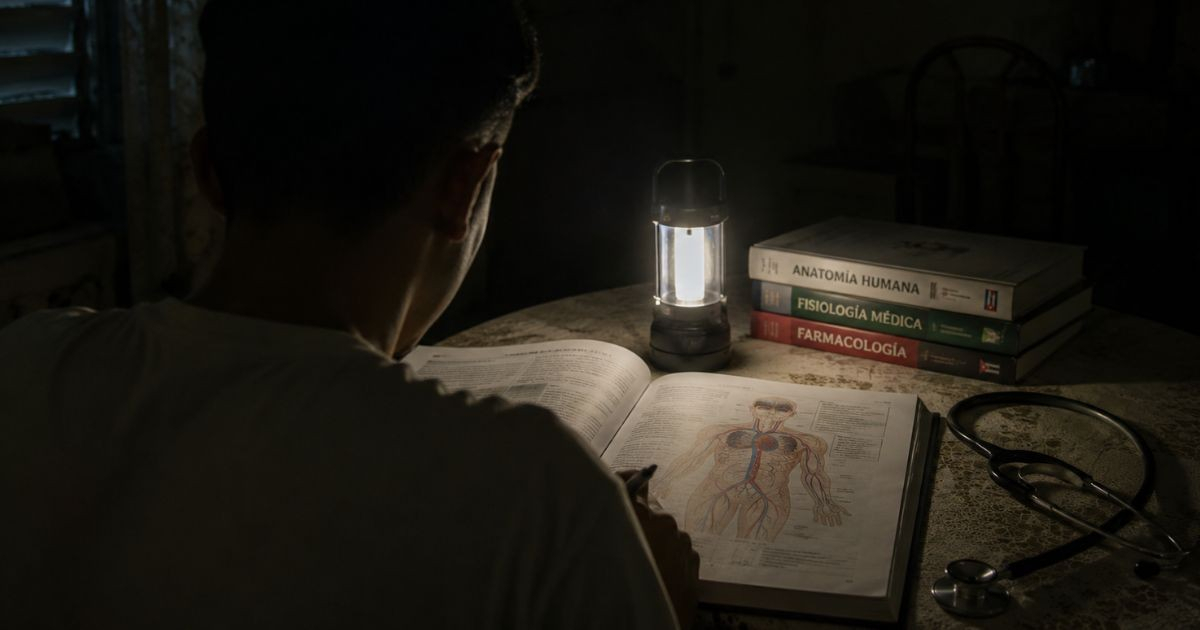
The Cuban photographer Mikely Arencibia Pantoja posted this Wednesday on Facebook a reflection titled "Normalizing the Abnormal," accompanied by a photograph showing three people playing dominoes during a blackout, illuminated only by the flashlight of a mobile phone.
In the text, the entrepreneur accurately describes the process by which a crisis ceases to be perceived as such: "There are things that, little by little, stop seeming strange. Not because they are normal, but because they repeat too much."
Arencibia points to power outages as the clearest example of that collective resignation: "One day you realize that you no longer count the hours without electricity and you simply limit yourself to organizing life around them."
The photographer identifies in everyday language the mark of that forced adaptation. The question "When is our blackout coming?" he writes, "shows that we have already made it our own, that it is part of our everyday life... because it has 'already come for us'."
Reflection goes beyond electricity. Arencibia describes how the crisis shapes our most basic desires: “You learn to buy less, to wait more, to half-sleep... to adjust even the simplest of wants. You learn to live life almost asking for permission, as if this were a rehearsal and you would have another chance after death.”
The phrase that encapsulates the drama is also the most unsettling: "The hardest part is not the scarcity. It's when the soul adapts to suffer less, because adapting helps one survive, but it can also make one stop noticing what is truly missing."
The publication comes just two days after Cuba experienced a new total collapse of the National Electric System, the third one in 2026 and the seventh in the last 18 months.
So far this year, interior regions have experienced up to 72 consecutive hours without electricity, and the energy deficit reached a record of 2,174 MW on May 14.
It’s not the first time Arencibia has used social media to document the exhaustion of the population. On July 3, he published "Surviving 24 Hours in Cuba," where he stated that "no community deserves to have to reinvent itself every 24 hours".
The phenomenon described by Arencibia is supported by expert analysis.
The psychologist Roxanne Castellanos Cabrera warned last Sunday that aggressiveness is becoming normalized in Cuba "as a means of managing life," diagnosing a moral collapse that goes beyond visible violence.
A study published in the journal Social Science & Medicine in May 2026 revealed that 55.4% of Cuban adults experience severe extreme depression, 66% severe anxiety, and 65.8% extreme stress, levels comparable to those of populations in war.
In addition to the energy crisis, there is a food emergency: 33.9% of Cuban households report recent hunger, and 79.4% allocate over 80% of their income to purchasing food, according to data presented by the UN in May 2026.
Nevertheless, Arencibia concludes his reflection with a note that acknowledges the silent resilience of the Cuban people: "And despite everything, people continue: they work, care for one another, find solutions, share what little they have... As if maintaining daily life were a silent act of resistance."
Filed under: