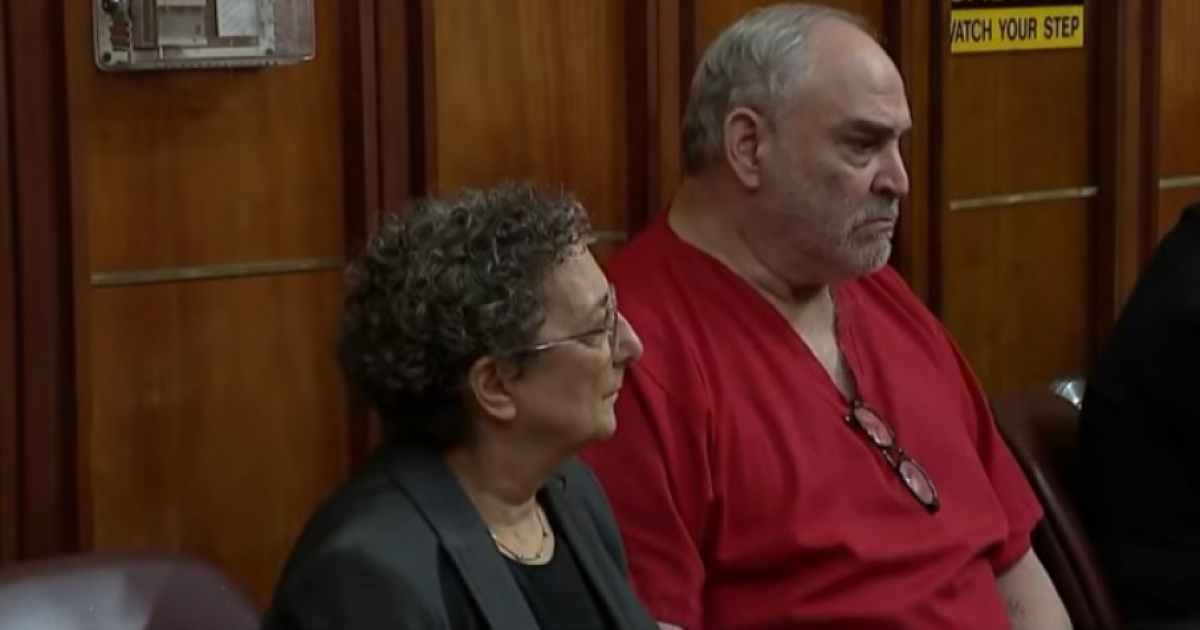
A Miami-Dade judge sentenced Rafael Andres, a 61-year-old Cuban, to death this Friday for the murder of Ivette Fariñas, a 31-year-old waitress, also Cuban, who worked at the La Carreta restaurant at Miami International Airport, a crime committed two decades ago.
According to Telemundo 51, Judge Zachary James of the Miami-Dade Circuit Court followed the jury's recommendation, which voted 9 to 3 in favor of the death penalty last November after reviewing all the evidence in the case.
The jury classified the crime as "atrocious, horrifying, or cruel," although they did not conclude that it was committed in a cold, calculated, and premeditated manner.
During the Spencer hearing—a post-verdict proceeding in Florida where the defense presents mitigating evidence—held in April of this year, two convicted murderers testified in favor of the Cuban, describing his good character in prison.
For its part, the defense argued that the brain damage caused by cocaine use in his youth should be taken into account.
However, none of those arguments influenced the jury's decision or that of Judge James.
How the crime occurred
The killer and the victim knew each other. She had hired him to make renovations in her apartment, located at 1100 Southwest 74th Avenue. On January 24, 2005, he entered using a spare key that he had as a maintenance worker.
Once inside, he beat her until she revealed the password for her ATM card, stabbed her multiple times in the chest, struck her in the face and head, and finally strangled her with the power cord of a rice cooker.
Before fleeing, Andres set the apartment on fire to destroy evidence.
The firefighters who responded to the fire found the woman's body with burns in addition to the injuries from the attack.
The individual stole the bank card and spent more than $1,600 on purchases at Home Depot and on a stay at the Miccosukee Resort and Casino before being captured in March 2006, about 14 months after the incident.
The evidence against him was overwhelming: his DNA was found on a bloodied cloth near Fariñas' body. A neighbor saw him leave the house with a can of gasoline in hand shortly before the fire. He also had traces of gasoline on his shoes, and records from his cellphone linked him to the crime scene.
Second ruling for the same case
This is the second sentencing trial that Andres is facing in this case: he was found guilty in 2014 and sentenced to death for the first time in 2015 (10 years after the homicide), also with a vote of 9 to 3.
On that occasion, Judge Dava Tunis summarized the brutality of the crime with these words: "When you took the rice cooker cord and wrapped it around her neck, the evidence is clear. She was alive. She knew you were strangling her. She fought for her life."
However, in 2018, the Florida Supreme Court overturned that sentence as a result of the ruling in Hurst v. Florida (2016), in which the U.S. Supreme Court declared Florida's capital punishment scheme unconstitutional because it allowed judges—rather than juries—to determine the facts necessary to impose the death penalty.
At this moment, Andrés is already serving a life sentence for other charges related to the murder. Now he must move to Florida's death row, as he was 10 years ago.
It was not his first murder
The background of the case is particularly murky: Andres had been tried in 1988 for the fatal stabbing of Linda Azcarreta, a 32-year-old Cuban and friend of his then-wife. The crime, committed in 1987, was motivated by a desire to steal 100 dollars. He justified his actions by claiming he suffered a drug-induced frenzy.
For that offense, he received nine years in prison, but he was released after just 18 months due to his good behavior and early release policies in effect in Florida at that time, when overcrowding in prisons led to a drastic reduction of sentences.
That premature freedom allowed him to return to the streets as a maintenance worker, which in turn gave him access years later to Ivette's apartment, his new victim.
In 2015, Judge Tunis, upon reading the verdict for the murder of Ivette Fariñas, noted that Andrés had served a very short sentence for the crime of Linda Azcarreta in 1987.
Who were Ivette Fariñas and Rafael Andres?
Ivette Fariñas had arrived in Miami from Cuba in 1999 and, at the time of her murder, was being evaluated to become a federal security agent at the airport.
Rafael Andres, for his part, Andrés arrived from the Island in the 80s along with his wife.
According to the portal 14ymedio, reported in April, Rafael Andrés is not listed as a foreign national in the records of the Death Penalty Information Center, which suggests that he obtained U.S. citizenship at some point.
Florida closed 2025 with a historic record of 19 executions, accounting for approximately 40% of all executions carried out in the United States that year, nearly double the previous record of eight in 2014.
Related videos:
Filed under: