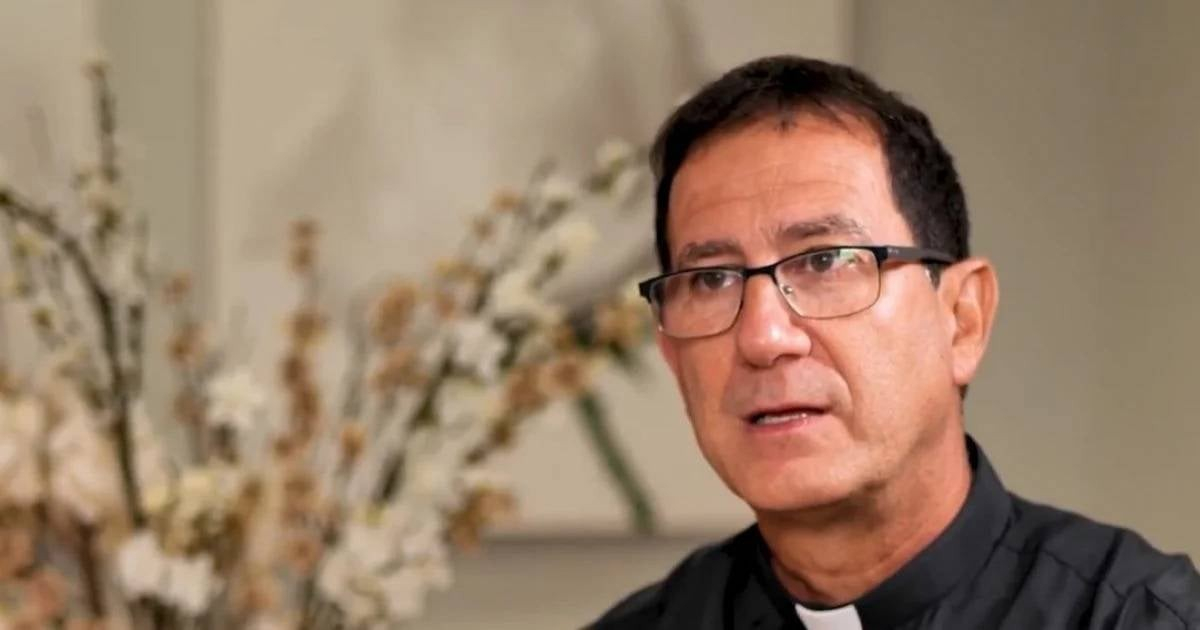
The Cuban priest Alberto Reyes Pías published the 167th installment of his weekly column on Facebook, titled "I Have Been Thinking About the Fears of Those Who Govern Us," in which he turns the usual analysis of fear in Cuba on its head, pointing out that those in power are also gripped by it.
"Our people are afraid: afraid of change, of the unknown, of the new. But it's not just the people who are afraid; the government also lives in fear," writes the parish priest of Esmeralda, Camagüey.
Reyes argues that those who took control of the country built a system of absolute impunity over decades, without accounting for the money, the properties, the travels, or the foreign universities where their children study, and that this very system has turned into a trap for them.
"Because those who one day took ownership of this Island and turned it into their personal fiefdom made it a prison that has ultimately ensnared them," he argues.
In his reflection, he precisely enumerates the fears that, in his view, paralyze the regime: fear of economic oversight and financial transparency, fear of freedom of thought and expression, fear of losing the monopoly over the media, fear of social networks, and fear of an independent judicial system that judges the guilty without orders "from above."
The priest also dismantles what he sees as a maneuver by the government: "That's why they change their rhetoric, talking about 'dialogue,' about 'negotiation,' but always from their perspective, from the clan that insists on keeping the reins under control. That's why they’re interested in presenting new but safe faces, fresh images that ensure the continuity of power."
The deepest fear that Reyes identifies is the one the dictatorship feels towards the Cuban people themselves: “the people they impoverished, manipulated, and deceived; the people they used to seize power and then reduced to slavery. They are afraid of that people, who may not know exactly how to initiate change, but who will not stop until they achieve it.”
"None of this exists anymore. Times have not only changed, but they demand change, and when one has played at being God, it is terrifying to feel like just a simple human again," the priest concludes in his reflection.
Reflection 167 fits into a thematic pattern that the priest has developed over the months.
The issue 166, published on July 17, already addressed fear as a pillar of the regime, though from the perspective of the population. The novelty of this issue is that it shifts the focus towards the rulers.
Reyes writes these reflections under increasing pressure from State Security.
In January, regime agents summoned him, along with fellow priest Castor José Álvarez Devesa, and issued a formal warning, threatening to treat their criticisms as prosecutable offenses.
In February, he reported "harassment, surveillance, and veiled death threats," and in June, he revealed that he had been summoned by State Security on two occasions under the threat of legal action.
Despite this, Father Reyes has maintained his column consistently.
In March, he warned that generations of Cubans have grown up "in lies, in double standards, in pretense, and in fear."
The repressive context surrounding the priest is extensive: according to data from the Cuban Observatory of Human Rights, in 2025 there were 873 violations of religious freedom reported in Cuba, and in 2026, the United States Commission on International Religious Freedom included the Island among the countries with "serious and ongoing violations" in this regard.
Related videos:
Filed under: