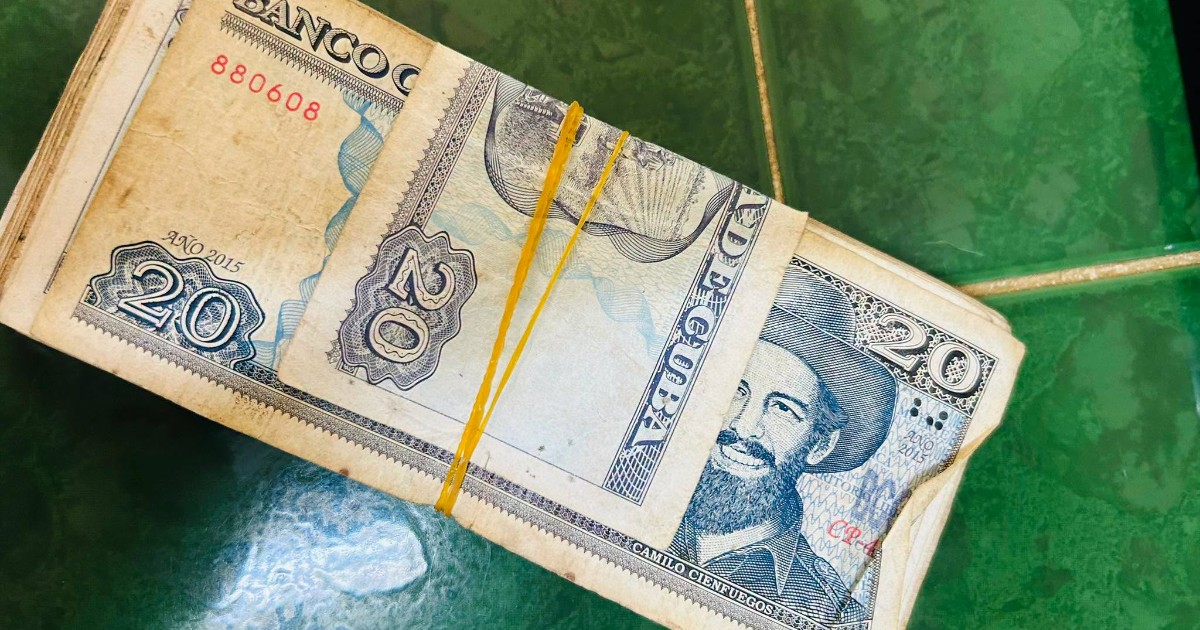
Yenney Caballero, an animal rights activist based in San José de las Lajas, Mayabeque, posted an angry message on Facebook denouncing that the El Rodeo fairground, a place where self-employed workers purchase their goods, refuses to accept 20 Cuban peso bills or bank transfers as forms of payment.
"I'm so tired of the lack of respect, consideration, poor work, and corruption in this country," wrote Caballero, who warned that she will continue to buy food for herself and her animals with the money she has, and that she will file formal complaints with the relevant authorities if her payment continues to be rejected.
The activist described a vicious cycle that ensnares thousands of Cubans: those who sell them dollars pay with 20 peso bills, but those same bills are not accepted where they need to buy food.
"The one who buys American dollars pays you with twenty-dollar bills; you go to the bank and can't withdraw the money you need from your card; you go to buy groceries and the small business doesn’t accept transfers, they can only accept 1,000 pesos in twenty-dollar bills," he explained.
According to Caballero, the self-employed workers who go to the venue El Rodeo face the same problem: "According to the self-employed, when they arrive there, they cannot purchase either by transfer or with 20-dollar bills."
The complaint points directly to those responsible for the fairgrounds: "You from the el Rodeo fairgrounds in San José de las Lajas, Mayabeque, who sell to self-employed workers, loosen up on the transfer issue and accept the 20 bills."
Faced with the impossibility of accessing higher denomination bills, Caballero was emphatic: "If the 20 bills no longer count as money, then take them off the streets."
"The people are the only ones affected by all this; we have to eat," wrote Caballero, encapsulating in a single sentence the reality of millions of Cubans caught between a dysfunctional banking system and businesses that impose their own rules outside the law.
And he ended with a warning that summarizes the desperation of those who care for animals without institutional support: "Neither I nor my own are going to go without food."
The case is situated within a problem that has intensified throughout Cuba in 2025 and 2026.
More and more private businesses are refusing to accept low denomination bills, despite the fact that the Central Bank of Cuba recognizes them as legal tender with full liberating power.
Banks usually dispense those bills when withdrawing cash, but businesses refuse to accept them, leaving the population without real purchasing power.
At the beginning of the month, the BANDEC of Ciego de Ávila demanded that mipymes and self-employed workers stop rejecting five, ten, and twenty peso bills, calling this practice illegal and warning of possible administrative sanctions, including the revocation of licenses in repeated cases.
Despite this, reports of rejection continued in various provinces.
The introduction on April 1, 2026, of new high-denomination bills —2,000 and 5,000 Cuban pesos— has paradoxically deepened merchants' disdain for smaller bills, which before this issuance coexisted with the 1,000 peso bill as the highest value in circulation.
Related videos:
Filed under: