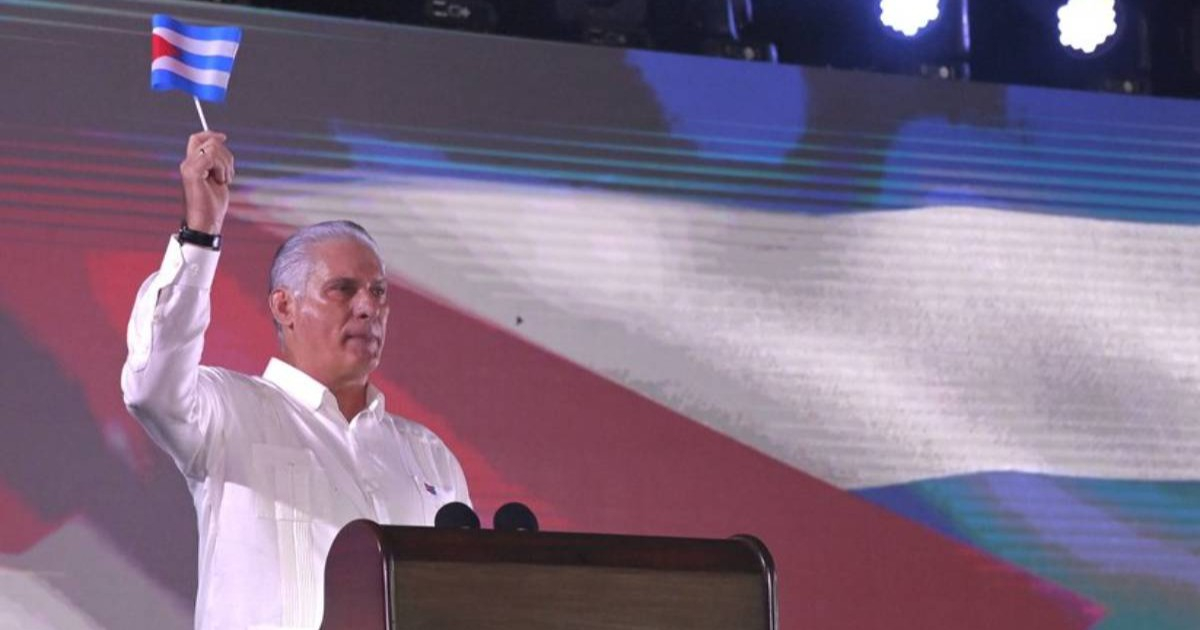
Miguel Díaz-Canel took the opportunity during his speech at the event commemorating the 73rd anniversary of the assaults on the Moncada and Carlos Manuel de Céspedes barracks to reiterate the political discourse that has characterized the regime over the last six decades.
The ruler held the United States responsible for the deep crisis that Cuba is facing, defended the continuity of the socialist system, and urged Cubans to maintain their resistance amid the hardships faced by the people.
The leader did not announce new economic measures or reforms to address issues such as blackouts, inflation, shortages, or the increasing exodus of Cubans. Instead, he reiterated the usual arguments of the government. Here are the five most important messages from his speech.
He blamed the United States again for the economic crisis in Cuba
The central focus of the intervention was the accusation that Washington's policy is the main cause of the situation the country is experiencing. Díaz-Canel stated that Cuba is a victim of a "maximum pressure" strategy aimed at provoking economic collapse and social discontent.
"The Government of the United States has consciously designed and implemented a policy of maximum economic suffocation against the Cuban people. It has intensified its six-decade-long blockade policy, imposing an energy and financial blockade, leading to a deep crisis in the Energy System," said the leader.
The leader attributed the difficulties in accessing fuel, financing, and raw materials to the U.S. embargo. However, he did not mention internal factors pointed out by independent economists, such as low productivity, state control over the economy, the failure of economic reforms, or the sustained decline in national production.
2. He presented the current situation in Cuba as a "new Moncada."
Díaz-Canel frequently invoked the revolutionary epic to draw parallels between the current moment and the historical event of July 26, 1953. He asserted that the current battle is being fought in the economic, political, and ideological arenas, urging Cubans to face difficulties with a spirit of sacrifice.
"Cuba is engaged in a historical battle today: a new Moncada! Just like the Generation of the Centenary that rose up with only a few rifles against the walls of two barracks of Batista's dictatorship 73 years ago, the current generations are standing against the walls of a genocidal policy that aims to suffocate the entire people in order to seize the country," he expressed.
The appeal to historical symbolism once again took center stage in a speech that prioritized references to the past over the presentation of concrete solutions for the current crisis. It maintains its refusal to reach agreements with the United States and portrays the Trump administration as an enemy with whom there will be no agreements.
3. He asked to produce more, but did not mention economic changes
Another recurring message was the call to increase national production, something the country has not achieved in 60 years of dictatorship. Díaz-Canel emphasized the need to substitute imports, enhance efficiency, and make better use of available resources.
"To produce, to substitute imports, to develop our potential. Let’s trust in our own strength! May every Cuban in their workplace, in their field, in their workshop, in their school, in their neighborhood be and feel like a protagonist of the transformation we owe ourselves to overcome this moment."
It did not include announcements about new reforms to stimulate the private sector, to make business activities more flexible, or to remove barriers that have long been identified as obstacles to increasing the production of food and essential goods in Cuba.
4. He confirmed that there will be no changes to the political model
The leader made it clear that the government remains committed to the continuity of the socialist system. He reaffirmed the legacy of Fidel Castro and Raúl Castro, defended the guiding role of the Communist Party, and asserted that political unity continues to be the main guarantee for facing external pressures.
"On this July 26, we reaffirm our commitment to the homeland, to the Revolution, to the achievements of socialism, and to the task of rebuilding an economy ruthlessly battered by four centuries of colonialism, six decades of neocolonialism, and another six decades of reinforced blockade...", said the communist leader.
At no point did he open the door to political reforms or changes in the power structure, despite the growing social discontent and the worst economic crisis the island has experienced in decades.
5. He urged the youth to stay in Cuba to defend the Revolution
Díaz-Canel dedicated part of his speech to the youth, presenting them as the heirs of the revolutionary project. He urged them to take an active role in production, in official organizations, and in the defense of the Revolution.
"You are the youth of Fidel’s Centennial! You are called to lead this moment from every neighborhood and every corner of this island. Participate and transform for the good of all, just as it was once done with your well-being in mind," he said.
Cuba is experiencing a massive exodus driven by the lack of economic opportunities, ideological repression, low wages, and the deterioration of living conditions. Díaz-Canel's call reveals an obvious contradiction. The regime asks young people to defend a reality from which they want to escape.
A speech without announcements in the face of an increasingly profound crisis
The July 26 speech revealed few novedades. Díaz-Canel maintained the official narrative that attributes the crisis to the U.S. embargo, defended the continuity of the socialist system, and once again appealed to the resilience of the population.
While millions of Cubans continue to face prolonged power outages, food shortages, inflation, the deterioration of public services, and unprecedented emigration, the leader avoided announcing concrete measures to reverse a crisis that continues to impact the daily lives of the population.
Díaz-Canel reiterated that as long as he is in power, the change that Cubans have been waiting for so many years will not come.
Related videos:
Filed under: