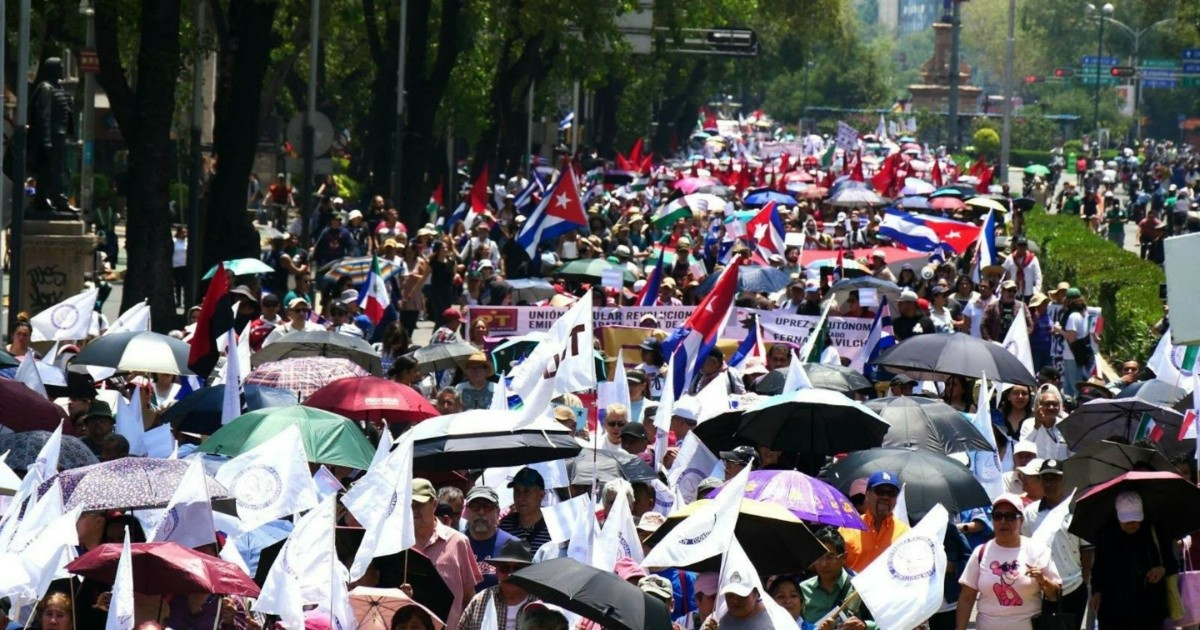
While more than a thousand supporters of the Cuban regime marched this Sunday along the Paseo de la Reforma in Mexico City to commemorate the 73rd anniversary of the assault on the Moncada Barracks, Cubans inside and outside the island flooded social media with raw testimonies of their everyday reality, in direct response to the public gratitude expressed by Miguel Díaz-Canel for the demonstration.
The Cuban leader wrote on his social media: "Thank you #Mexico. Once again at the forefront of the dignity of Our America. To all those who marched for #Cuba this July 26, the grateful embrace of a people that has always found solidarity in the noble and generous Aztec land. #CubaIsNotAlone." The post, far from generating support, became the stage for an avalanche of criticism.
The pro-Cuba demonstration in Mexico ended in controversy for another reason as well: a group of participants vandalized the Cuauhtémoc Mayor's office, an act that Mayor Alessandra Rojo de la Vega publicly condemned.
While the Mexican Eugenio Martínez celebrated in the thread by Díaz-Canel that "several thousand for Cuba in Mexico" was something "very exciting and encouraging," the Cuban Reinier Álvarez responded bluntly: "Eugenio Martínez, several Cubans in Cuba without electricity or water."
One of the most heart-wrenching testimonies was that of Ileidys Del Monte Sánchez: "In Mexico, they can't even imagine how the people live. My son's brothers are malnourished children; they have suffered from dengue five times since they were born and have gone without food. The children are weak; one is hospitalized with pneumonia. This is not life; they have forgotten the people, they have forgotten the most vulnerable."
Another Cuban, Cary Rivero, extended an ironic invitation to the Mexican protesters: "Come to Cuba, join me, and I'll even offer a room in my house so you can help me cook with charcoal and give me some money to buy food. Because my pension isn’t enough." When a Mexican wrote that "the people of Mexico support and back the government of Cuba," Rivero responded with sarcasm: "Well said, the government of Cuba."
The communicator Magdiel Jorge Castro pointed out the limited mobilization within the island itself: "There were more people in Mexico than in Pinar del Río... it's clear that none of them understand what communism does to people. Poor ignorant souls."
User Jorge Ramírez drew a geopolitical comparison: "They no longer talk about Venezuela, now the fat cow is Mexico," referring to the role that the Aztec country has taken on as the main external ally of the regime in 2026, following the shift in Venezuela. Manuel Antonio Ricardo was more direct: "If they come to live here, they're going to be hit with a class of hate."
The contrast between the image of international solidarity projected by the regime and the reality experienced by Cubans is stark. More than half a million residents of Havana are suffering from a water crisis in a context where 2.7 million Cubans nationwide lack regular water supply, exacerbated by an electricity crisis that on July 10 reached a historic deficit of 2,341 MW.
This pattern of reactions is not new. Each time Díaz-Canel thanks Mexico for its help, Cubans respond on social media with the same implicit question: who does that solidarity really reach?
Related videos:
Filed under: