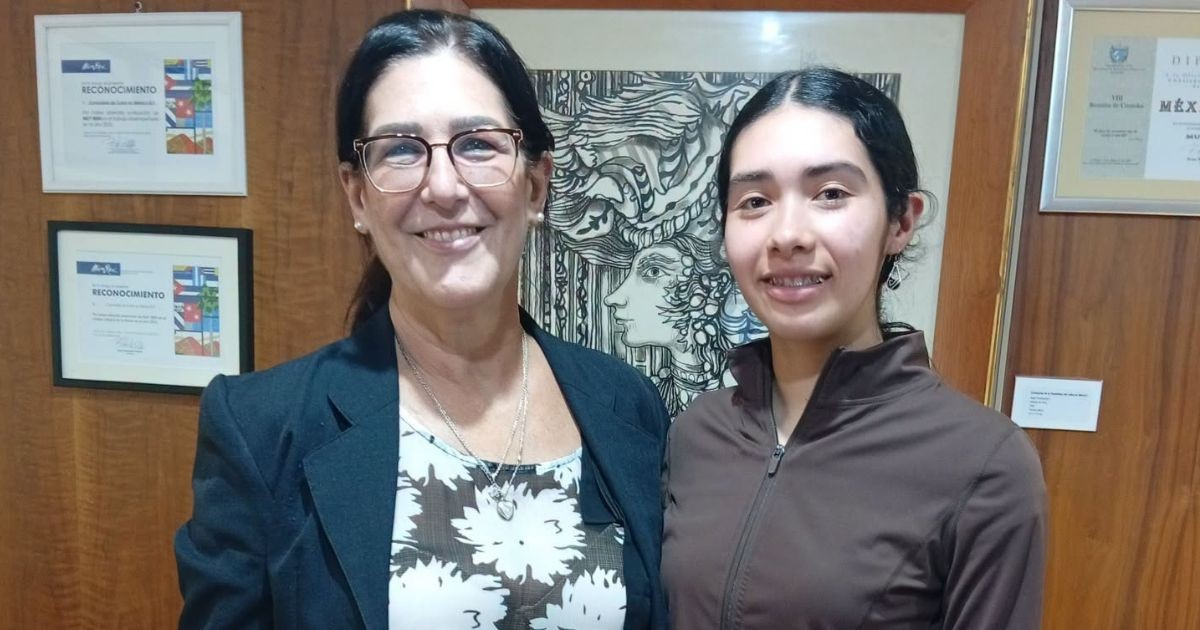
The Consular Section of Cuba in Mexico City delivered this Wednesday the DACCRE Scholarship to Lis Vinajel López, a young Cuban-Mexican who will pursue a degree in Medicine completely free of charge on the island.
The consulate described the event as "a great pride" and specified that the DACCRE Scholarships "are exceptionally awarded to descendants of Cubans residing abroad to pursue their studies in our country."
The program, whose full name is the General Directorate of Consular Affairs and Cubans Residing Abroad, was established in 2005 as a result of the III Conference "The Nation and Emigration," promoted by Fidel Castro in 2004 with the declared goal of strengthening ties between the regime and the Cuban diaspora.
However, the announcement does not specify if the assistance also includes accommodation, food, transportation, academic materials, travel, or other expenses related to the stay on the island.
Since its establishment, the program had awarded up until 2025 over 140 scholarships to children of Cubans residing in 54 countries, with Medicine and Dentistry being the most common fields of study.
Why is the scholarship considered "attractive"?
The economic appeal of the scholarship becomes evident when comparing it to the costs of studying Medicine at a private university in Mexico. As a reference, Tecnológico de Monterrey offers a program for this degree that consists of eight semesters and eight trimesters.
According to the official rates consulted, a period of 18 credits costs 201,150 Mexican pesos, while one of 12 credits costs 134,100 pesos ; both figures are unimaginable for the vast majority of Mexicans.
Other private institutions also charge high tuition fees. At the Anáhuac University Mexico , for instance, a semester of 40 credits amounts to four payments of 40,311 pesos, totaling 161,244 pesos in tuition, in addition to registration, health insurance, and other expenses.
In light of those amounts, a DACCRE scholarship that covers medical studies in Cuba represents a significant saving for the beneficiary and her family.
Regarding professional practice, a medical degree issued in Cuba does not, by itself, authorize one to work as a doctor in Mexico.
Although both countries have a bilateral agreement for the recognition and validation of university degrees, the treaty itself stipulates that its beneficiaries must meet the legal requirements of the host country.
And then?
In 2023, authorities in Morelos rejected a group of twenty Cuban doctors for lacking professional licenses and not having completed the apostille of documents issued in Cuba.
However, despite these difficulties, many doctors trained on the island eventually manage to practice in Mexico, where the demand for healthcare professionals is high, making Cuban training a perceived long-term profitable investment.
From a critical perspective, the program serves as a tool for political influence by the regime: it attracts descendants of émigrés—many of whom have never lived in Cuba—and trains them for years in an ideologically controlled environment, strengthening identity and political ties with Cuban communities abroad.
In November 2025, during the XII DACCRE Scholars Meeting, the program's director, Ana Teresita González Fraga, defined education as "a solid bridge that connects the nation with its residents abroad."
Related videos:
Filed under: