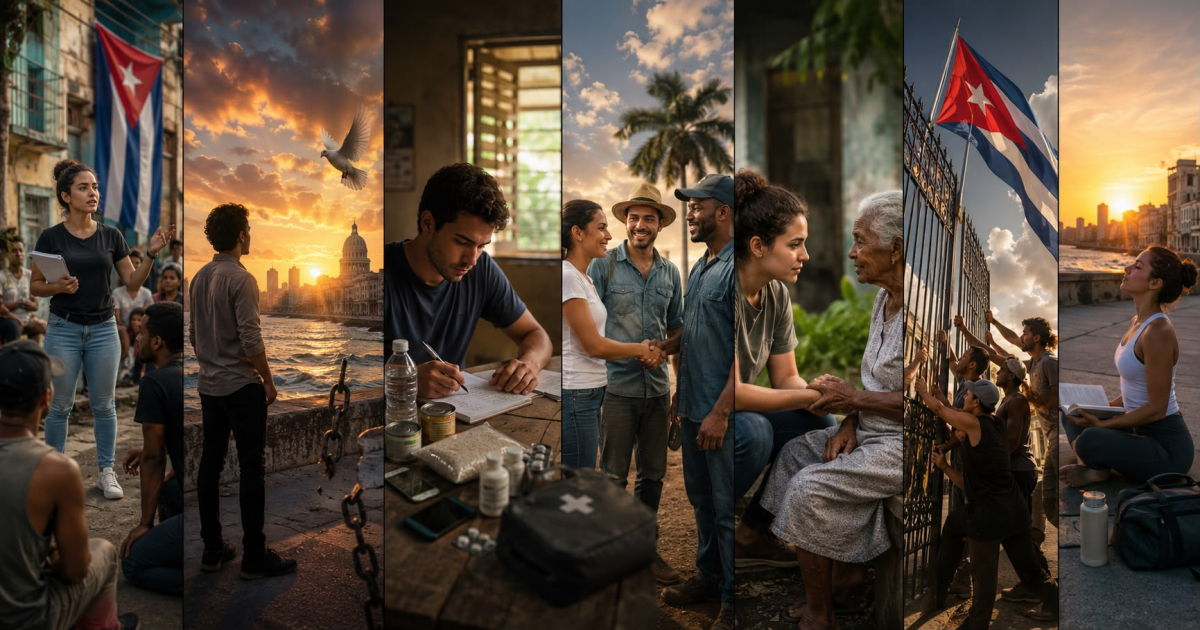
The book "The 7 Habits of Highly Effective People" by Stephen R. Covey is not just a work on personal growth. It can also be read as a manual for those who wish to transform society, build strong organizations, and pursue ambitious goals without compromising their principles. For Cubans who fight for freedom, democracy, human rights, and a free and prosperous economy, its teachings provide invaluable tools.
The first habit is being proactive. This means understanding that, although we cannot always control circumstances, we can choose how to respond to them. For decades, the Cuban regime has instilled fear, resignation, and dependence. Proactivity requires abandoning the mindset of being a permanent victim and taking responsibility. Every Cuban can do something: inform, denounce, organize, assist political prisoners and persecuted activists, participate in civic initiatives… Freedom begins when we stop waiting for others to solve our problems and fight resolutely.
The second habit is to begin with the end in mind. It is not enough to oppose communism. We must know what kind of Cuba we want to build. The goal must be a democratic nation, with separation of powers, free elections, freedom of expression, respect for private property, an independent judiciary, and full rights for all. We must also envision a Cuba where no one is discriminated against due to their ideas, religion, origin, economic status, or political position. Having a clear objective prevents the struggle from becoming improvised or merely reactive.
The third habit is to put first things first. In a democratic cause, there are many urgent matters, but not all hold the same weight. The essential element must be unity around basic principles, the defense of political prisoners, support for victims of repression, citizen organization, and preparation and action to make the transition possible. Personal conflicts, rivalries, and excessive protagonism cannot take precedence over the national cause. An effective movement knows how to distinguish between what is truly important and what is secondary.
The fourth habit is to think win-win. No one should impose their leadership or their project in a dishonest or unfair manner. No project or leadership can stand if it does not arise from transparent choices or the approval of the majority. In the future Cuban politics, the logic that some must destroy others cannot prevail. A true democracy must seek agreements, coexistence, and benefits for the entire nation. This does not mean impunity or renouncing justice. It means understanding that a free Cuba will require the participation of citizens with diverse ideas. The transition will be stronger if it offers opportunities to those who break away from the regime and align themselves with the people who wish to live in freedom and democracy, as long as they have not committed serious violations of human rights.
The fifth habit is to seek first to understand, then to be understood. The pro-democracy opposition must listen to one another and to the population. It must understand and empathize with the suffering of the worker, the farmer, the youth without a future, the retiree, the prisoner, the exile, and also those who remain silent out of fear. One cannot lead a people without knowing their concerns. Listening strengthens credibility and allows for a message that resonates with genuine needs.
The sixth habit is to create synergies. Synergy arises when different individuals and organizations cooperate and achieve results that are greater than what they could attain separately. The democratization of Cuba requires coordination among opponents, activists, independent journalists, families of prisoners, exile organizations, churches, intellectuals, and workers. Diversity should not be viewed as a weakness, but rather as a source of experience and creativity.
The seventh habit is to sharpen the saw. Covey explains that every person and organization needs to renew themselves. Those who struggle for years against a dictatorship may experience exhaustion, frustration, and demoralization. It is essential to take care of health, strengthen spiritual life, study, prepare, foster new leaders, and maintain family and human connections. A cause cannot be sustained if its members are physically or emotionally drained.
These seven habits teach that effectiveness does not solely depend on talent or the desire to succeed. It depends on character, discipline, vision, cooperation, and fidelity to principles. The struggle for a free Cuba requires individuals who can govern themselves before aspiring to govern a nation.
The democracy we want to build must begin with our present conduct. Being responsible, listening, cooperating, respecting differences, acting with integrity, and maintaining a clear vision of the future are essential steps. Freedom will not merely be the result of the fall of a dictatorship. It will be the conscious work of citizens ready to construct a republic where all Cubans can live with dignity, justice, full rights, and prosperity.
Related videos:
Filed under:
Opinion article: Las declaraciones y opiniones expresadas en este artículo son de exclusiva responsabilidad de su autor y no representan necesariamente el punto de vista de CiberCuba.