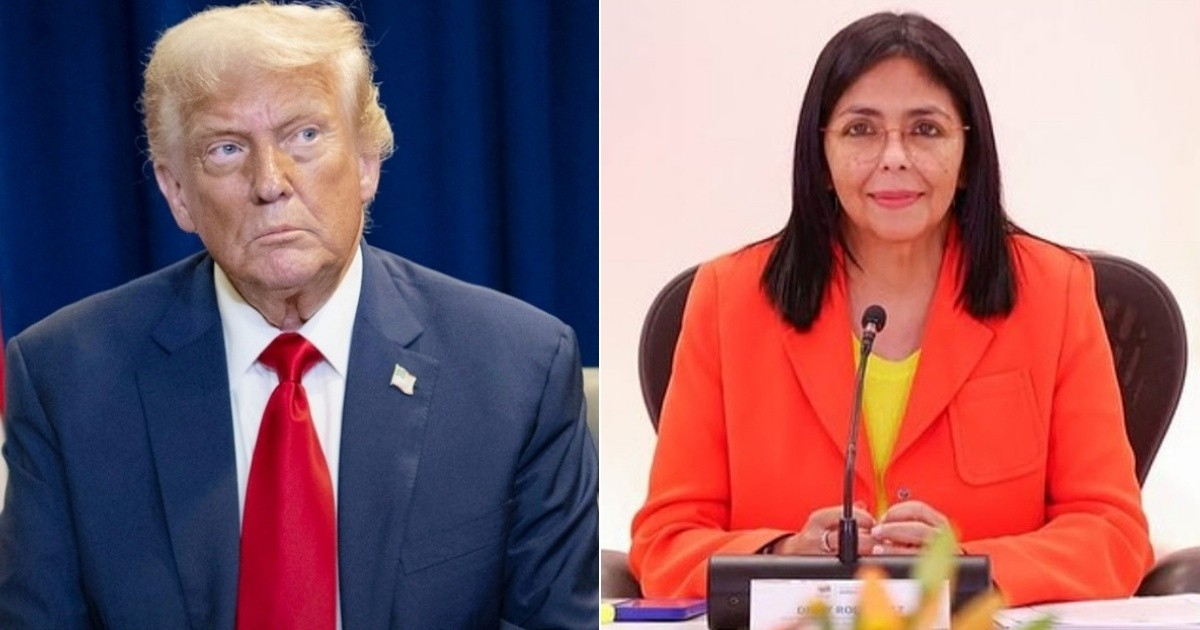
The administration of President Donald Trump formally requested a federal court in Florida to grant judicial immunity to Delcy Rodríguez, the acting president of Venezuela, in a civil lawsuit for kidnapping and torture filed by three U.S. citizens.
On July 20, the Department of Justice (DOJ) filed a "suggestion of immunity" in the Southern District Court of Florida in favor of Rodríguez, arguing that the executive branch has the exclusive authority to determine which heads of state enjoy that legal protection.
The document does not contest the accusations against Rodríguez but rather focuses on the legal protections that she is entitled to as the sitting head of state.
A letter from the State Department to the DOJ, dated June 11, warned that including Rodríguez in the case "may have implications for U.S. foreign policy."
The State Department formally recognized Rodríguez as the head of state of Venezuela in March 2026, following the capture of Nicolás Maduro by U.S. forces on January 3 and his subsequent imprisonment in the U.S.
Is there a legal basis for immunity?
According to experts consulted by PolitiFact, the nonprofit organization run by the Poynter Institute that won the Pulitzer Prize in 2009 for its work in journalistic fact-checking, the answer is yes.
Rob Howse, professor of international law at New York University, was categorical: "There is no legal basis that allows the court to deny immunity to Rodríguez, as the precedents cited by the U.S. government appear to be valid."
Howse specified that "it is an immunity based on her status as acting head of state."
Professor Mary Ellen O'Connell from the University of Notre Dame explained that this protection has a clear time limit:
"If the Venezuelans remove Rodríguez from power tomorrow, she would no longer have immunity."
O'Connell further clarified that, once out of office, Rodríguez could be sued again, but only for actions that are not protected as official acts.
The Trump administration supported its request by referencing the precedent of the Congo v. Belgium case, decided by the International Court of Justice in 2002, in which the court ruled that Belgium violated international law by issuing an arrest warrant against the then foreign minister of Congo.
The case that gave rise to the lawsuit
The lawsuit was filed in January 2026 by Jerrel Kenemore, Jason Saad, and Edgar José Marval, three American citizens who claimed to have been kidnapped and tortured in Venezuela under Maduro's government, and who were released in a prisoner exchange in December 2023.
Kenemore was detained for 643 days; Saad, 560; and Marval, 123, in facilities of the General Directorate of Military Counterintelligence in Caracas.
On July 14, federal judge Darrin P. Gayles approved a compensation of 314 million dollars against Maduro, Alex Saab, and other Chávez officials, although Delcy Rodríguez was excluded from that ruling.
The rapprochement between Washington and Caracas
The request for immunity is part of a broader policy of bilateral normalization.
After formally recognizing Rodríguez's government in March, Washington raised the American flag at its embassy in Caracas and removed Rodríguez from the OFAC sanctions list in April.
This is added to the fact that -according to reports- ordered to halt criminal investigations by the DEA against her in May, although the DOJ publicly denied that instruction.
Behind that approach are specific energy interests: both governments agreed to deliver between 30 and 50 million barrels of Venezuelan oil to U.S. refineries.
What's next?
It is not yet known exactly when the judge will formalize the dismissal of charges against Rodríguez, but a conference call is scheduled for September 30 where that issue could be resolved.
Meanwhile, Secretary of State Marco Rubio announced on July 20 that discussions for a democratic transition in Venezuela would begin in early August of this year.
Related videos:
Filed under: