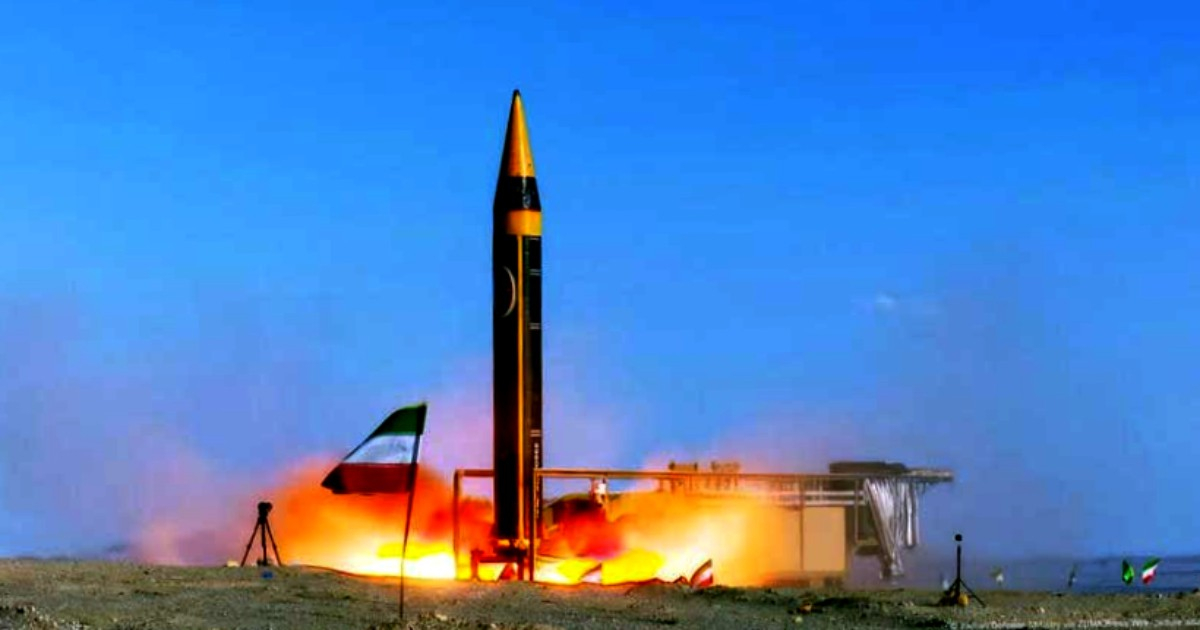
The Islamic Revolutionary Guard Corps of Iran launched multiple ballistic missiles on Wednesday against U.S. military positions in the Middle East, in what U.S. Central Command (CENTCOM) described as an attempted surprise attack that was completely neutralized.
According to the official statement from CENTCOM, the attack occurred at 5:45 p.m. Eastern Time: "The Islamic Revolutionary Guard Corps of Iran launched multiple ballistic missiles from Iran in an attempted surprise attack against U.S. forces based in the Middle East."
All Iranian missiles were successfully intercepted. U.S. forces remain vigilant and in a high state of readiness.
The Jordanian Army confirmed that it had intercepted five of those projectiles over its territory, as reported by DW.
"Air defenses intercepted five missiles launched from Iran towards Jordanian territory in the early hours of Wednesday. The missiles were intercepted and destroyed in accordance with established engagement rules," stated a brief communiqué from the Jordanian Armed Forces, which reported no human or material damage.
The IRGC claimed responsibility for the attack and justified it as a "response to the aggressive actions of the US military" against Tehran. The newspaper Times of Israel reported that Iran may have fired up to 12 missiles aimed at a US command center in Jordan, possibly the Muwaffaq Salti airbase, although CENTCOM did not specify the target in its statement.
The Iranian attack is a direct retaliation for the operations carried out on Tuesday by the U.S. and Saudi Arabia, which conducted joint precision strikes against the positions of the Popular Mobilization Forces (PMF), Iran-backed Shiite militias in Iraq.
According to CENTCOM, these strikes were in response to more than 30 drone attacks in the previous 72 hours and targeted logistics and armament sites in the eastern part of the country.
The FMP reported at least 20 dead and injuries in provinces such as Basra, Diyala, Salahuddin, Nineveh, and Karbala, condemning the operation as a "very dangerous escalation" and a violation of Iraqi sovereignty.
It was the first time that Saudi Arabia participated directly in military operations against pro-Iranian militias on Iraqi territory, marking a new dimension in the conflict.
The new missile launch comes just two days after the President of the United States, Donald Trump, announced a pause in bombings against Iran to open a path for diplomatic negotiations.
Trump then stated that there were "possibilities for an agreement", although he warned that military operations would resume if the talks failed. However, Tehran denied negotiating directly with Washington and maintained that its contacts were limited to regional mediators, highlighting the fragility of any attempt at de-escalation.
Jordan has been one of the countries most affected since the breakdown of the truce between Washington and Tehran.
On July 17, Iranian missiles and drones struck the Muwaffaq Salti base, resulting in the deaths of two American soldiers and leaving one missing. On July 22, the Pentagon confirmed the death of Sergeant Angel S. Rampersad, raising the number of casualties linked to that attack to three.
The conflict intensified following the collapse of a truce announced on June 14, 2026. Trump formally declared it over on July 8; the U.S. completed a new wave of bombings against Iran on July 14; and Iran formally suspended its commitments under the agreement on July 18, leaving the conflict in a state of escalation at the time of Wednesday's attack.
With Saudi Arabia's involvement in direct military operations and the new Iranian attack on Jordan, the confrontation between Washington and Tehran threatens to extend to an increasing number of countries in the region.
Related videos:
Filed under: