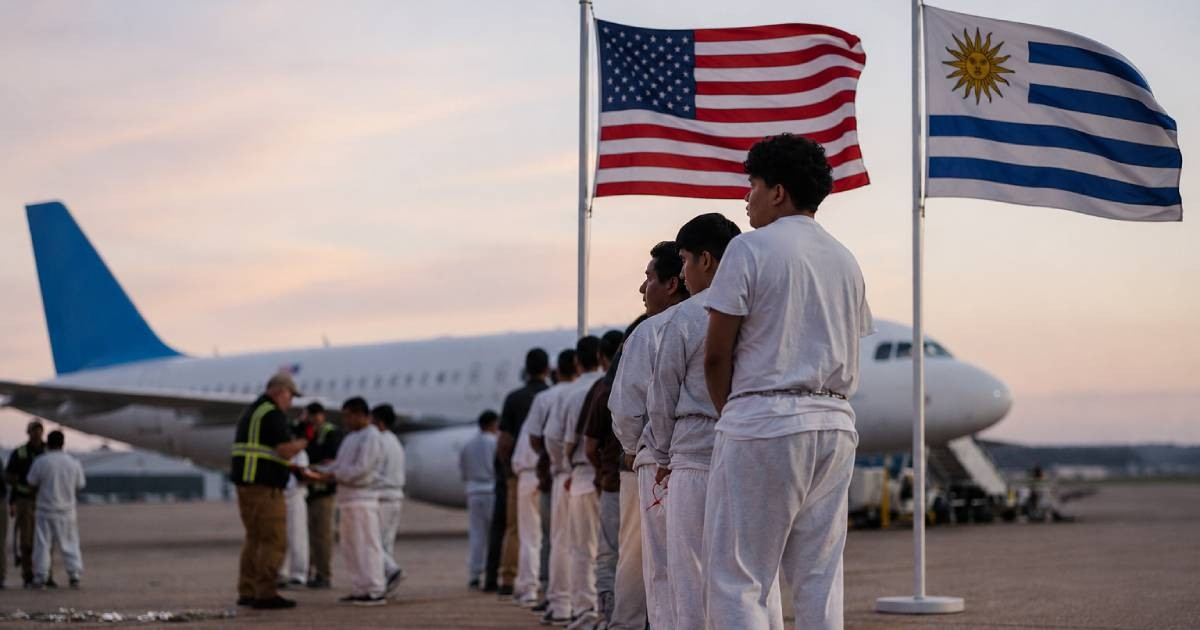
The administration of President Donald Trump has been in talks with Uruguay for months to turn the South American country into a new destination for Cubans deported from the United States, as revealed in an investigation by The New York Times on Wednesday.
According to the newspaper, the State Department, led by Secretary Marco Rubio, has negotiated with the Ministry of Foreign Affairs of Uruguay a mechanism to transfer Cuban migrants that Washington cannot or does not wish to return directly to the island. This information was confirmed by officials from both governments who spoke on the condition of anonymity.
According to the sources consulted, a potential agreement may not explicitly mention Cubans, although they would be the primary beneficiaries — or affected — by this relocation scheme.
Why Uruguay?
The negotiations reflect both U.S. and Uruguayan interests.
On one hand, the White House seeks to expand the list of countries willing to accept deported migrants as part of its strategy to expedite expulsions to third countries.
On the other hand, Uruguay sees immigration as an opportunity to address the aging of its population and the shortage of labor. Furthermore, according to a senior Uruguayan official quoted by The New York Times, the government is also looking to strengthen its relationship with the Trump administration.
Uruguay's profile differs significantly from that of other countries recently used for these deportations. With a population of around 3.4 million inhabitants, it maintains a relatively open immigration policy, has a well-established asylum system, and hosts a steadily growing Cuban community.
Data from the United Nations indicates that last year nearly 24,000 Cubans sought asylum in Uruguay and that more than 22,000 arrived in the country during 2025.
The Uruguayan Minister of the Interior, Carlos Negro, defended that migratory tradition.
"We have a tradition of welcoming people who come from other nations," he stated, recalling that Uruguay has historically been formed as a country of immigrants.
A strategy that is already affecting thousands of Cubans
The possible agreement with Uruguay is part of the policy promoted by Washington to send migrants to third countries when direct deportation is unfeasible.
In March of this year, the Trump administration informed a federal court that it had relocated 6,000 Cubans to Mexico, where many have faced difficulties in regularizing their status and accessing the job market.
Other Cubans have also been sent to Eswatini and South Sudan, where they remained confined in detention centers, while a journalistic investigation revealed that 19 Cuban citizens were deported to Nicaragua between January 2025 and June 2026.
Some U.S. officials believe that offering deportees the opportunity to legally resettle in Uruguay would reduce the likelihood of them attempting to return to the United States illegally, as well as prevent their return to Cuba.
Rubio warns about migration from Cuba
During his recent visit to Manila, Secretary of State Marco Rubio acknowledged that the situation on the island continues to drive the migration of individuals.
"The massive migration from Cuba is always a risk that one takes when countries are so deeply destabilized," he stated to the journalists accompanying his tour.
In recent months, the Trump administration has increased economic pressure on Havana through new sanctions, including measures aimed at restricting the supply of oil to the island, amid an unprecedented energy and economic crisis.
At the same time, Washington has tightened its immigration policy towards Cubans themselves.
According to María José Espinosa, executive director of the Center for Engagement and Advocacy in the Americas, around 600,000 Cubans could be at risk of deportation following the closure or tightening of various immigration regularization pathways.
A policy that sparks debate
Historian Ada Ferrer, a professor at Princeton University, believes that this shift represents a profound change in the way Cuban migrants have traditionally been treated in the United States.
"There was a time when Cubans were not pursued due to the Cuban Adjustment Act, but no one is adhering to that anymore. If you campaigned on mass deportations, you are going to attempt mass deportations. But Cuban-Americans thought they would be protected," he stated.
Although organizations advocating for migrant rights question the deportation policy to third countries, some acknowledge differences among the chosen destinations.
Yael Schacher, director for America and Europe of Refugees International, stated that, compared to options like Eswatini or South Sudan, a Latin American country with functional asylum institutions represents "the least bad option."
However, settling in Uruguay is not easy for many newcomers either. The cost of living is one of the highest in South America and many Cubans end up working as delivery drivers, caregivers, or security guards while they try to regularize their situation and build a new life far from the island.
Related videos:
Filed under: