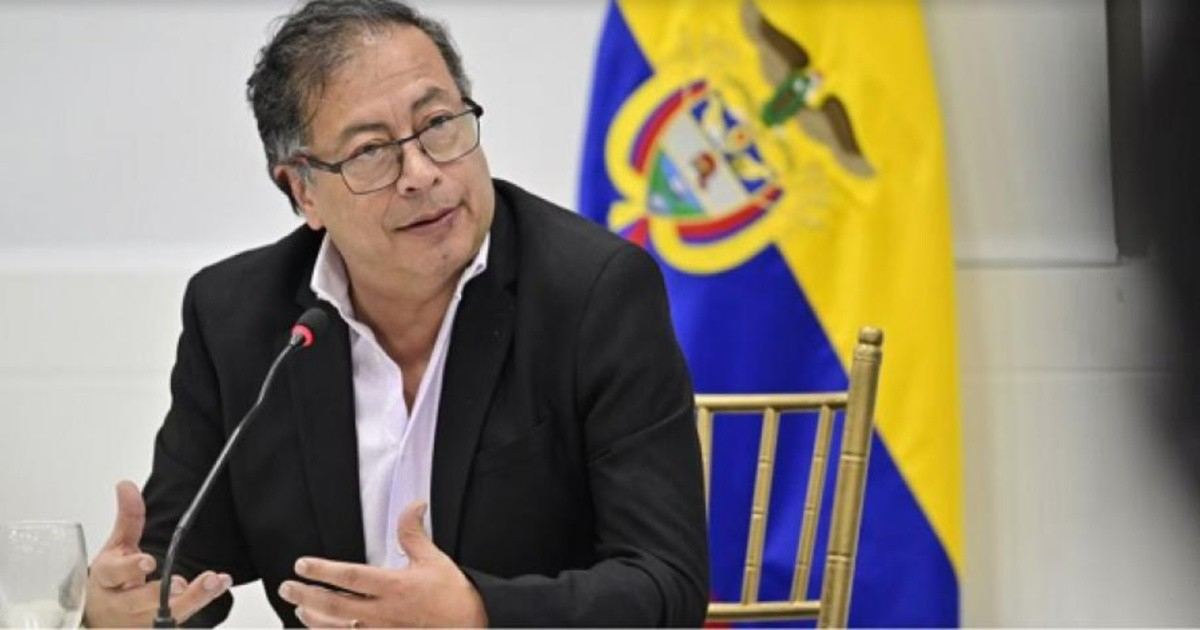
The Colombian president, Gustavo Petro, will travel to Havana this Friday in what appears to be his final international trip before concluding his term on August 7, 2026, as reported by Infobae Colombia.
The visit will last approximately 48 hours and will include bilateral meetings with the Cuban leader Miguel Díaz-Canel, with the declared purpose of conveying a message of solidarity from the Colombian government in light of the economic and social crisis facing the island.
The Presidency of Colombia had not disclosed the official schedule of the trip nor the specific topics that would be addressed in the meetings.
The trip came about due to a last-minute change in agenda: Petro was scheduled to travel to Washington and New York to participate in a United Nations conference on natural resource governance and visit the headquarters of the Organization of American States, but he canceled that itinerary.
The leader explained on his X social media account that the President of the Democratic Republic of the Congo, Félix Tshisekedi, would not attend the UN event, which lowered the protocol level of the meeting.
"I replaced it with a place that I consider vital for national sovereignty and the struggle for life in the Caribbean: the attacked Cuba," Petro wrote to justify his decision.
In that same post, the outgoing leader mentioned Cuba, Haiti, South Africa, Algeria, and Malaysia as countries he considers strategic for Colombia, precisely the same ones that the elected president Abelardo de la Espriella included in the list of embassies he plans to close.
If the trip materializes, it would be Petro's third official visit to the island during his administration. The first took place in June 2023, when he traveled to Havana for the conclusion of the third cycle of peace negotiations with the ELN guerrilla, a process in which Cuba serves as a guarantor country.
The second occurred in September of that same year, when he participated in the G77+China Summit and held a bilateral meeting with Díaz-Canel.
The trip carries significant political symbolism given the context in which it occurs. Last Monday, De la Espriella announced the complete severance of diplomatic relations with Cuba and Nicaragua, which he labeled as "tyrannies," along with the closure of 14 Colombian embassies in the initial phase.
"In my government, there will be no ties with tyrannies," declared the elected leader.
The Cuban regime responded on Tuesday accusing De la Espriella of acting in "subordination" to Washington's policies, after the elected vice president José Manuel Restrepo met with Secretary of State Marco Rubio in Washington on July 15.
Petro's visit to Havana thus concludes four years of explicit political affinity with the Cuban regime and contrasts sharply with the radical shift that De la Espriella will implement starting August 7, when he assumes power in Cali and Colombia breaks diplomatic relations with the island for the third time in its history.
Related videos:
Filed under: