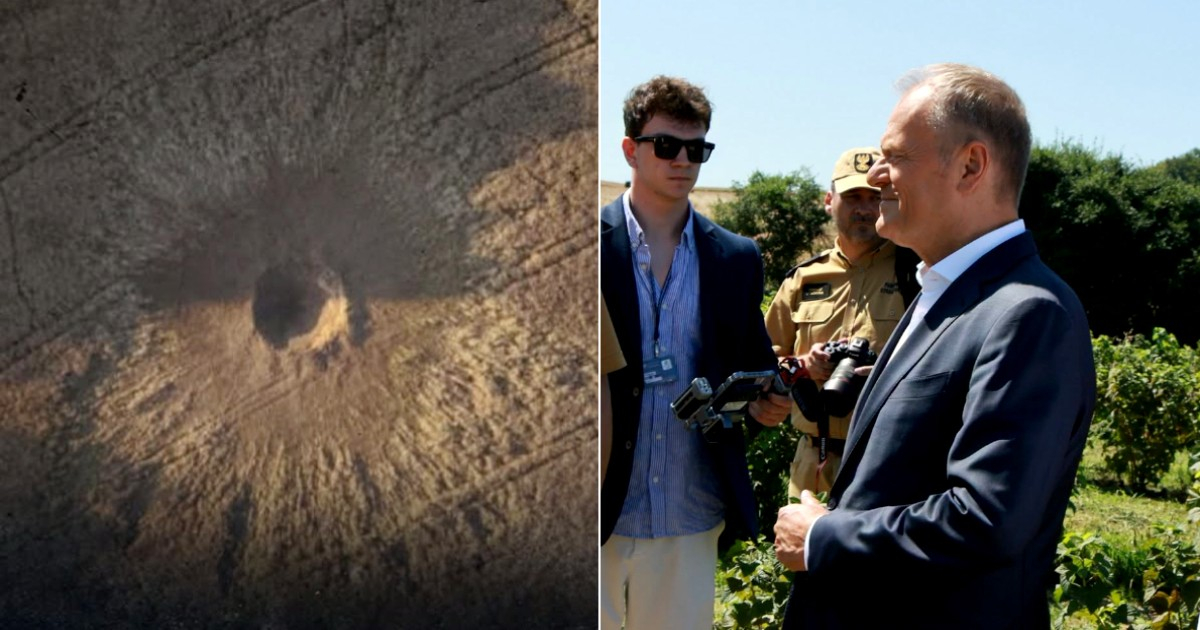
A Russian cruise missile Kh-101 entered Polish airspace early Thursday morning and crashed into an agricultural field in Tarnawa-Kolonia, in the Lublin Voivodeship, 94 kilometers from the Ukrainian border, marking the most serious violation of NATO territory since the start of the Russian invasion.
Polish Prime Minister Donald Tusk confirmed on his social media the identity of the projectile after personally visiting the impact site: "The overwhelming majority of the evidence—including the recovered fragments—indicates that it is a Russian Kh-101 cruise missile," he stated, also warning that "Russian disinformation is underway."
The missile created a crater approximately 10 meters in diameter in agricultural land, with fragments scattered over a radius of up to two kilometers. No casualties or damage to residential buildings were reported, although the projectile fell just a few kilometers from populated areas.
Tusk labeled the event as a "very serious incident," but ruled out that Poland was the deliberate target: "There is absolutely no reason to believe that Poland was the objective."
The missile was part of one of the most massive attacks that Russia has launched against Ukraine: over 70 missiles—many of them ballistic—and more than 280 Shahed drones, of which over 260 were shot down.
That offensive left at least eight civilians dead, including children, and more than 50 injured in Ukrainian territory, according to authorities cited by El Mundo.
The air raid sirens sounded in Poland for the first time in response to a real threat — they had only been inaugurated days earlier during a drill — and NATO and Polish forces immediately activated their air and ground defenses.
According to Colonel Martin O'Donnell, spokesperson for the Allied Military Headquarters, the deployment included two Polish F-16 fighter jets, an early warning Saab 340 aircraft, a Mi-24 helicopter, and an Airbus A330 tanker.
The NATO Secretary General, Mark Rutte, described the incident as "another reckless act by Russia and a dangerous consequence of its war against Ukraine," and promised that the Alliance would continue "strengthening our readiness to defend ourselves against any threat, including missile attacks."
The President of the European Commission, Ursula von der Leyen, was even more direct: "Another unacceptable violation of our EU airspace caused by Russia's latest attacks on Ukraine, this time over Poland."
Analysts are considering two hypotheses regarding what happened. The first, and deemed more probable, is a deliberate provocation to test the response times and procedures of the Atlantic Alliance.
The second points to a technical failure in the navigation or propulsion system, although it is considered unlikely: the Kh-101 has an accuracy of between 70% and 90%, and an accidental deviation of over 100 kilometers is technically very improbable.
This is not the first time that Russia has violated Polish airspace. In September 2025, around 20 Russian drones crossed the border and struck rural areas, prompting Poland to invoke NATO's Article 4 and the Alliance to launch Operation Eastern Sentinel to reinforce the eastern flank.
The incident occurs at a time of sustained escalation: a report from the International Institute for Strategic Studies published this month records at least 144 incidents involving Russian drones in Europe between 2024 and 2026, and Romania has already recorded 18 Russian air incursions just this year.
A few days before the impact, Ukrainian President Zelenski traveled to Washington to urge Trump for more air defense, in a context where the reserves of Patriot interceptors are depleted partly due to the war in Iran and the production of new units could take months.
Related videos:
Filed under: