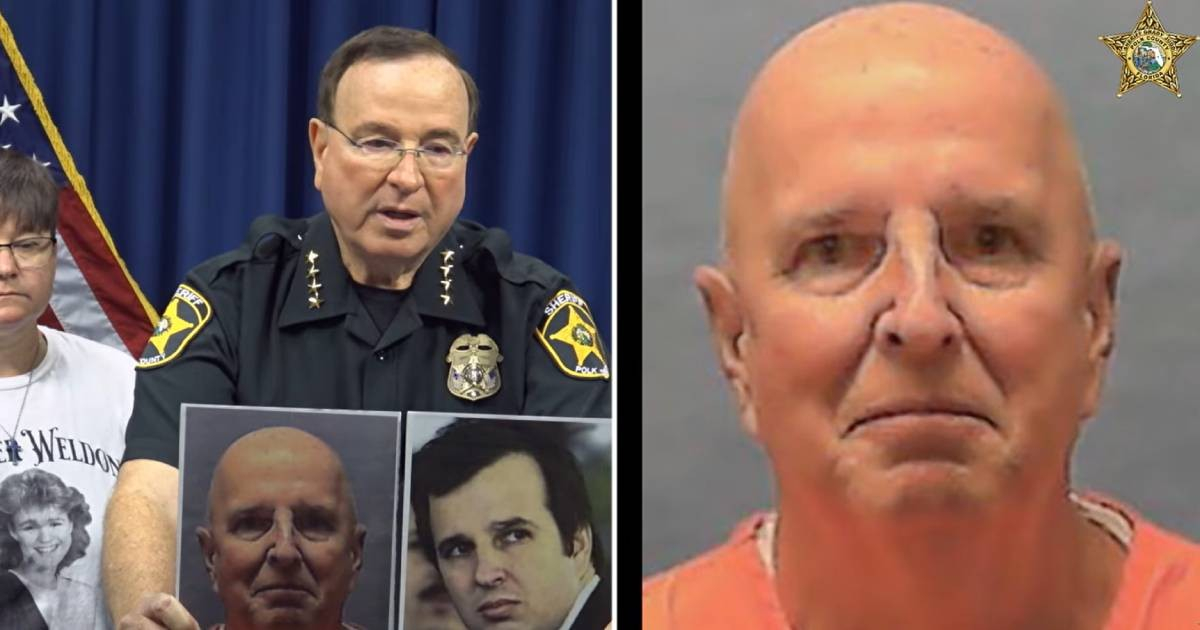
Polk County Sheriff Grady Judd announced this Thursday that the unsolved murder of Jeanifer Weldon, a 14-year-old girl who went missing in September 1987, is linked to James Duckett, the former Florida police officer who was executed last Tuesday for the kidnapping, rape, and murder of another minor that occurred that same year.
During a press conference, the Polk County Sheriff's Office (PCSO) stated that Duckett was the sole suspect in Jeanifer's homicide for nearly four decades, although he could never be charged due to a lack of conclusive forensic evidence.
"We never had a shred of evidence that anyone other than James Duckett committed this crime. Never," Judd stated.
Jeanifer Weldon disappeared on the night of September 19, 1987, while walking from a friend's house in Lakeland to her home, which was located just over three kilometers away.
He never reached his destination.
His body was found on October 2, 1987, by a worker at the Gardiner Mine phosphate mines in Fort Meade, after discovering a pair of shoes on a dirt path and noticing a strong smell of decomposition.
The autopsy determined that the girl had been strangled, and the case was classified as homicide.
The clues that always pointed to Duckett
Although no DNA was ever obtained to process it, researchers maintain that the circumstantial evidence gathered over the years consistently pointed to James Duckett.
According to the investigation, the then-officer left his home five hours before the start of his shift at the WR Grace mines and drove precisely along Highway 98 North, the same route that Jeanifer was taking when she disappeared.
The detectives also found that Duckett arrived two hours late to work, visibly sweating and agitated.
Upon returning home, he handed his wife a green bag containing a gray stuffed cat, a toy identical to the one Jeanifer had purchased that same day during a visit to Tampa.
Additionally, she lived just 1.8 miles from the location where the teenager's body was later found.
His wife, Carla Duckett, also reported that that night she saw scratches on her husband's back.
Over nearly 38 years, investigators sent more than ten articles of clothing belonging to the victim to various laboratories for DNA testing, but none yielded conclusive results.
They waited until the execution
Judd revealed that the sheriff's office decided not to file charges for the murder of Jeanifer while Duckett remained on death row for the case of Teresa McAbee, an 11-year-old girl who was raped and murdered also in 1987.
The objective, he explained, was to avoid any risk that could affect the previously obtained death sentence.
A few days before the execution, the detectives went to the prison to offer him one last chance to confess.
"He didn’t want to see us. He didn’t want to talk. He was a psychopathic child pedophile, a murderer, egocentric, and depraved until the end," Judd stated.
Duckett, 68 years old, was executed by lethal injection on July 28, nearly 38 years after the crime for which he was convicted. His death was part of Florida's first double execution since 1964.
"I am sure the right person died."
The press conference was attended by family and friends of Jeanifer Weldon.
Mindy Oakley, the teenager's best friend, also attended the execution and shared a particularly painful memory.
"We shared everything. That was my shirt and my shoes that she was wearing the night she was killed," he said.
On her part, Hope Limansah, Jeanifer's younger sister born after the murder, spoke about the void that marked her family.
"They are very large shoes to fill when arriving in the world as the first daughter born after the last one was taken away," she expressed.
The victim's other sister, Amy Weldon, stated that she has no doubts about the identity of the person responsible.
"I am sure they executed the right person. I don't like how long it took, but I am 100% sure that the right person died," she stated.
The sheriff announced that the case file will now be sent to the State Prosecutor's Office for final review and closure through an "exceptional clarification," a procedure used when authorities believe they have identified the perpetrator, but the individual has passed away before being prosecuted for that crime.
Related videos:
Filed under: